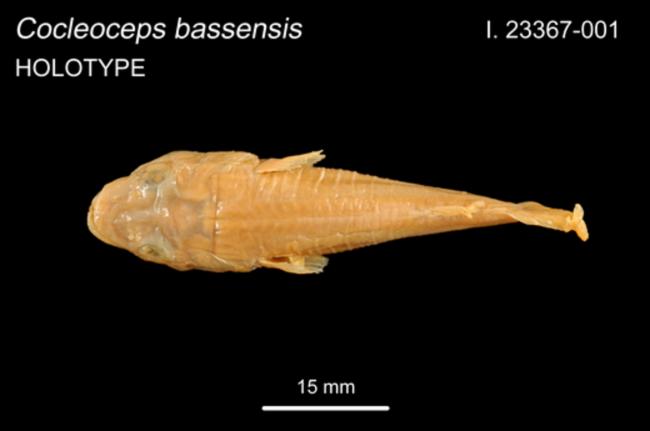
Broadhead Clingfish, Cochleoceps bassensis Hutchins 1983
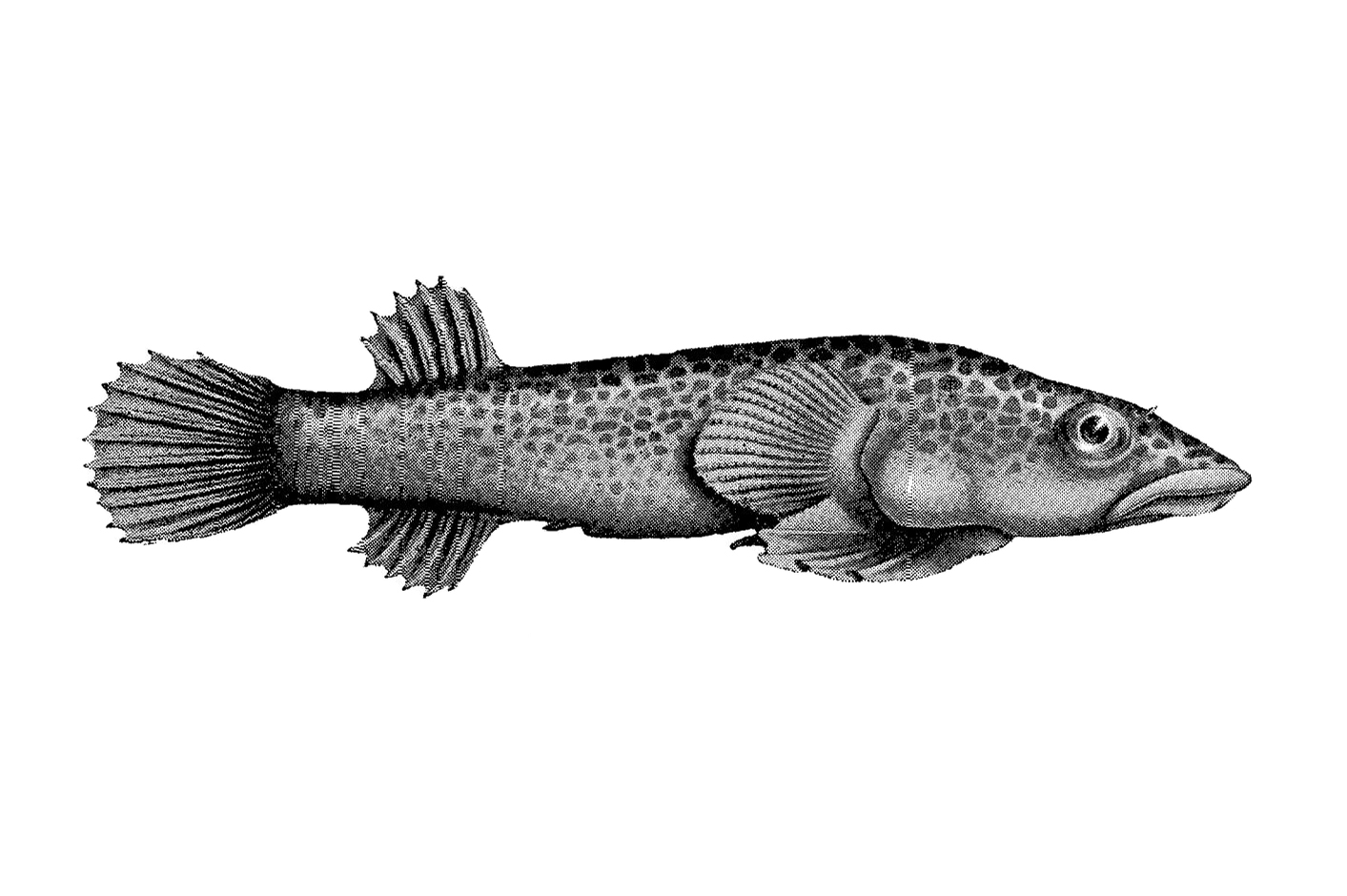
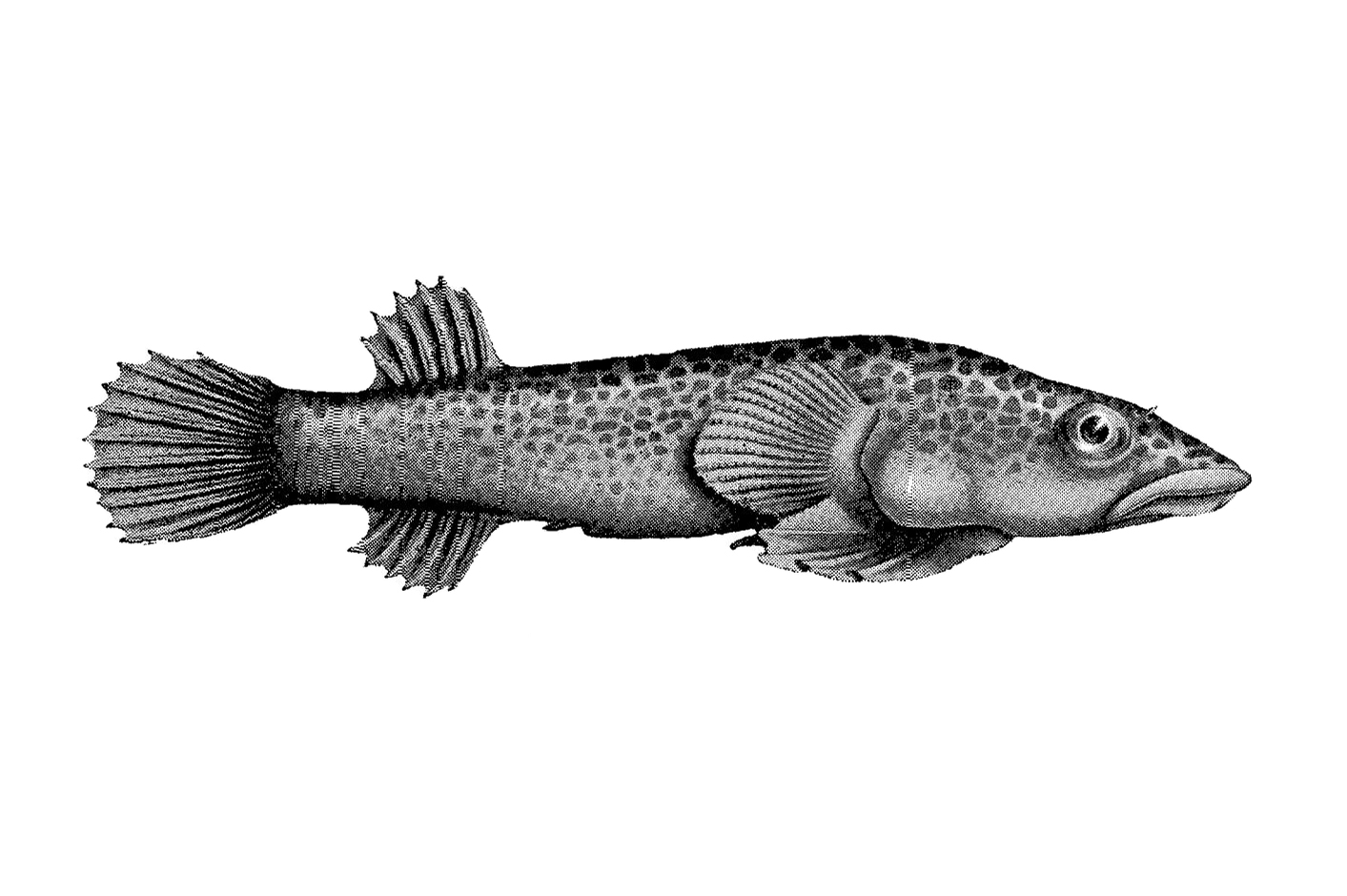
Illustration of a Broadhead Clingfish, Cochleoceps bassensis. Source: A.R. McCulloch, in Waite (1906) Rec. Aus. Mus. 6: Pl. 36(fig. 4). License: Public Domain
A small clingfish covered in large close-set red spots or blotches over a paler background; spots on upper part of body may form close-set bands. As the common name suggests, this species has a very broad, flattened head and a prominent triangular snout with a rounded tip.
Broadhead Clingfish, Cochleoceps bassensis Hutchins 1983
More Info
|
Distribution |
Endemic to south-eastern Australia, from eastern Tasmania, and Westernport, Victoria to South Australia. The species is uncommon inshore, preferring sponge gardens on deeper offshore reefs in depths to 40 m; also on jetty piles. |
|
Features |
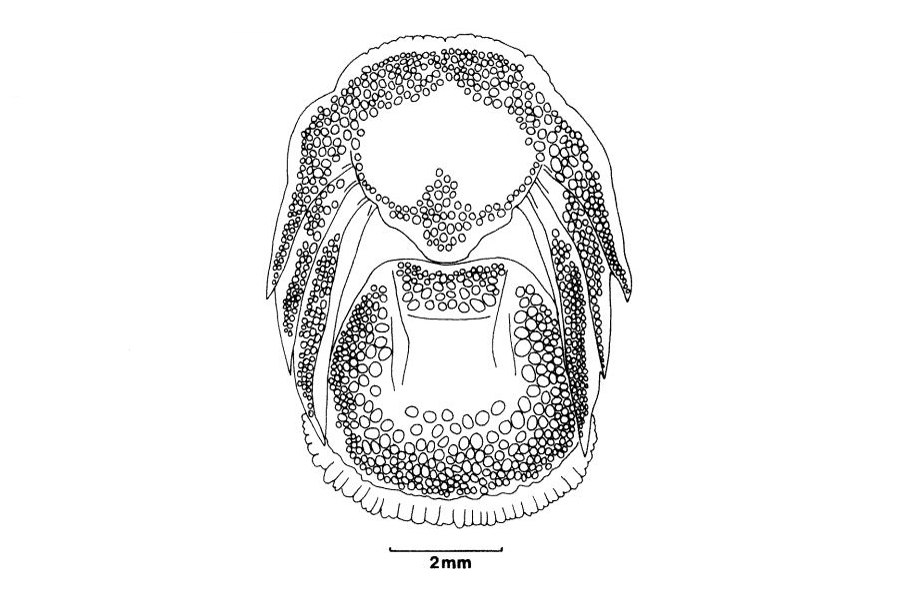
Dorsal fin 5-6; Anal fin 5-6; Pectoral fin 24-26; Pelvic fin i, 4; Caudal fin 11-12; Vertebrae (total) 33-34. Body robust, moderately depressed anteriorly, compressed posteriorly; caudal peduncle of moderate length. Head broad, flat; snout of moderate length, somewhat triangular shaped with rounded tip in dorsal view; posterior nostril above or behind front margin of each eye; eyes of moderate size; lips narrow, fleshy; mouth small, reaching to below centre of eyes, jaws of equal length; teeth small, conical; no spines laterally on head; gill openings large, lateral. Scales and lateral line absent; some sensory papillae on sides. A single, short-based dorsal fin close to, but distinctly separated from caudal fin; anal fin similar to and opposite dorsal fin, anterior rays of neither fin swollen at base; caudal fin rounded. Pectoral fins rounded, with no fleshy pad ventrally on bases. Pelvic fins united into a relatively large ventral sucking disc, consisting of anterior and posterior halves, posterior edge with fleshy fringe. |
|
Size |
To 7 cm. |
|
Colour |
Head and body covered in large close-set red spots or blotches over a paler background; spots on head round, those on body oval-shaped. Colour throughout yellow, the head and body above and on the sides ornamented with crowded carmine spots, those on the head round, those on the body lengthened; the upper ones arranged transversely to form closely packed bands. Fins and lower surfaces without markings (Waite, 1906). |
|
Biology |
The sexes are separate and fertilisation is external. Females lay and guard demersal eggs that are attached to the substrate. |
|
Fisheries |
Of no interest to fisheries, although taken as bycatch in scallop dredges. |
|
Conservation |
IUCN Least Concern |
|
Similar Species |
In the past, this species had been confused with the Spadenose Clingfish, Cochleoceps spatula, which has a more westerly distribution. |
|
Etymology |
The species is named bassensis for Bass Strait, the type locality. |
|
Species Citation |
Cochleoceps bassensis Hutchins 1983, Records of the Western Australian Museum 11(1): 40, Figs. 3b, 4b, 5-7. Type locality: Western Port, 38°26'S, 145°08'E, Victoria, Australia. |
|
Author |
Bray, D.J. 2025 |
|
Resources |
Broadhead Clingfish, Cochleoceps bassensis Hutchins 1983
References
Briggs, J.C. 1955. A monograph of the clingfishes (order Xenopterygii). Stanford Ichthyological Bulletin 6: 1-224 figs 1-114 (misidentified as Cochleoceps spatula)
Conway, K.W. & Fujiwara, K. 2025. Cochleoceps bassensis. The IUCN Red List of Threatened Species 2025: e.T241149659A241149661. https://dx.doi.org/10.2305/IUCN.UK.2025-1.RLTS.T241149659A241149661.en. Accessed on 19 September 2025.
Hutchins, J.B. 1983. Redescription of the clingfish Cochleoceps spatula (Gobiesocidae) from Western Australia and South Australia, with the description of a new species from Victoria and Tasmania. Records of the Western Australian Museum 11(1): 33-47. See ref online
Hutchins, J.B. 1991. Descriptions of three new species of gobiesocid fishes from southern Australia, with a key to the species of Cochleoceps. Records of the Western Australian Museum 15(3): 655-672. See ref online
Hutchins, J.B. 1994. Family Gobiesocidae, in Gomon, M.F., Glover, C.J.M. & Kuiter, R.H. (eds) The fishes of Australia's south coast. Flora and Fauna of South Australia Handbooks Committee. State Printer, Adelaide. 1-992.
Hutchins, J.B. 2008. Family Gobiesocidae, pp 722-741, in Gomon. M.F., Bray, D.J. & Kuiter, R.H. (eds) (2008) Fishes of Australia's Southern Coast. Sydney : Reed New Holland 928 pp.
Last, P.R., Scott, E.O.G. & Talbot, F.H. 1983. Fishes of Tasmania. Hobart : Tasmanian Fisheries Development Authority 563 pp. figs.
Scott, T.D. 1954. Four new fishes from South Australia. Records of the South Australian Museum (Adelaide) 11(2): 105-112 figs 1-3 pl. 22 (misidentified as Cochleoceps spatula)
Scott, T.D., Glover, C.J.M. & Southcott, R.V. 1974. The Marine and Freshwater Fishes of South Australia. Adelaide : Government Printer 392 pp. figs. (misidentified as Cochleoceps spatula)
Waite, E.R. 1906. Descriptions of and notes on some Australian and Tasmanian fishes. Records of the Australian Museum 6: 194-210 (as Crepidogaster spatula) https://doi.org/10.3853/j.0067-1975.6.1906.1000 (misidentified as Diplocrepis cardinalis)
Waite, E.R. 1921. Illustrated catalogue of the fishes of South Australia. Records of the South Australian Museum (Adelaide) 2(1): 1-208 293 figs pl. 1 (misidentified as Aspasmogaster spatula)