Venus Tuskfish, Choerodon venustus (De Vis 1884)
Other Names: Blue Parrot, Blue-spotted Groper, Pink-sided Tusk-fish, Roseate Tusk-fish, Tuskfish, Venus Tusk-fish
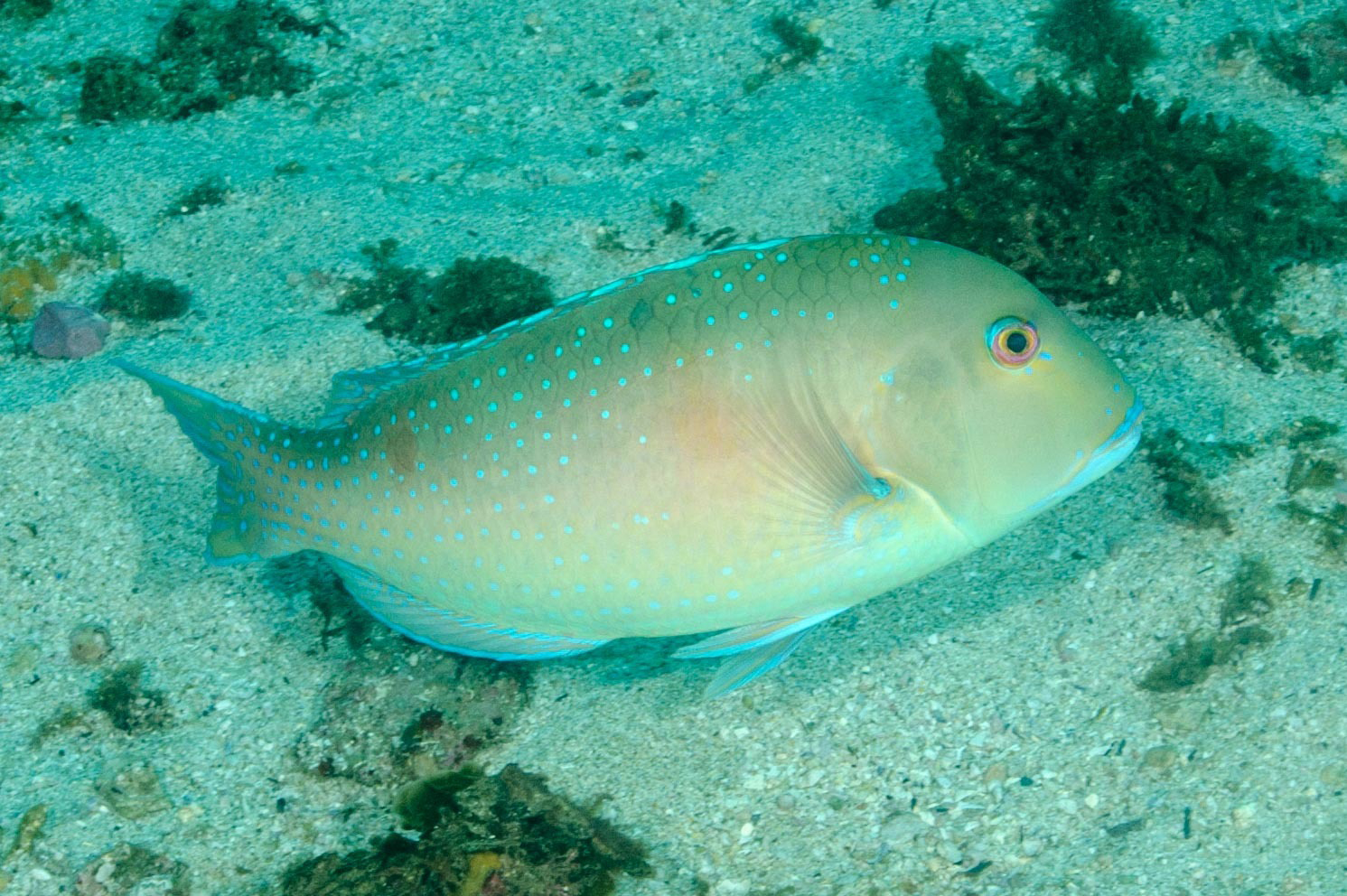
A Venus Tuskfish, Choerodon venustus, at North West Solitary Island, New South Wales, March 2015. Source: Ian Shaw / iNaturalist.org. License: CC by Attribution-NonCommercial
Summary:
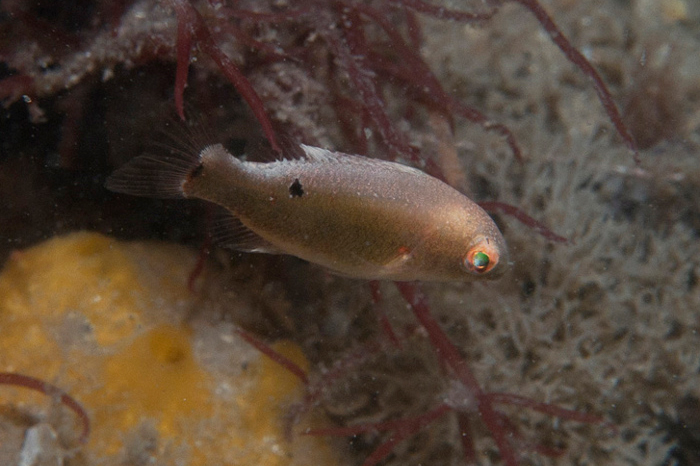
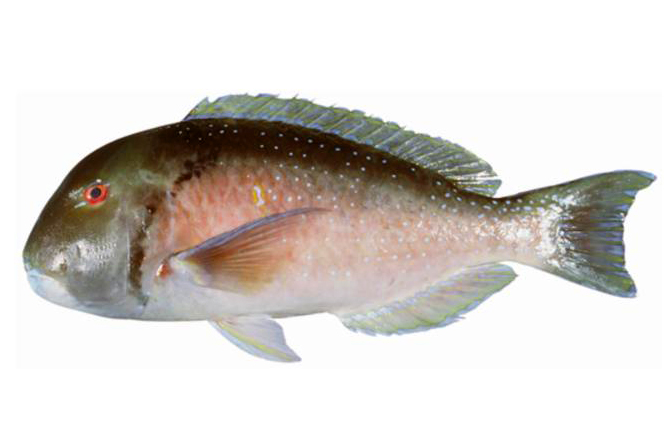
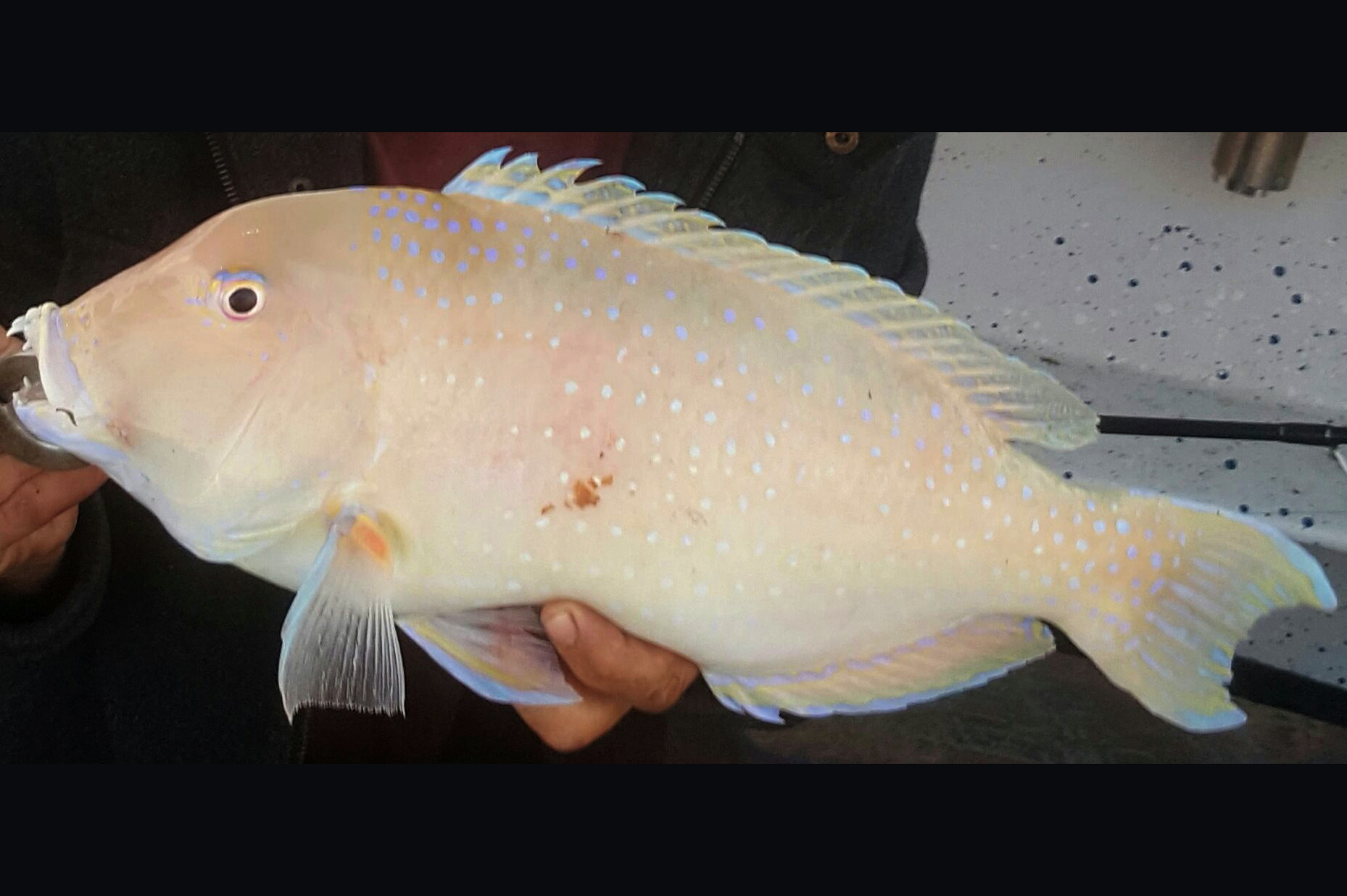
Females (initial phase) are bluish-green above, becoming pale crimson on the sides and whitish below, with a blue spot on the scales, a red blotch behind the pectoral-fin base and a smaller red blotch just above lateral line beneath the soft dorsal fin. A blue rim surrounds the eye, the lips are edged in blue. Males (terminal phase) are brightly coloured with a bright pinkish-red sides. Juveniles are brown above with a broad dark smudge along the midside, and a distinct black spot below the soft part of the dorsal fin.
Cite this page as:
Bray, D.J. 2025, Choerodon venustus in Fishes of Australia, accessed 27 Sep 2026, https://fishesofaustralia.net.au/Home/species/1929
Venus Tuskfish, Choerodon venustus (De Vis 1884)
More Info
|
Distribution |
Coral Sea northeawst of Cairns, Queensland, to Nelson Bay, New South Wales, with juveniles south to Sydney. The species is widespread on offshore reefs including areas in the Great Barrier Reef. Inhabits sandy, rubble and weedy areas on deep outer reefs at depths of 20–60 m. |
|
Features |
Dorsal fin XIII, 7; Anal fin III, 10; Pectoral fin ii, 14, dorsal-most ray of moderate length 24.9–46.8% pectoral fin length, ventralmost rays shorter than those above, posterior edge of fin obliquely straight, dorsoposterior corner bluntly pointed, posteroventral corner angular. Body deep, 36.4–41.5% SL, head depth 26.1–37.2% SL, caudal peduncle depth 12.9–15.0% SL; head bluntly pointed, dorsal profile of snout moderately steep, snout length 11.9–18.6% SL; second pair of canines in lower jaw directed anterodorsally, very little laterally. Predorsal scales approximately 4–6, reaching forward on dorsal midline to not quite to above posterior edge of preopercle; cheek with small partially embedded scales in about 5 or 6 diagonal rows, posteriormost with about 10–12 scales to upper extent of free preopercular edge, reaching forward noticeably short of corner of upper lip crease above mouth, with broad naked margin posteriorly and ventrally on preopercle; row of about 8–11 small scales on subopercle adjacent preopercular edge extending forward in advance of middle of ventral preopercular margin; each lateral line scale with multiple branched laterosensory canal tube; scales above lateral line about 3½ or 4; many cephalic sensory canal pores above and behind eyes. Dorsal and anal fins with very low basal sheath comprising 1–3 progressively smaller accessory scales at deepest; posterior lobe of dorsal and anal fins not quite reaching hypural crease; caudal fin double emarginate, upper and lower lobes distinctly but not greatly produced, posterior margin of fin concave, smoothly curved; pelvic fin reaching to or just past anus, length 21.3– 22.9% SL. |
|
Colour |
Initial phase adults bluish green above, pale crimson midlaterally and white below; each scale on side with blue spot; red blotch midlaterally posterior to pectoral fin base and smaller red blotch just above lateral line beneath segmented dorsal fin rays; eye edged with blue, with yellow patch anteriorly, forward directed mark at middle of patch; blue lines along edges of lips, upper followed by yellow line; chin and throat pale blue. Dorsal fin yellow with blue basal and marginal stripes and intermediate row of blue spots; anal fin yellow with broad blue submarginal stripe broken posteriorly and series of blue spots near base; caudal fin greenish yellow with some middle rays blue. Pectoral fin with upper rays and bases of other rays blue; base of fin yellow. Terminal phase individuals with vivid colours and much of side midlaterally dominated by bright pinkish red colouration. |
|
Feeding |
|
|
Fisheries |
Taken by recreational fishers, and occasionally taken as bycatch in commercial trawls. |
|
Etymology |
The specific name is from the Latin venustus (= beautiful, lovely, charming), presumably in reference to the attractive coloration of this species. |
|
Species Citation |
Choerops venustus De Vis 1884, Proceedings of the Royal Society of Queensland 1(3): 147. Type locality: Moreton Bay, Queensland. |
|
Author |
Bray, D.J. 2025 |
|
Resources |
Venus Tuskfish, Choerodon venustus (De Vis 1884)
References
Allen, G.R. 1997. Marine Fishes of Tropical Australia and South-east Asia. Perth : Western Australian Museum 292 pp. 106 pls.
Cappo, M., De’ath, G. & Speare, P. 2007. Inter-reef vertebrate communities of the Great Barrier Reef Marine Park determined by baited remote underwater video stations. Marine Ecology Progress Series 350: 209-221.
Choat, J.H. 2010. Choerodon venustus. The IUCN Red List of Threatened Species 2010: e.T187734A8616044. http://dx.doi.org/10.2305/IUCN.UK.2010-4.RLTS.T187734A8616044.en. Downloaded on 11 September 2017.
De Vis, C.W. 1884. On new fish from Moreton Bay. Proceedings of the Royal Society of Queensland 1(3): 144-147.
Gomon, M.F. 2017. A review of the tuskfishes, genus Choerodon (Labridae, Perciformes), with descriptions of three new species. Memoirs of Museum Victoria 76: 1-111 DOI: http://doi.org/10.24199/j.mmv.2017.76.01 Open access
Grant, E.M. 1975. Guide to Fishes. Brisbane : Queensland Government, Co-ordinator General’s Department 640 pp.
Grant, E.M. 1991. Fishes of Australia. Brisbane : EM Grant Pty Ltd 480 pp.
Johnson, J.W. 2010. Fishes of the Moreton Bay Marine Park and adjacent continental shelf waters, Queensland, Australia. pp. 299-353 in Davie, P.J.F. & Phillips, J.A. Proceedings of the Thirteenth International Marine Biological Workshop, The Marine Fauna and Flora of Moreton Bay. Memoirs of the Queensland Museum 54(3)
Kuiter, R.H. 1993. Coastal Fishes of South-eastern Australia. Bathurst : Crawford House Press 437 pp.
Kuiter, R.H. 1996. Guide to Sea Fishes of Australia. A comprehensive reference for divers and fishermen. Sydney, NSW, Australia : New Holland Publishers xvii, 434 pp.
Kuiter, R.H. 2010. Labridae fishes: wrasses. Seaford, Victoria, Australia : Aquatic Photographics pp. 398.
Marshall, T.C. 1964. Fishes of the Great Barrier Reef and Coastal Waters of Queensland. Sydney : Angus & Robertson 566 pp. 136 pls.
Ogilby, J.D. 1910. On some new fishes from the Queensland coast. Endeavour Series No. 1 23: 85-139, (as Choerodon ambiguus)
Ogilby, J.D. 1913. Ichthyological notes. Memoirs of the Queensland Museum 2: 90-93.
Platten, J.R., Tibbets, I.R. & Sheaves, M.J. 2002. The influence of increased line-fishing mortality on the sex ratio and age of sex reversal of the venus tusk fish. Journal of Fish Biology 60(2): 301-318.
Puckridge, M., P.R. Last & N. Andreakis. 2015. The role of peripheral endemism and habitat associations in the evolution of the Indo-West Pacific tuskfishes (Labridae:Choerodon). Molecular Phylogenetics and Evolution 84: 64-72. Abstract
Randall, J.E., Allen, G.R. & Steene, R. 1997. Fishes of the Great Barrier Reef and Coral Sea. Bathurst : Crawford House Press 557 pp. figs.
Roughley, T.C. 1957. Fish and Fisheries of Australia. Sydney : Angus & Robertson 341 pp.
Russell, B.C. 1983. Annotated checklist of the coral reef fishes in the Capricorn-Bunker group, Great Barrier Reef, Australia. Great Barrier Reef Marine Park Authority. Special Publication Series 1: 1-184 figs 1-2
Westneat, M.W. 2001. Labridae. pp. 3381-3467 in Carpenter, K.E. & Niem, T.H. (eds). The Living Marine Resources of the Western Central Pacific. FAO Species Identification Guide for Fisheries Purposes. Rome : FAO Vol. 6 pp. 3381-4218.
Whitley, G.P. 1932. Studies in Ichthyology No. 6. Records of the Australian Museum 18(6): 321-348 figs 1-3 pls 36-39 (in part as Choerodon lineatus)