
Winton’s Grunter, Hannia wintoni Shelley, Delaval, Le Feuvre, Dempster, Raadik & Swearer 2020
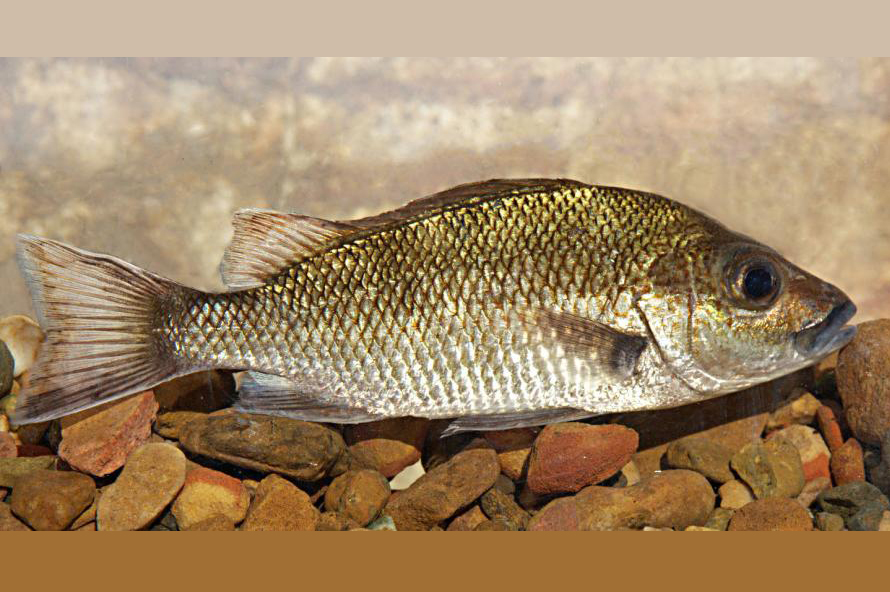
Winton's Grunter, Hannia wintoni, from the Prince Regent River in The Kimberley, Western Australia. Source: Matt Le Feuvre / University of Melbourne & Museums Victoria. License: All rights reserved
Summary:
A silvery-gold grunter becoming paler below, with dark scale margins, orange fins, and a grey to whitish margin on the pelvic fins,. Juveniles have a dark spot at the bases of the soft dorsal and anal fins.
Cite this page as:
Bray, D.J. 2025, Hannia wintoni in Fishes of Australia, accessed 21 Sep 2026, https://fishesofaustralia.net.au/Home/species/5565
Winton’s Grunter, Hannia wintoni Shelley, Delaval, Le Feuvre, Dempster, Raadik & Swearer 2020
More Info
|
Distribution |
Endemic to the Prince Regent and Roe River catchments draining northwest from the Kimberley Plateau, Western Australia. Inhabits clear waters, over sandy to rocky substrates, with larger adults in deeper (> 2 m), in slow to moderate flowing areas around large boulders, or holding position in the centre of stream flow. Juveniles more commonly found in moderately deep and shallow runs, darting between the cover of rocks and woody debris. |
|
Features |
Dorsal fin XII–XIII, 9–10; Anal fin III, 7–9; Caudal fin 10+8+7+10 (9–10+8+7+8–10; Pectoral fin 13–16; Pelvic fin I, 5; Vertebrae 10+15=25; Lateral line scales 34–40; Scales above lateral line 6–7; scales below lateral line 11–12; Pre-dorsal scales 10–13; Cheek scale rows 4–6; Caudal circumpeduncular scales 16–19; Gill rakers on first arch 8–10 + 15–16=23–26; Opercular spines 2; Preopercular spines 16–27. Body depth at dorsal fin origin 33.5–39.8 % SL; body depth at anal fin origin 27.8–34.2 % SL. |
|
Colour |
Top of head, from tip of snout to insertion of first scale row, dark orange. A horizontal silvery-gold band of pigmentation from posterior of lacrimal around ventral and posterior borders of orbit to level of dorsal edge of eye. Body overall silvery-gold dorsally, fading to silver below. Each scale above scale row running through base of pectoral fin edged with dark orange pigmentation; intensity of pigmentation increasing dorsally. Dorsal fins dusky orange overall with dark outer margin; outer rays of soft dorsal whitish-grey. Caudal fin dusky orange overall with dark outer margin; outer rays of soft dorsal whitish-grey; dark blotch sometimes present on lower lobe, more prominent in juveniles. Anal fin dusky orange overall; whitish-grey blotch on posterior rays. Pelvic fin dusky orange overall; whitish-grey outer margin. Pectoral fins dark at base, overall dusky with increasing orange-brown colouration to ray margins dorsally |
|
Feeding |
Omnivore - feeds mostly on insect larvae, terrestrial insects, crustaceans and some vegetation. |
|
Remarks |
|
|
Similar Species |
Differs from the similar Greenway's Grunter, Hannia greenwayi, in attaining a larger size (~25 cm vs. ~14 cm in H. greenwayi), and in having a convex posterior nape profile (vs. straight head profile between the posterior of occiput and base of first dorsal spine), with a slight hump forward of the first dorsal spine before the nape continues anteriorly as a straight slope; usually 15 pectoral-fin rays (vs. usually 13); 16-27 (usually 19) preopercular spines vs. 0–16 (usually 10 or 11); and a postorbital length 35.1–40.8 % HL vs. 26.5–36.6 % HL. The two species do not occur in the same drainage basins. |
|
Etymology |
The species is named in honour of Western Australian author and Kimberley conservationist Tim Winton, whose many novels espouse a love of fish and the Australian landscape. |
|
Species Citation |
Hannia wintoni Shelley, Delaval, Le Feuvre, Dempster, Raadik & Swearer 2020, Zootaxa 4869(4): 573, Fig. 5. Type locality: unnamed creek flowing into the lower Prince Regent River, Western Australia, 15°25’1.7’’S, 125°14’13.3”E, 25 m elevation. |
|
Author |
Bray, D.J. 2025 |
|
Resources |
Winton’s Grunter, Hannia wintoni Shelley, Delaval, Le Feuvre, Dempster, Raadik & Swearer 2020
References
Shelley, J.J., Delaval, A. Le Feuvre, M.C., Dempster, T., Raadik, T.A. & Swearer, S.E. 2020. Revision of the genus Hannia (Teleostei, Terapontidae), with description of a new species, Hannia wintoni, from the Kimberley, Western Australia. Zootaxa 4869(4): 562-586 https://doi.org/10.11646/zootaxa.4869.4.5 (as Hannia greenwayi II)
Shelley, J.J., Gomon, M.F. & Le Feuvre, M.C. 2018. Family Terapontidae, pp. 118-158 in Shelley, J.J., Morgan, D.L., Hammer, M.P., Le Feuvre, M.C., Moore, G.I., Gomon, M.F., Allen, M.G. & Saunders, T. (eds) A field guide to the freshwater fishes of the Kimberley. Murdoch University, Murdoch, Western Australia, 262 pp. (as Hannia sp.)
Shelley, J.J., Swearer, S.E., Dempster, T., Adams, M., Le Feuvre, M.C., Hammer, M.P. & Unmack, P.J. 2020. Plio-Pleistocene sea-level changes drive speciation of freshwater fishes in north-western Australia. Journal of Biogeography 47(8): 1727-1738. https://doi.org/10.1111/jbi.13856 (as Hannia greenwayi II)
Shelley, J.J., Unmack, P.J., Dempster, T., Le Feuvre, M.C. & Swearer, S.E. 2019. The Kimberley, north-western Australia, as a cradle of evolution and endemic biodiversity: An example using grunters (Terapontidae). Journal of Biogeography 46: 2420-2432. https://doi.org/10.1111/jbi.13682 (as Hannia greenwayi II)
