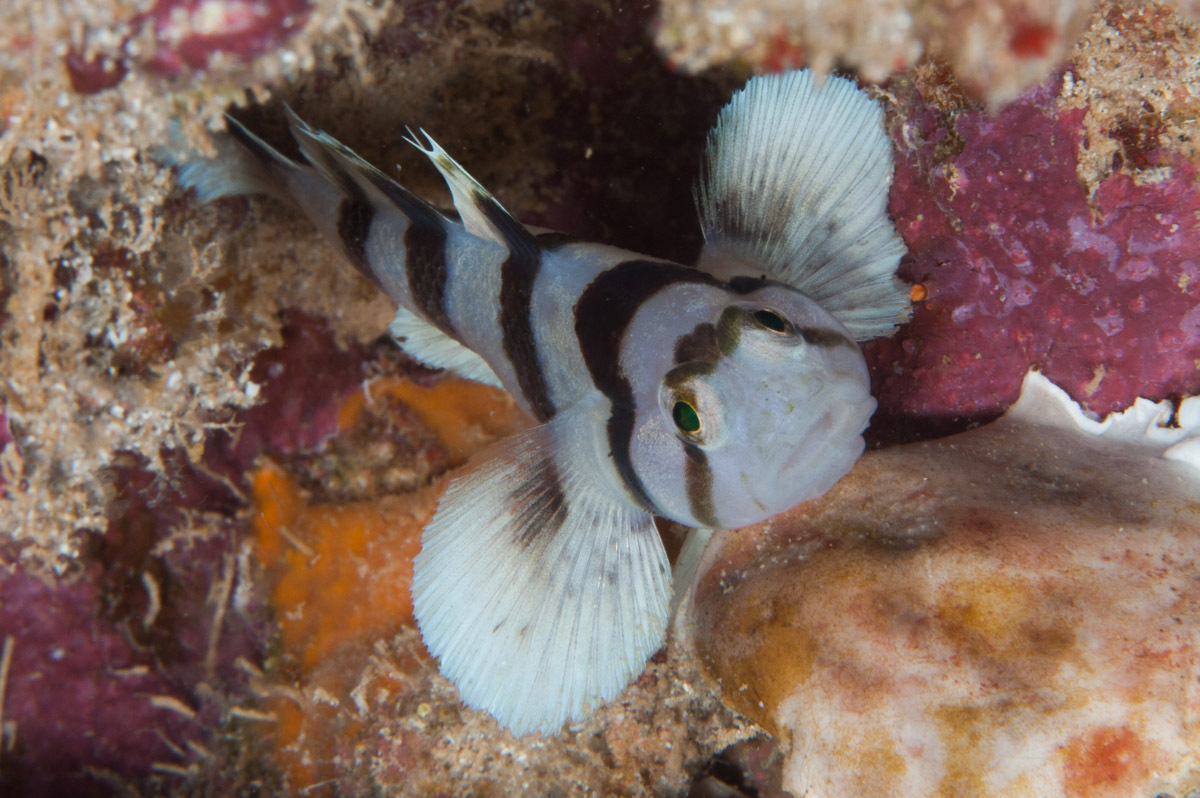
Blackbarred Reefgoby, Priolepis nocturna (Smith 1957)
Other Names: Black Barred Circus Goby, Circus Goby, White Tiger Goby
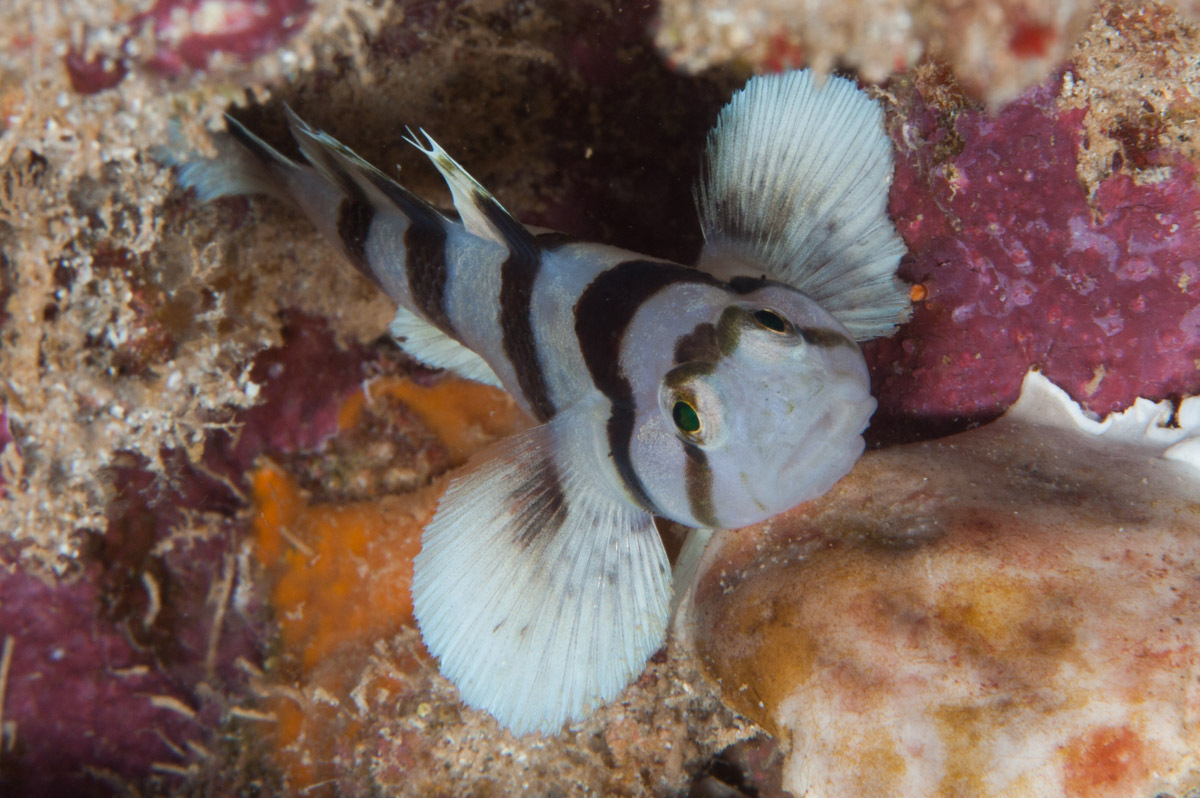
A Blackbarred Reefgoby, Priolepis nocturna, in Lighthouse Bay, North West Cape, Western Australia, May 2008. Source: Kristin Anderson / iNaturalist.org. License: CC by Attribution-NonCommercial
Summary:
A milky-white reefgoby with 4-5 broad dark bars across the head and body, two of which extend onto the dorsal fins, a pair of dark bars below the eye, a partly ocellated black spot on the anterior margin of both dorsal fins and on the anterodorsal margin of the caudal fin.
Cite this page as:
Bray, D.J. 2025, Priolepis nocturna in Fishes of Australia, accessed 12 Oct 2026, https://fishesofaustralia.net.au/Home/species/5783
Blackbarred Reefgoby, Priolepis nocturna (Smith 1957)
More Info
|
Distribution |
North West Cape, Western Australia. Elsewhere the species occurs in the Indo-West Pacific: South Africa and southern Mozambique, east to Kiribati and the Marquesas Islands, south to Papua New Guinea and Australia. A solitary, cryptic species found on seaward reef slopes, rocky drop-offs and lagoons; usually shelters in coral and rocky crevices at depths to ~35 m. |
|
Features |
Dorsal fin VI + I, 10; Anal fin I, 8; Pectoral fin 20-21; Gill rakers 4-5 + 12-16; Lateral scale series 28-31; Transverse scale count 11-12. Body depth 4.1 in SL. Fraenum absent. Body scales ctenoid to level of second dorsal-fin spine, cycloid anteriorly, including base of pectoral fin, breast and ventrally on abdomen; head and median part of nape without scales; side of nape to above middle of opercle with small embedded scales; predorsal scales absent; cheek without vertical row of papillae. |
|
Size |
|
|
Similar Species |
The colour pattern of P. nocturna has a unique colour pattern, more pectoral-fin rays, and more lateral and transverse scales that other species in the genus Priolepis. |
|
Etymology |
The specific name is from the Latin nocturnus (= of the night), presumably in reference to the author's belief that this species lives a '... sheltered life in coral, almost certainly where the light is of low intensity." |
|
Species Citation |
Ctenogobius nocturnus Smith 1957, Annals and Magazine of Natural History (12) 9 (106) (art. 93): 723, Fig. 2. Type locality: Aldabra Island, western Indian Ocean, depth 5-10 fathoms. |
|
Author |
Bray, D.J. 2025 |
|
Resources |
Blackbarred Reefgoby, Priolepis nocturna (Smith 1957)
References
Allen, G.R. & Erdmann, M.V. 2012. Reef fishes of the East Indies. Perth : Tropical Reef Research 3 vols, 1260 pp.
Allen, G.R., Steene, R., Humann, P. & DeLoach, N. 2003. Reef Fish Identification - Tropical Pacific. Florida : New World Publications, Inc., 457 pp.
Larson, H. 2016. Priolepis nocturna. The IUCN Red List of Threatened Species 2016: e.T193067A2190816. https://dx.doi.org/10.2305/IUCN.UK.2016-3.RLTS.T193067A2190816.en. Accessed on 22 October 2025.
Larson, H. K. 2022. Family Gobiidae, Gobies and mudskippers, pp. 19-179 in Heemstra, P.C., Heemstra, E., Ebert, D.A., Holleman, W. & Randall, J.E. 2022. Coastal fishes of the western Indian Ocean. Makhanda, South Africa : South African Institute for Aquatic Biodiversity Vol. 5 pp. 1-487, pl. 1-129. [https://www.saiab.ac.za/coastal-fishes-of-the-western-indian-ocean.htm]
Ohnishi, N., Iwata, A. & Hiramatsu, W. 1996, First record of the gobiid fish, Priolepis nocturna, from Japan. Ichthyological Research 43(2): 178-181. https://doi.org/10.1007/BF02348243
Smith, J.L.B. 1957. The fishes of Aldabra. Part V. Annals and Magazine of Natural History 12 9 (106) (art. 93): 721-729.
Winterbottom, R. & Burridge, M. 1993. Revision of the species of Priolepis possessing a reduced transverse pattern of cheek papillae and no predorsal scales (Teleostei; Gobiidae). Canadian Journal of Zoology 71: 494-514. https://doi.org/10.1139/z93-071