
Dwarf Lefteye Flounder, Arnoglossus tenuis Günther 1880
Other Names: Slender Flounder
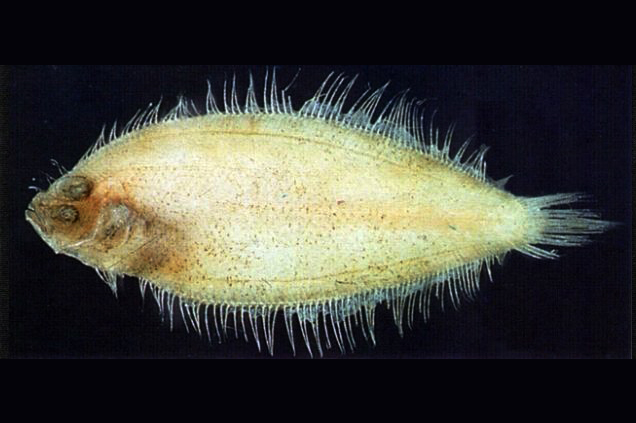
Dwarf Lefteye Flounder, Arnoglossus tenuis. Source: Fish Database of Taiwan / http://fishdb.sinica.edu.tw. License: CC BY Attribution-Noncommercial
Summary:
A small, slender uniformly pale brown flounder with no distinct blotches or spots, uniformly pale brownish fins without spots, and a uniformly milky-white underside. The species has relatively few dorsal and anal fin rays, a very small mouth, and a distinct concavity on the head in front of the upper eye.
This species was previously referred to as Arnoglossus tenuis.
This species was previously referred to as Arnoglossus tenuis.
Cite this page as:
Bray, D.J. 2026, Arnoglossus tenuis in Fishes of Australia, accessed 18 Oct 2026, https://fishesofaustralia.net.au/Home/species/944
Dwarf Lefteye Flounder, Arnoglossus tenuis Günther 1880
More Info
|
Distribution |
North of Peron Islands to Arnhem Bay Northern Territory, and north of Mackay, Queensland. Elsewhere the species occurs in the Western Pacific, from Vietnam, China, Taiwan, Korea, to off Southern Japan, and south to New Caledonia. |
|
Features |
Dorsal fin 89-98; Anal fin 68-78; Pectoral fin 10-12; Caudal fin 2+13+2=17; Gill rakers 19 + 5-8; Lateral-line scales 51-58; Vertebrae 10 + 28-30. = 38-40. Body elongate, greatest depth slightly before midbody; head small, length about half body depth; front of head with distinct concavity in front of upper eye; snout shorter than eye diameter. Mouth very small, maxilla extending to or slightly behind anterior margin of lower eye. Pectoral fin on ocular side much shorter than head length; fin on blind side very short. Scales large, deciduous, ctenoid with short ctenii on ocular side, cycloid on blind side. Few scales on lateral line, and relatively few dorsal and anal fin rays. |
|
Feeding |
Feeds on small benthic invertebrates. |
|
Fisheries |
Taken as by-catch in demersal trawl fisheries, and discarded to used for aquaculture fishmeal in parts of its range. |
|
Etymology |
The specific name is from the Latin tenuis (= slender, thin), in reference to the compressed slender shape of the body. |
|
Species Citation |
Arnoglossus tenuis Günther 1880, Report on the Scientific Results of the Voyage of H.M.S. Challenger 1873–1876, Zoology 1(6): 55. Type locality: Hong Kong. |
|
Author |
Bray, D.J. 2026 |
|
Resources |
Dwarf Lefteye Flounder, Arnoglossus tenuis Günther 1880
References
Amaoka, K. & H.-C. Ho, 2019. The lefteye flounder family Bothidae (order Pleuronectiformes) of Taiwan in Ho, H.-C., Koeda, K. & Hilton, E.J. (eds) Study on the fish taxonomy and diversity of Taiwan. Zootaxa 4702(1): 155-215, https://doi.org/10.11646/zootaxa.4702.1.18
Amaoka, K. & Mihara, E. 2000. Pisces Pleuronectiformes: Flatfishes from New Caledonia and adjacent waters. Genus Arnoglossus. Mémoires du Muséum national d'Histoire naturelle, Paris 184: 783-813 (as Arnoglossus tenuis) See ref at BHL
Günther, A. 1880. Report on the shore fishes procured during the voyage of H.M.S Challenger, in the years 1872–1876. Report on the Scientific Results of the Voyage of H.M.S. Challenger 1873–1876, Zoology 1(6): 1-82 pls 1-32
Hensley, D.A. & Amaoka, K. 2001. Bothidae. pp. 3799-3841 in Carpenter, K.E. & Niem, T.H. (eds). The Living Marine Resources of the Western Central Pacific. FAO Species Identification Guide for Fisheries Purposes. Rome : FAO Vol. 6 pp. 3381-4218. (as Arnoglossus tenuis)
Munro, I.S.R. 1961. Handbook of Australian fishes. Nos 1–42. Australian Fisheries Newsletter 15–17, 19, 20: 1-172 [published as separates 1956–1961] (as Arnoglossus tenuis)
Munroe, T. 2016. Arnoglossus tenuis. The IUCN Red List of Threatened Species 2016: e.T69741720A69742779. https://dx.doi.org/10.2305/IUCN.UK.2016-3.RLTS.T69741720A69742779.en. Accessed on 11 August 2026. (as Arnoglossus tenuis)
Norman, J.R. 1934. A Systematic Monograph of the Flatfishes (Heterosomata) Psettodidae, Bothidae, Pleuronectidae. London : British Museum Vol. 1 459 pp. 317 figs: 188 (footnote). (as Arnoglossus tenuis)
Tongboonkua, P., Chanet, B. & Chen, W.-J. 2026. Integrated Molecular and Morphological Analyses Resolve Long-Standing Classification Challenges in the Sinistral Flatfish Family Bothidae (Teleostei: Carangiformes). Zoologica Scripta 55: 15-36. https://doi.org/10.1111/zsc.70020

