Eastern Shovelnose Ray, Aptychotrema rostrata (Shaw & Nodder 1794)
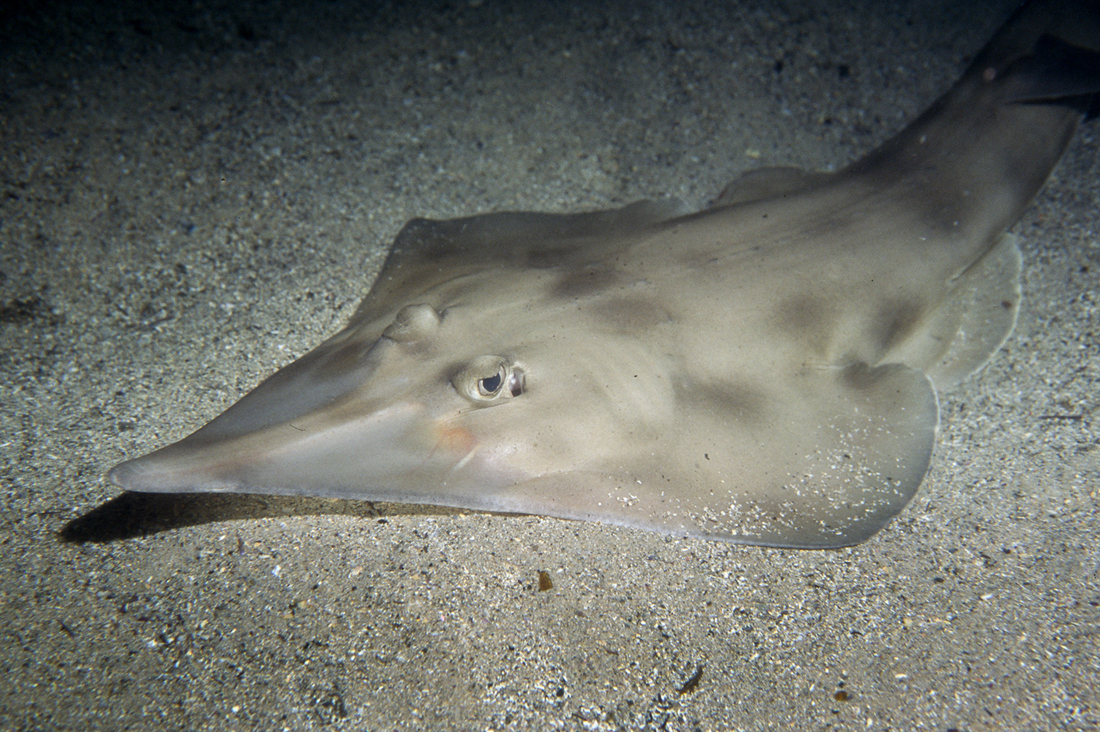
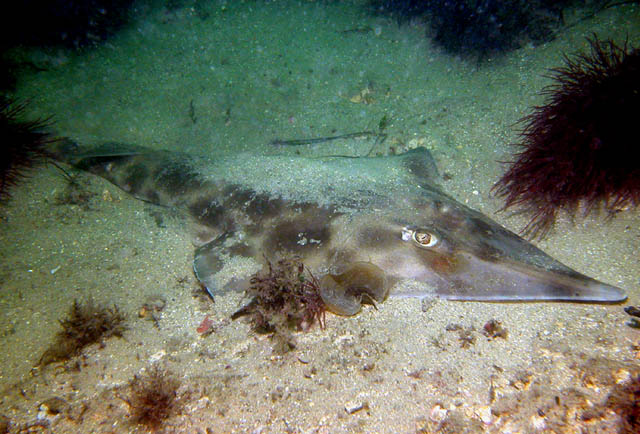
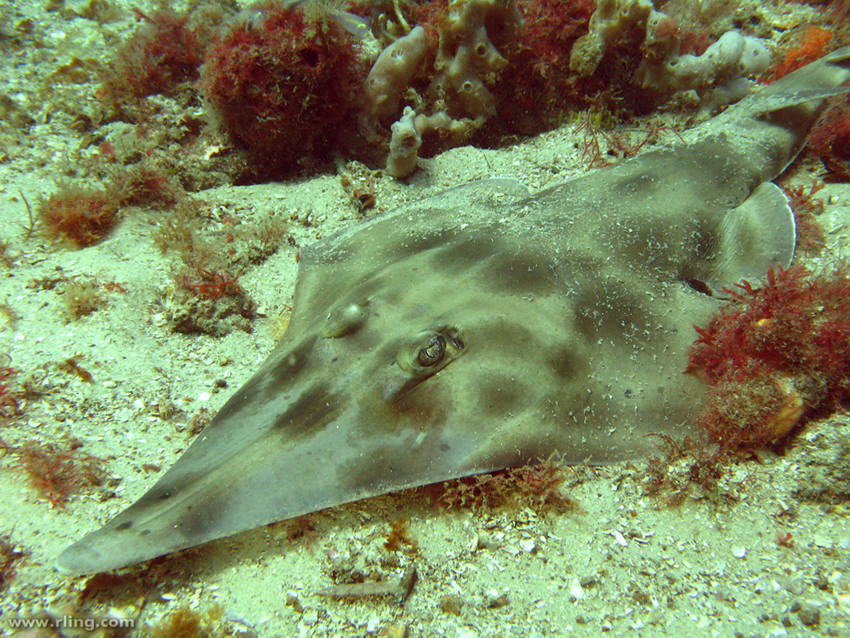
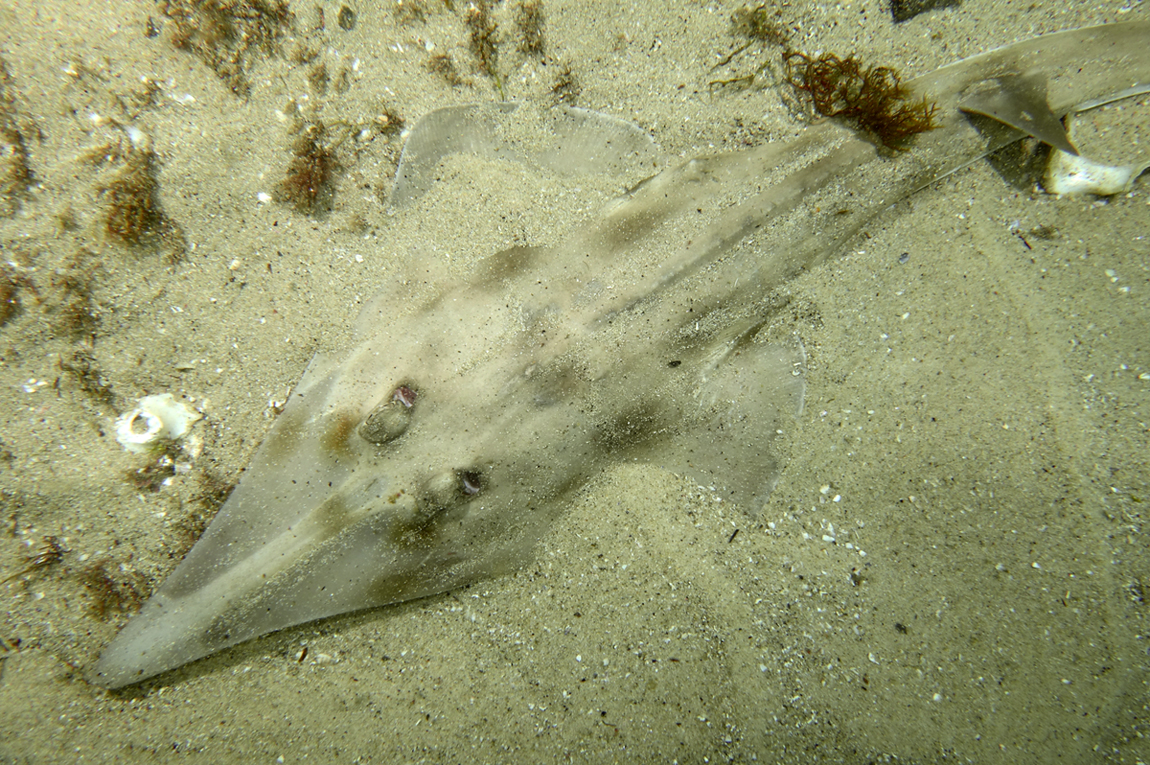
An Eastern Shovelnose Ray, Aptychotrema rostrata, in Gordons Bay, Sydney, New South Wales, December 2000. Source: Erik Schlogl / iNaturalist.org. License: CC by Attribution-NonCommercial
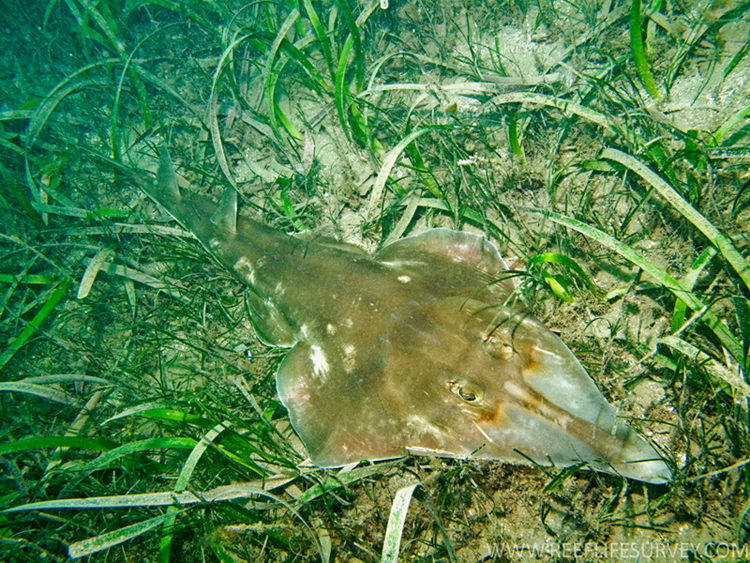
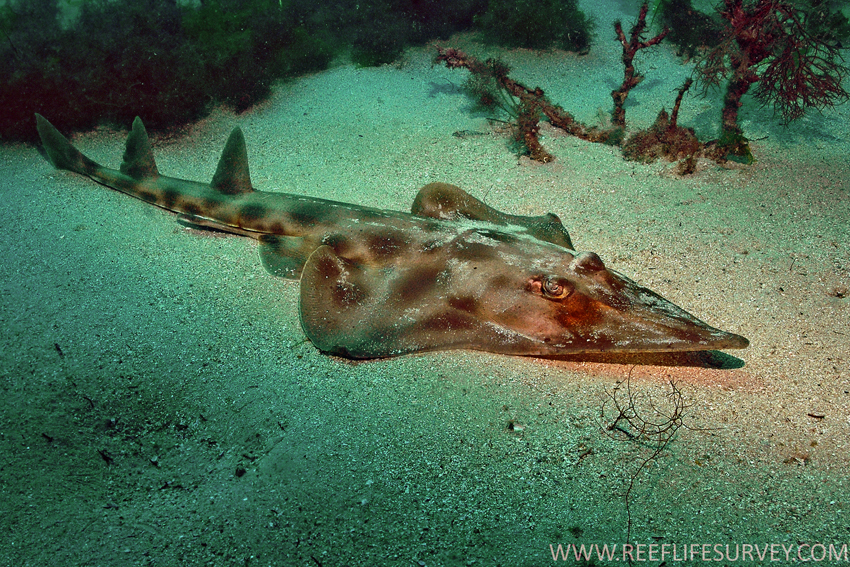
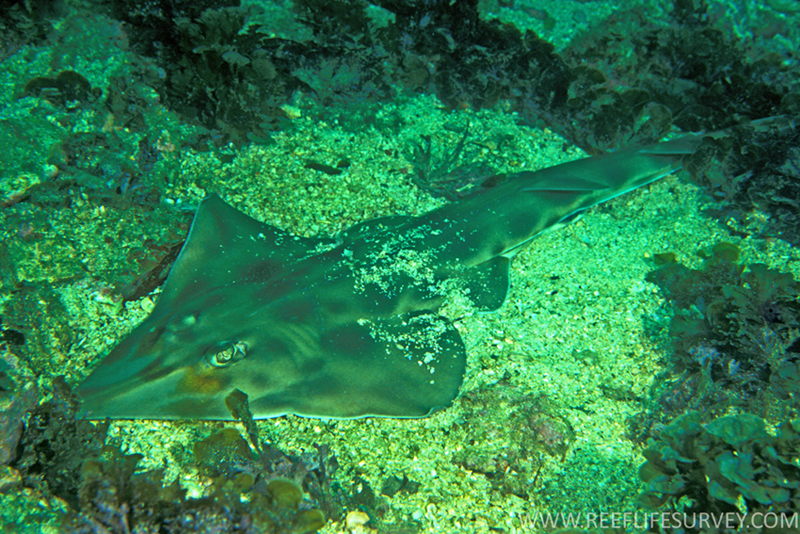
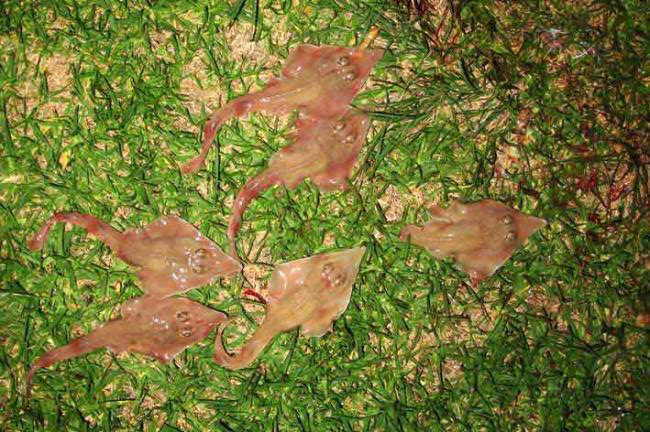
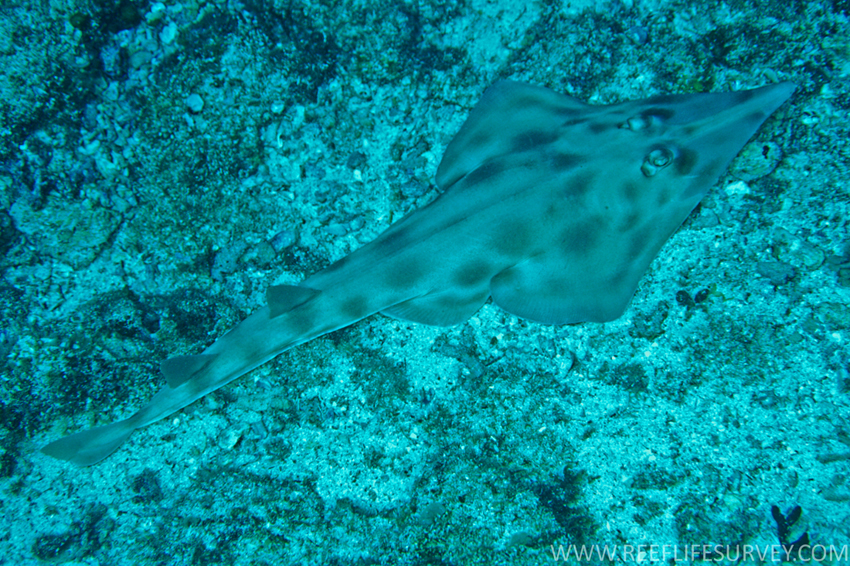
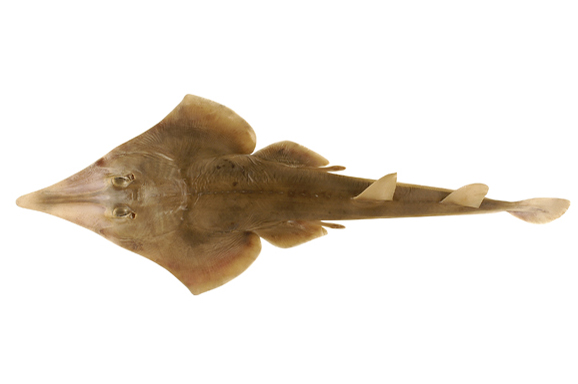
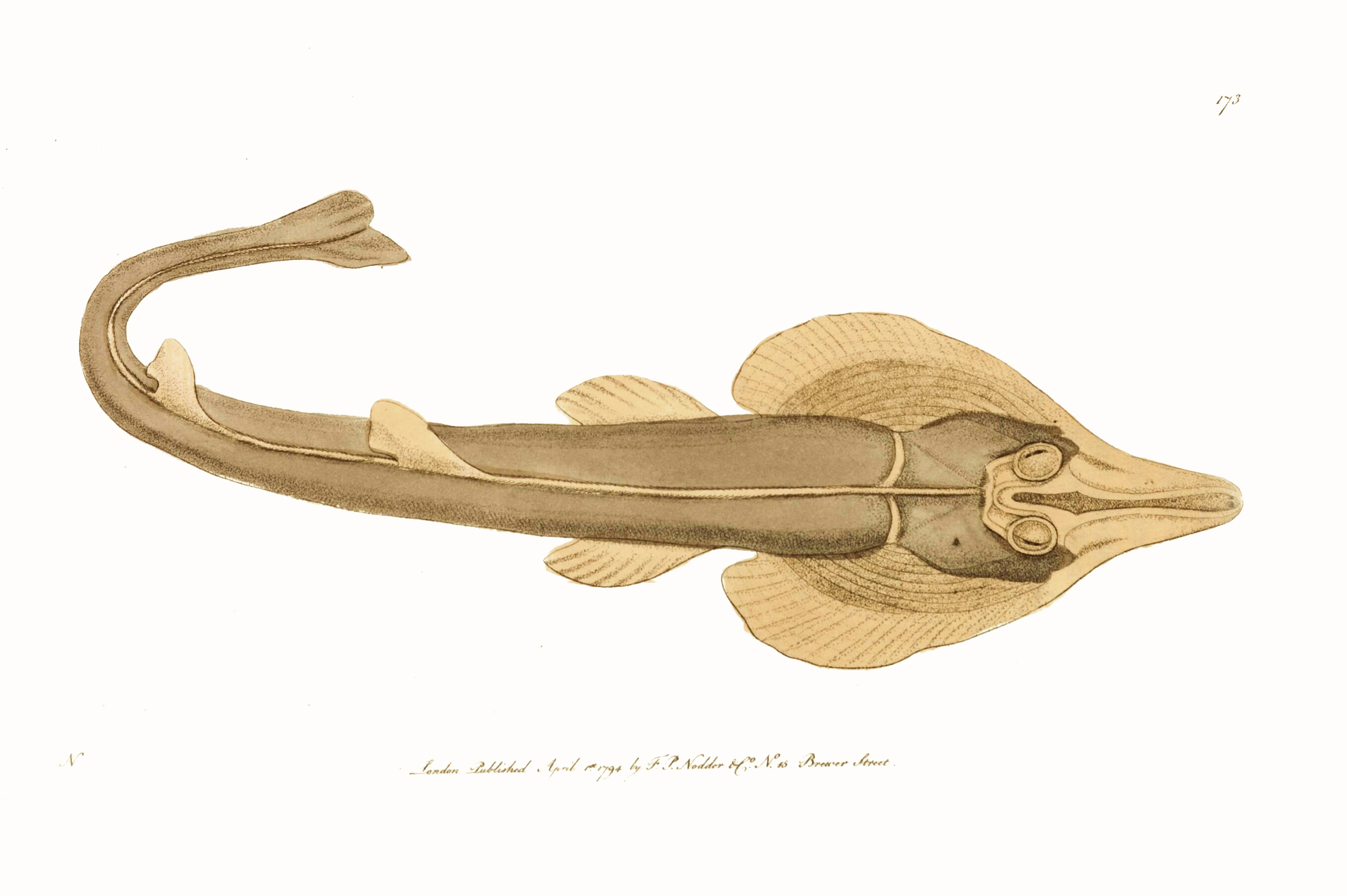
A medium-sized ray with a long flattened triangular snout, a wedge-shaped disc and a long shark-like tail. Body overall sandy to brownish above, often with darker blotches; pale below with darker flecks and a dark snout.
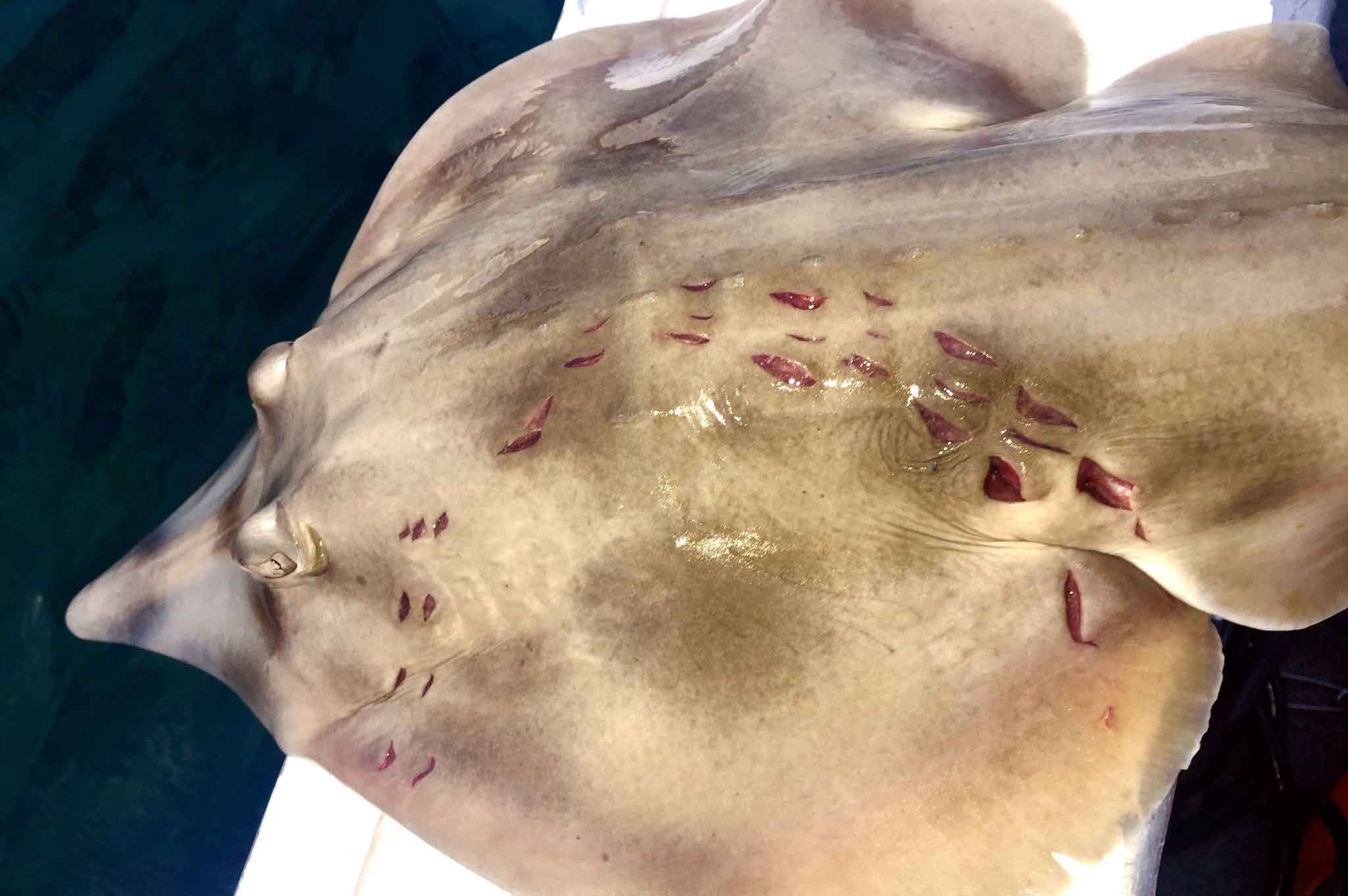
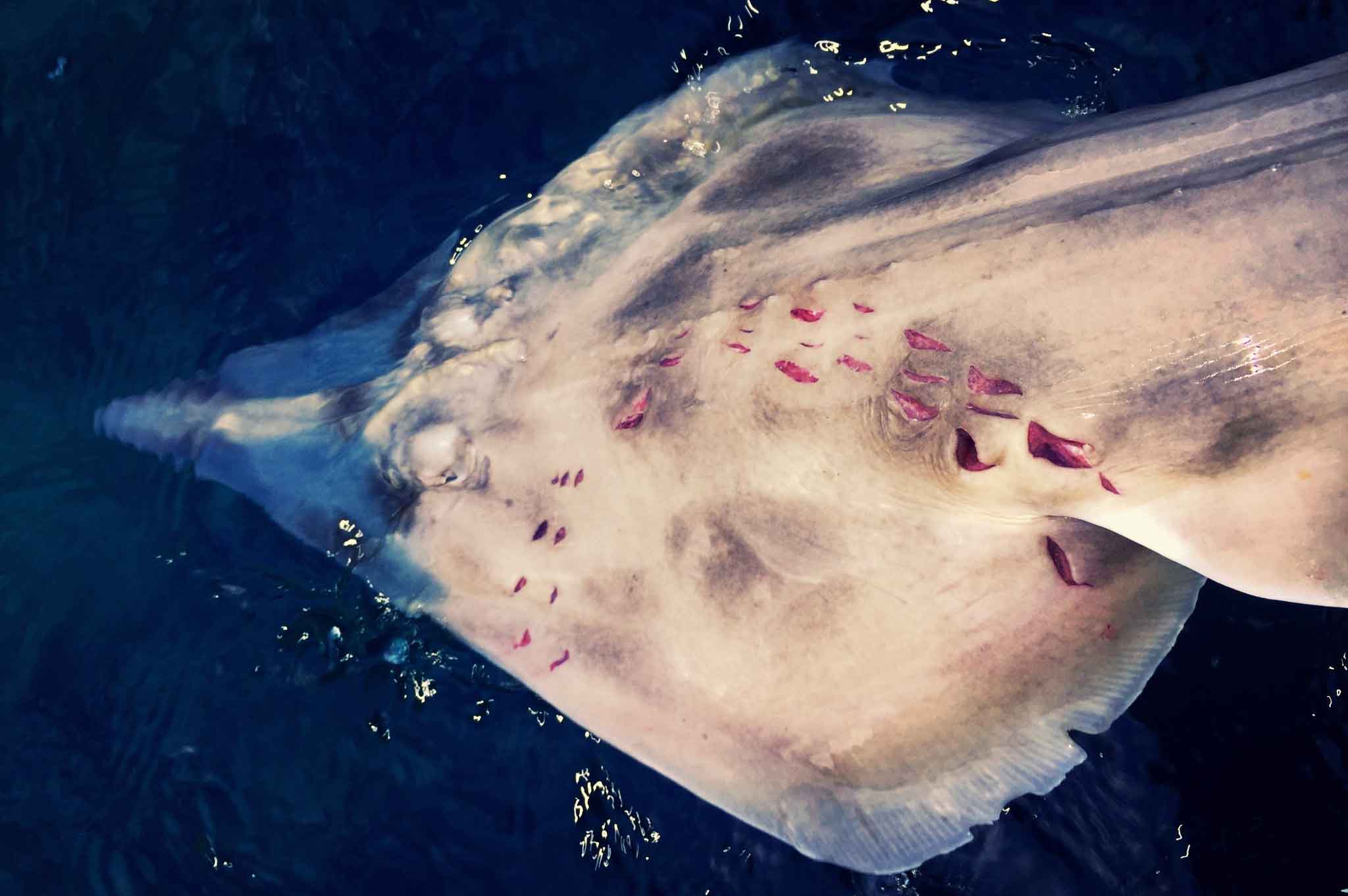
Like some other rays, the Eastern Shovelnose Ray has sexually dimorphic dentition. Mature males develop elongate cusps on their anterior teeth allowing them to grip onto the fin of a female during copulation.
Eastern Shovelnose Ray, Aptychotrema rostrata (Shaw & Nodder 1794)
More Info
|
Distribution |
Endemic to subtropical and temperate waters of eastern Australia, from north of Eagle Reef, Great Barrier Reef, Queensland, to Mallacoota, Victoria. Inhabits sandflats, mudflats and seagrass beds in bays, estuaries, river mouths, around rocky reefs and in surf zones, at depths to about 100 m. |
|
Size |
To a maximum total length of 120 cm. |
|
Colour |
Overall sandy to brownish above, often with darker blotches; pale below with darker flecks and a blackish tip to the snout. |
|
Feeding |
Feeds on fishes and a range of benthic invertebrates, including prawns, shrimps, crabs, stomatopods, and molluscs. |
|
Biology |
Females mature between 54-66 cm TL and males between 60-68 cm TL. Reproductive mode is aplacental yolksac viviparity with an annual, seasonal reproductive cycle. Females give birth to litters of 4-18 pups, with larger females producing more offspring than smaller individuals. Size at birth is about 13-15 cm TL. Experiments have shown that the Eastern Shovelnose Ray has spectrally distinct visual pigments in the retina, suggesting that the species may have colour vision (Hart et al. 2004). |
|
Fisheries |
Taken as bycatch in a number of commercial fisheries in New South Wales and Queensland. The species is also caught on hook and line by recreational anglers. The Eastern Shovelnose ray cannot be marketed in Queensland and should be released alive following capture. It can only be marketed in New South Wales. |
|
Conservation |
IUCN Red list: Least Concern |
|
Etymology |
The specific name is from the Latin rostrata (= beaked), in reference to the elongate snout of this species. |
|
Species Citation |
Raja rostrata Shaw & Nodder 1794, Naturalist's Miscellany 5: pl. 173. Type locality not stated: Botany Bay (ex Banks manuscript). |
|
Author |
Bray, D.J. 2023 |
|
Resources |
Eastern Shovelnose Ray, Aptychotrema rostrata (Shaw & Nodder 1794)
References
Adams, K.R., Fetterplace, L.C., Davis, A.R., Taylor, M D. & Knott, N.A. 2018. Sharks, rays and abortion: The prevalence of capture induced parturition in elasmobranchs. Biological Conservation 217: 11-27 https://doi.org/10.1016/j.biocon.2017.10.010
Campbell, M.J., Courtney, A.J., Wang, N., McLennan, M.F. & Zhou, S. 2017. Estimating the impacts of management changes on bycatch reduction and sustainability of high-risk bycatch species in the Queensland East Coast Otter Trawl Fishery: FRDC Final Report Project number 2015/014, Brisbane, Queensland 78 pp.
Campbell, M.J., McLennan, M.F., Courtney, A.J. & Simpfendorfer, C.A. 2018. Post-release survival of two elasmobranchs, the eastern shovelnose ray (Aptychotrema rostrata) and the common stingaree (Trygonoptera testacea), discarded from a prawn trawl fishery in southern Queensland, Australia. Marine and Freshwater Research 69: 551–561. https://doi.org/10.1071/MF17161
Compagno, L.J.V. & Last, P.R. 1999. Families Pristidae, Rhinidae, Rhinobatidae, Platyrhinidae. pp. 1410-1432 in Carpenter, K.E. & Niem, V.H. (eds). The Living Marine Resources of the Western Central Pacific. FAO Species Identification Guide for Fisheries Purposes. Rome : FAO Vol. 3 1397-2068 pp.
Grant, E.M. 2002. Guide to Fishes. Redcliffe : EM Grant Pty Ltd 880 pp. Kuiter, R.H. 1993. Coastal Fishes of South-eastern Australia. Bathurst : Crawford House Press 437 pp.
Gutteridge, A.N. & Bennett, M.B. 2014. Functional implications of ontogenetically and sexually dimorphic dentition in the eastern shovelnose ray, Aptychotrema rostrata. Journal of Experimental Biology 217: 192-200. https://doi.org/10.1242/jeb.089326
Hart, N.S., Lisney, T.J., Marshall, N.J. & Collin, S.P. 2004. Multiple cone visual pigments and the potential for trichromatic colour vision in two species of elasmobranch. Journal of Experimental Biology 207: 4587-4594.
Kuiter, R.H. 1993. Coastal Fishes of South-eastern Australia. Bathurst : Crawford House Press 437 pp.
Kuiter, R.H. 1996. Guide to sea fishes of Australia. A comprehensive reference for divers and fishermen. Sydney, NSW, Australia : New Holland Publishers xvii, 434 pp.
Kuiter, R.H. & Kuiter, S. 2018. Coastal sea-fishes of south-eastern Australia. Seaford, Victoria : Aquatic Photographics, 371 pp.
Kyne, P.M. 2000. Aspects of the reproductive biology and diet of the eastern shovelnose ray, Aptychotrema rostrata (Shaw & Nodder, 1794), from Moreton Bay, Queensland. Honours Thesis, Department of Anatomical Sciences, The University of Queensland.
Kyne, P.M. & Bennett, M.B. 2002. Reproductive biology of the eastern shovelnose ray, Aptychotrema rostrata (Shaw & Nodder, 1794), from Moreton Bay, Queensland, Australia. Marine and Freshwater Research 53: 583-589 https://doi.org/10.1071/MF01063
Kyne, P.M. & Bennett, M.B. 2002. Diet of the eastern shovelnose ray, Aptychotrema rostrata (Shaw & Nodder, 1794), from Moreton Bay, Queensland, Australia. Marine and Freshwater Research 53(3): 679-686. https://doi.org/10.1071/MF01040
Kyne, P.M., Courtney, A., Campbell, M., Chilcott, K., Gaddes, S., Turnbull, C., Van Der Geest, C. & Bennett, M.B. 2002. An Overview of the Elasmobranch By-catch of the Queensland East Coast Trawl Fishery (Australia). Scientific Council Meeting September 2002. Northwest Atlantic Fisheries Organization Serial No. N4718 NAFO SCR Doc. 02/97.
Kyne, P.M., Courtney, A.J., Jacobsen, I.P. & Bennett, M.B. 2016. Reproductive parameters of rhinobatid and urolophid batoids taken as by‐catch in the Queensland (Australia) east coast otter‐trawl fishery. Journal of Fish Biology 89: 1208-1226 https://doi.org/10.1111/jfb.13020
Kyne, P.M. & Stevens, J.D. 2015. Aptychotrema rostrata. The IUCN Red List of Threatened Species 2015: e.T161596A68609037. http://dx.doi.org/10.2305/IUCN.UK.2015-4.RLTS.T161596A68609037.en. Downloaded on 10 January 2018.
Last, P.R. 1994. Families Torpedinidae, Rajiidae, Rhinobatidae. pp. 154-172 figs 132-149 in Gomon, M.F., Glover, C.J.M. & Kuiter, R.H (eds). The Fishes of Australia's South Coast. Adelaide : State Printer 992 pp. 810 figs
Last, P.R. & Séret, B. 2016. 12 Banjo Rays Family Trygonorrhinidae, pp. 117-126 in Last, P.R., White, W.T., de Carvalho, M.R., Séret, B., Stehmann, M.F.W. & Naylor, G.J.P. (eds). Rays of the World. Melbourne : CSIRO Publishing, 800 pp.
Last, P.R., Séret, B. & Naylor, G.J.P. 2016. A new species of guitarfish, Rhinobatos borneensis sp. nov. with a redefinition of the family-level classification in the order Rhinopristiformes (Chondrichthyes: Batoidea). Zootaxa 4117(4): 451-475 https://doi.org/10.11646/zootaxa.4117.4.1
Last, P.R. & Stevens, J.D. 1994. Sharks and Rays of Australia. Canberra : CSIRO Australia 513 pp. 84 pls
Last, P.R. & Stevens, J.D. 2009. Sharks and Rays of Australia. Collingwood : CSIRO Publishing Australia Edn 2, 550 pp.
Macbeth, W.G., Vandenberg, M. & Graham, K.J. 2008. Identifying Sharks and Rays; a Guide for Commercial Fishers. Sydney : New South Wales Department of Primary Industry 71 pp.
Macleay, W.J. 1882. Notes on the Pleuronectidae of Port Jackson with descriptions of two hitherto unobserved species. Proceedings of the Linnean Society of New South Wales 1 7(1): 11-15 (described as Rhinobatus tuberculatus)
Müller, J. & Henle, F.G.J. 1841. Systematische Beschreibung der Plagiostomen. Berlin : Veit & Co. pp. 103-200 pls. [p. 117, described as Rhinobatus (Syrrhina) bougainvillii; p. 123, described as Rhinobatus (Rhinobatus) Banksii]
Ogilby, J.D. 1885. Notes on the distribution of some Australian sharks and rays, with a description of Rhinobatus bougainvillei, Müller and Henle. Proceedings of the Linnean Society of New South Wales 1 10 (2): 463–466
Pierce, S.J. & Scott-Holland, T.B. & Bennett, M.B. 2011. Community composition of elasmobranch fishes utilizing intertidal sand flats in Moreton Bay, Queensland, Australia. Pacific Science 65 (2): 235-247 https://doi.org/10.2984/65.2.235
Shaw, G. & Nodder, F.P. 1794. The Naturalist's Miscellany, or coloured figures of natural objects; drawn and described from nature. London Vol. 5 pls 162–182, unnumbered pages. See ref at BHL
Whitley, G.P. 1940. The Fishes of Australia. Part 1. The sharks, rays, devil-fish, and other primitive fishes of Australia and New Zealand. Sydney : Roy. Zool. Soc. N.S.W. 280 pp. 303 figs (p. 169, as Aptychotrema bouganvillii)
Wueringer, B.E., Squire, L.S. Jnr, Kajiura, S.M., Tibbetts, I.R., Hart, N.S. & Collin, S.P. 2012. Electric field detection in sawfish and shovelnose rays. PLoS ONE 7(7): e41605 https://doi.org/10.1371/journal.pone.0041605
Wueringer, B.E. & Tibbetts, I.R. 2008. Comparison of the lateral line and ampullary systems of two species of shovelnose ray. Reviews in Fish Biology and Fisheries 18(1): 47-64. https://doi.org/10.1007/s11160-007-9063-9
Wueringer, B.E. & Tibbetts, I.R. & Whitehead, D.L. 2009. Ultrastructure of the ampullae of Lorenzini of Aptychotrema rostrata (Rhinobatidae). Zoomorphology 128(2): 45-52. https://doi.org/10.1007/s00435-008-0073-5
Yearsley, G.K., Last, P.R. & Ward, R.D. (eds) 1999. Australian Seafood Handbook. Hobart : CSIRO Marine Research 460 pp.