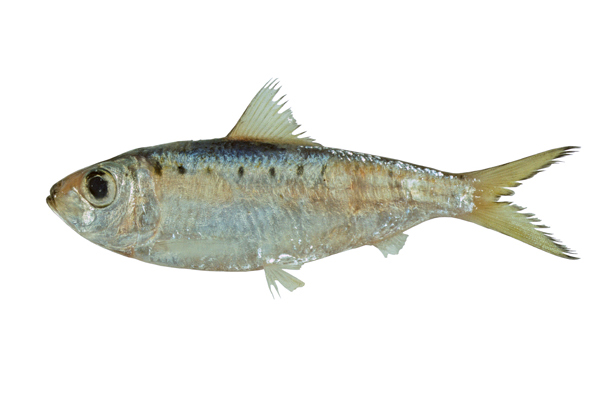
Smallspotted Herring, Herklotsichthys lippa (Whitley 1931)
Other Names: Australian Spotted Herring, Small-spotted Herring
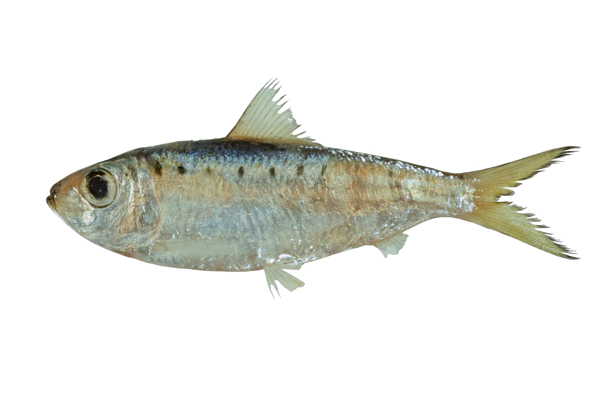
Smallspotted Herring, Herklotsichthys lippa. Source: Australian National Fish Collection, CSIRO. License: CC by Attribution-NonCommercial
Summary:
A silvery herring with a dark bluish-grey back, and a black blotch immediately behind the upper part of the gill cover, followed by a row of 8-12 small black spots along the upper side.
Cite this page as:
Bray, D.J. 2025, Herklotsichthys lippa in Fishes of Australia, accessed 14 Sep 2026, https://fishesofaustralia.net.au/home/species/2057
Smallspotted Herring, Herklotsichthys lippa (Whitley 1931)
More Info
|
Distribution |
Shark Bay, Western Australia, to Hervey Bay, Queensland, including the Arafura Sea and the Torres Strait; also Aru Island, West Papua, Indonesia, and Papua New Guinea. Forms pelagic schools in coastal marine habitats. |
|
Features |
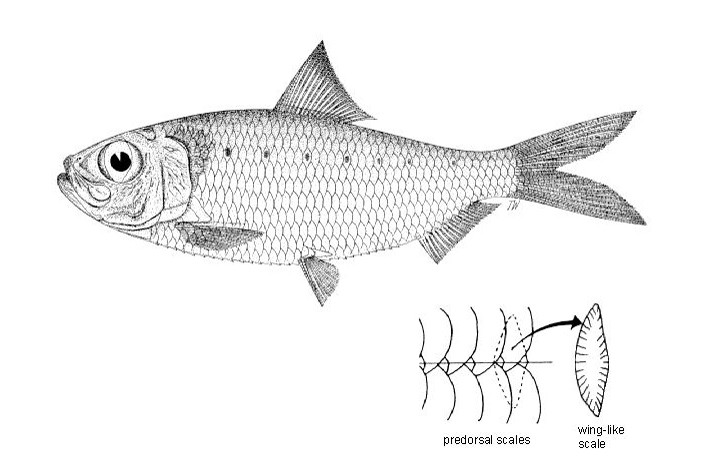
Dorsal fin 13-21; Anal fin 12-23; Gill rakers (lower limb) 33-36; Ventral scutes 17-18 + 11-13. Body moderately slender, depth 29-35%SL; eye large, adipose eyelids present; distinct wing-like scales present beneath normal paired pre-dorsal scales. |
|
Size |
|
|
Etymology |
The specific name is from the Latin lippus (= bleary-eyed, bleared, inflammed), possibly in reference to the adipose eyelids. |
|
Species Citation |
Harengula lippa Whitley 1931, Records of the Australian Museum 18(4): 142, fig. 1. Type locality: Port Hedland, Western Australia. |
|
Author |
Bray, D.J. 2025 |
|
Resources |
Smallspotted Herring, Herklotsichthys lippa (Whitley 1931)
References
Blaber, S.J.M., Brewer, D.T. & Harris, A.N. 1994. Distribution, biomass and community structure of demersal fishes of the Gulf of Carpentaria, Australia. Australian Journal of Marine and Freshwater Research 45(3): 375-396.
Gaughan, D., Munroe, T.A. & Mohd Arshaad, W. 2017. Herklotsichthys lippa. The IUCN Red List of Threatened Species 2017: e.T97755938A97756249. https://dx.doi.org/10.2305/IUCN.UK.2017-3.RLTS.T97755938A97756249.en. Accessed on 30 September 2025.
Gloerfelt-Tarp, T. & Kailola, P.J. 2022. Trawled fishes of southern Indonesia and northwestern Australia. 2nd ed. Self published: i-vii, 1-422, Pls. 1-3. See ref online
Munro, I.S.R. 1961. Handbook of Australian fishes. Nos 1–42. Australian Fisheries Newsletter 15–17, 19, 20: 1-172.
Munroe, T.A., Wongratana, T. & Nizinski, M.S. 1999. Family Clupeidae. pp. 1775-1821 in Carpenter, K.E. & Niem, V.H. (eds). The Living Marine Resources of the Western Central Pacific. FAO Species Identification Guide for Fisheries Purposes. Rome : FAO Vol. 3 pp. 1397-2068.
Russell, B.C. & Houston, W. 1989. Offshore fishes of the Arafura Sea. The Beagle 6(1): 69-84.
Sainsbury, K.J., Kailola, P.J. & Leyland, G.G. 1984. Continental Shelf Fishes of Northern and North-Western Australia. Canberra : Fisheries Information Service 375 pp. figs & pls.
Whitehead, P.J.P. 1985. FAO species catalog. Clupeoid fishes of the world (suborder Clupeoidei). Part 1 — Chirocentridae, Clupeidae and Pristigasteridae. FAO Fisheries Synopsis No. 125 Vol. 7 Pt 1. pp. 1-303 (as Herklotsichthys Species A)
Whitley, G.P. 1931. Studies in Ichthyology No. 5. Records of the Australian Museum 18(4): 138-160 figs 1-2 pls 20-21. https://doi.org/10.3853/j.0067-1975.18.1931.722