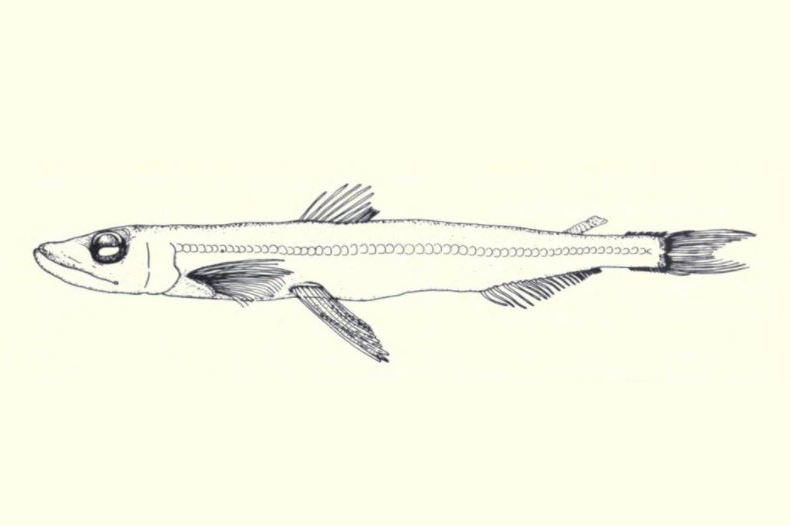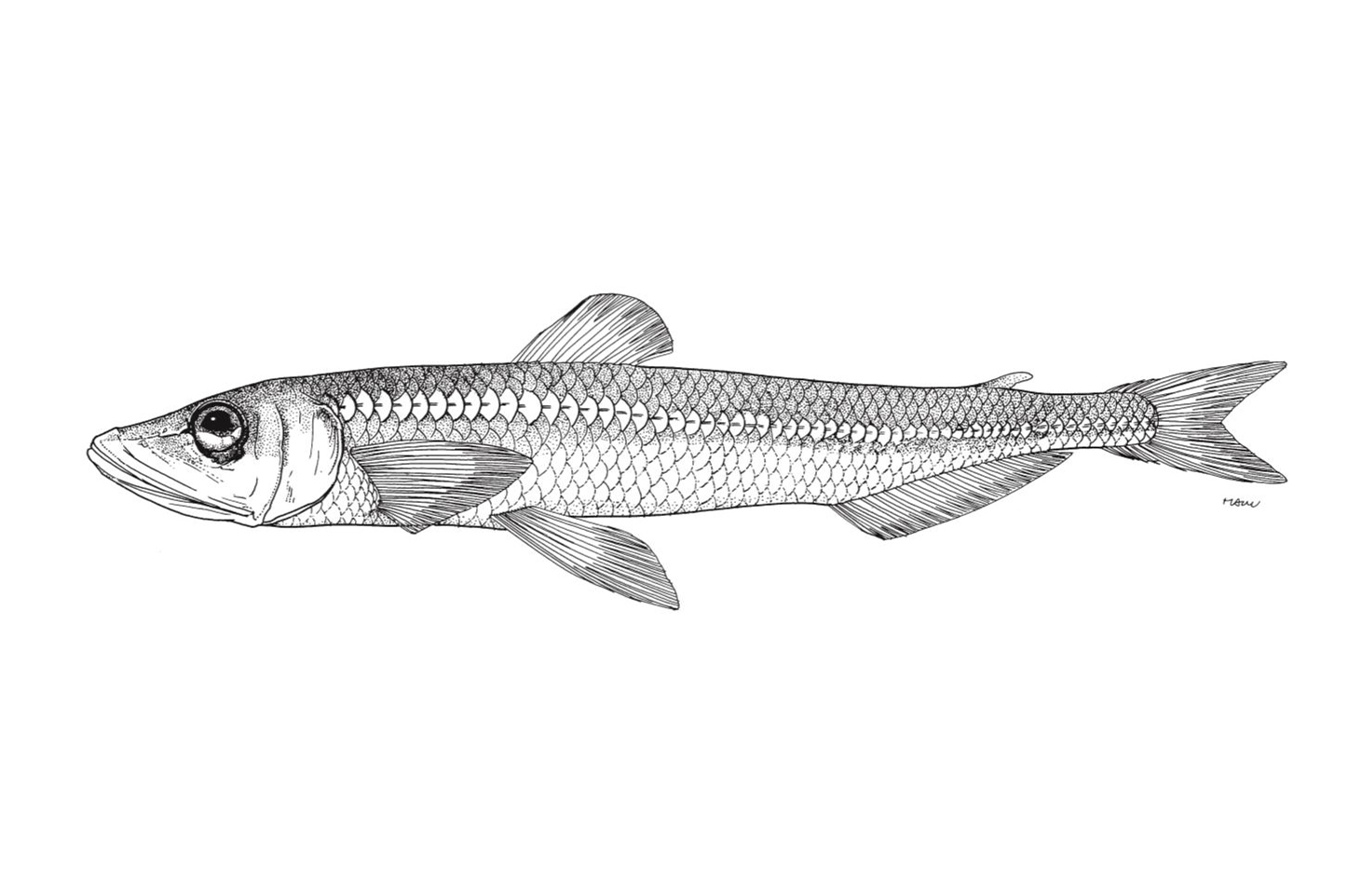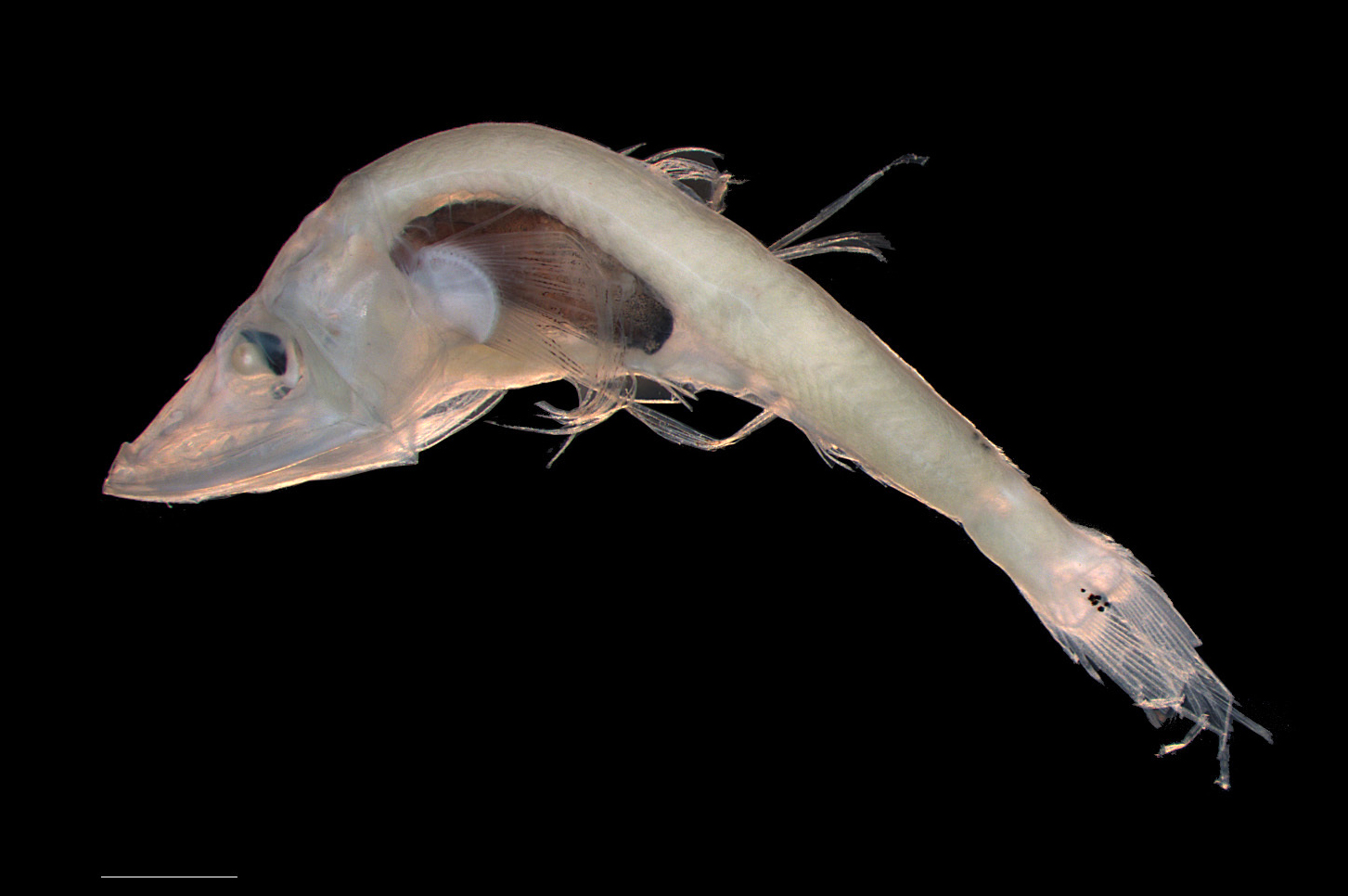
Childish Pearleye, Benthalbella infans Zugmayer 1911
Other Names: Zugmayer's Pearleye
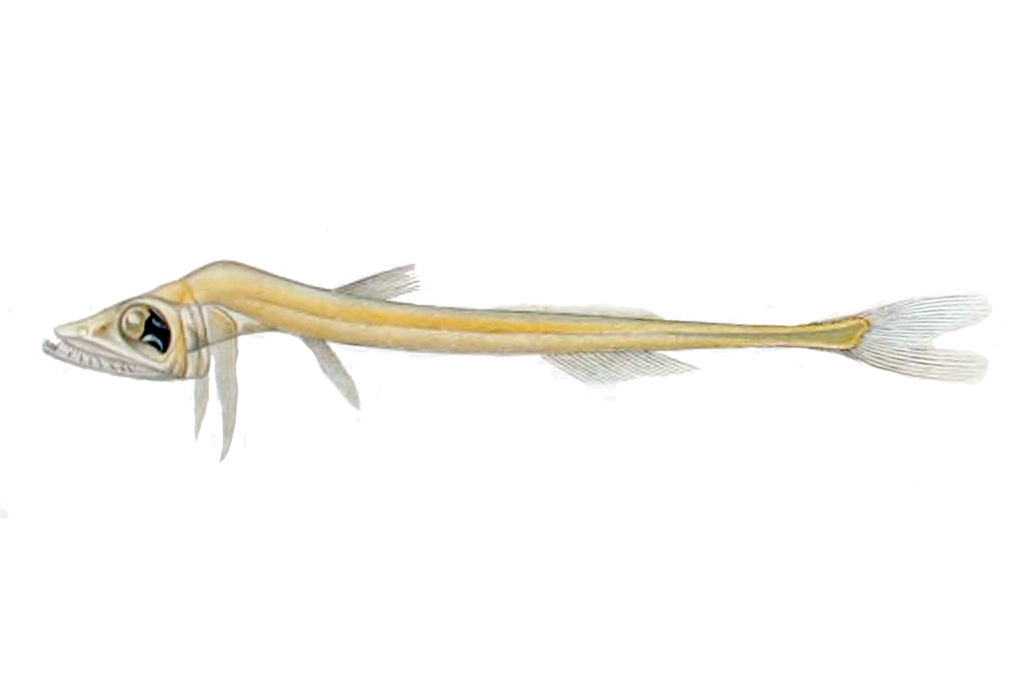
Illustration of the holotype of the Childish Pearleye, Benthalbella infans. Source: Pl. 2 (fig. 8) in Zugmayer (1911) Résultats des campagnes scientifiques accomplies sur son yacht par Albert 1er Monaco. Fasc. 35: 1-174, Pls. 1-6. License: Public Domain
Cite this page as:
Bray, D.J. 2025, Benthalbella infans in Fishes of Australia, accessed 31 Aug 2026, https://fishesofaustralia.net.au/home/species/3319
Childish Pearleye, Benthalbella infans Zugmayer 1911
More Info
|
Distribution |
Off Newcastle, New South Wales, to south of Point Hicks, Victoria. Elsewhere the species is circumglobal in warmer temperate to tropical waters world-wide (absent from the Mediterranean), including in the Coral Sea outside AUS EEZ. |
|
Features |
Dorsal fin 8-9; Anal fin 20-25; Pectoral fin 25-28; Lateral-line scales 55-59; Photophores 4 - one on the isthmus, one anterior and one posterior to the pelvic-fin bases, and one before the anal fin. Pectoral fins shorter than pelvic fins; pelvic fins inserted anterior to dorsal-fin origin. |
|
Biology |
A simultaneous hermaphrodite, with functional male and female reproductive tissue. |
|
Remarks |
Marshall (1955) described Neoscolarchoides dubius (a junior synonym of B. infans), writing: "Note. I have called this species dubius, because it is possible that future work may reveal it to be the adult of the larval form, Benthalbella infans Zugmayer. " |
|
Etymology |
The specific name is from the Latin infans (= infant, immature) in reference to the type specimen - a larval or juvenile fish: "This fish is very young, or rather larval;" |
|
Species Citation |
Benthalbella infans Zugmayer 1911, Bulletin of the Oceanographic Institute Monaco 193: 14. Type locality: North of Madeira, eastern Atlantic, station 3036, 6°07'N, 10°18'W, depth 0-4740 m. |
|
Author |
Bray, D.J. 2025 |
|
Resources |
Childish Pearleye, Benthalbella infans Zugmayer 1911
References
Locket, N.A. 2000. On the lens pad of Benthalbella infans, a scopelarchid deep-sea teleost. Philosophical Transactions of the Royal Society B: Biological Sciences 355(1401): 1167-1169. https://doi.org/10.1098/rstb.2000.0660
Marshall, N.B. 1955. Studies of alepisauroid fishes. Discovery Reports 27: 303-336, Pl. 19. https://www.biodiversitylibrary.org/part/36627
Merrett, N.R., Badcock, J. & Herring, P.J. 1973. The status of Benthalbella infans (Pisces: Myctophoidei), its development, bioluminescence, general biology and distribution in the eastern North Atlantic. Journal of Zoology 170: 1-48. https://doi.org/10.1111/j.1469-7998.1973.tb05042.x
Russell, B., Poss, S., Nunoo, F. & Bannermann, P. 2015. Benthalbella infans. The IUCN Red List of Threatened Species 2015: e.T13485675A15603275. http://dx.doi.org/10.2305/IUCN.UK.2015-4.RLTS.T13485675A15603275.en . Downloaded on 20 February 2018.
Stewart, AL 2015. Family Scopelarchidae. pp. 566-574 in Roberts, CD, Stewart, AL & Struthers, CD The Fishes of New Zealand . Wellington: Te Papa Press Vol. 2 pp. 1-576.
Sutton, TT, Hulley, PA, Wienerroither, R., Zaera-Perez, D. & Paxton, JR 2020. Identification guide to the mesopelagic fishes of the central and south east Atlantic Ocean. FAO Species Identification Guide for Fishery Purposes. FAO, Rome. 327 pp.
Zugmayer, E. 1911. Diagnoses des poissons nouveaux terminals des campagnes du yacht Princesse Alice (1901 à 1910). Bulletin de l’Institut Océanographique Monaco 193: 1-14. https://www.biodiversitylibrary.org/bibliography/2185
Zugmayer, E. 1911. Poissons provenant des campagnes du yacht Princesse-Alice (1901-1910). Résultats des campagnes scientifiques accomplies sur son yacht par Albert 1er Monaco. Fasc. 35: 1-174, Pls. 1-6. https://doi.org/10.5962/bhl.title.55724.