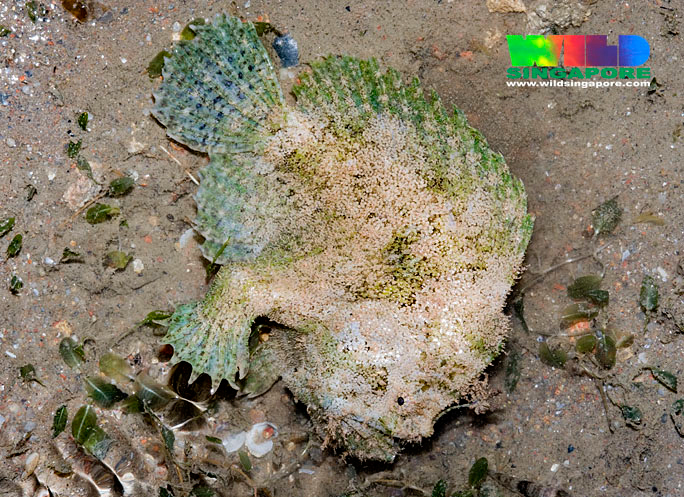
Spot-tail Anglerfish, Lophiocharon trisignatus (Richardson 1844)
Other Names: Rough Angler Fish, Spot-tailed Anglerfish, Spotted-tail Anglerfish, Threespot Frogfish, Three-spot Frogfish
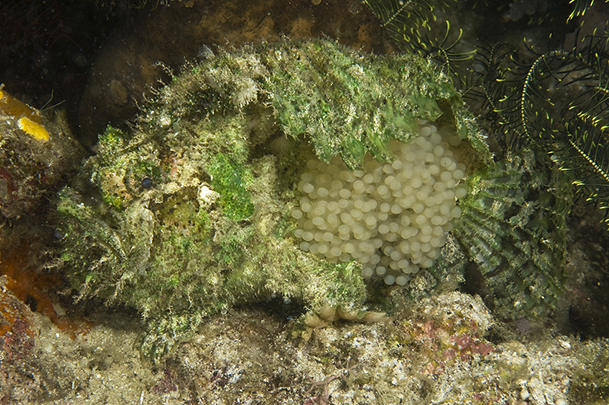
A Spot-tail Anglerfish, Lophiocharon trisignatus, brooding eggs at Raja Ampat Islands, West Papua, Indonesia. Source: Mary Jane Adams. License: All rights reserved
Summary:
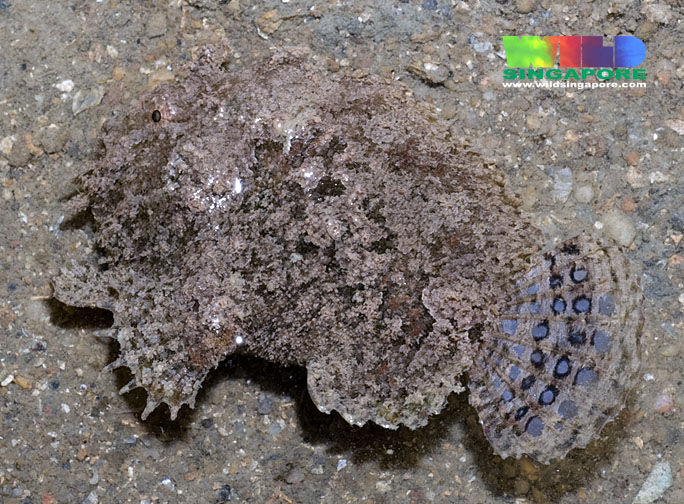
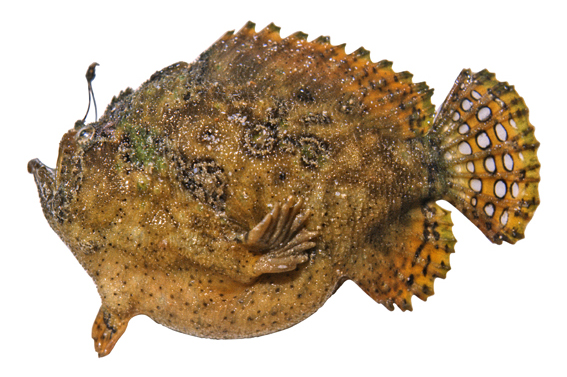
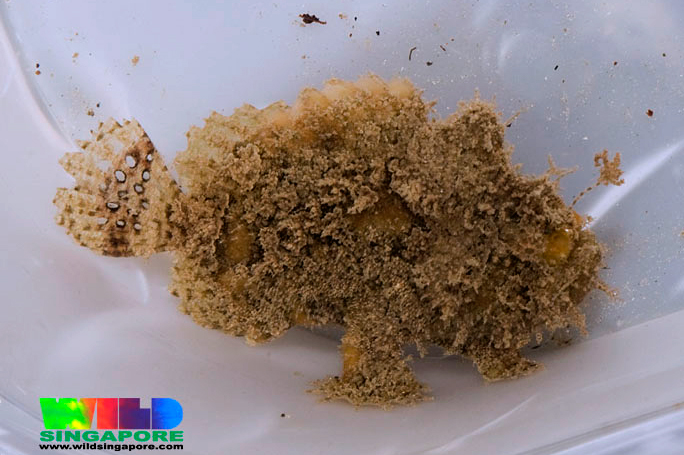
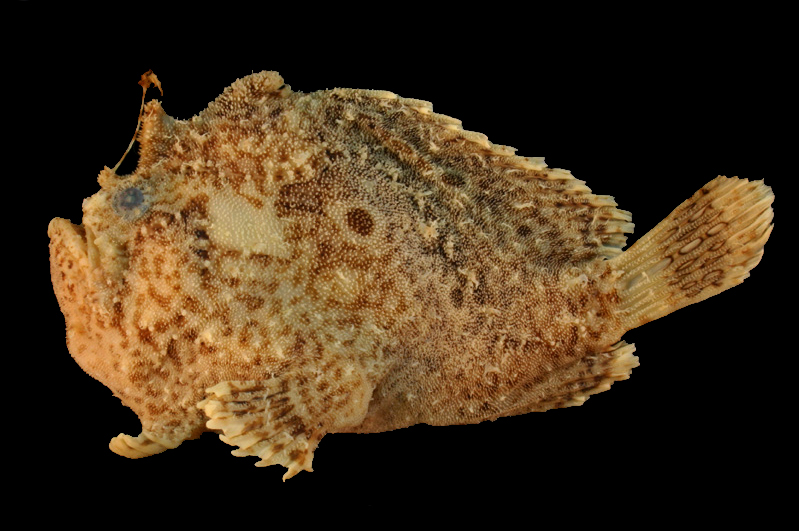
A mottled greenish-brown to reddish-orange anglerfish with rows of dark-edged transparent spots (ocelli) on the tail membranes, a long naked illicium (fishing rod) with a large complex esca (lure). With its skin flaps and appendages, this very cryptic anglerfish resembles sponges or rocks covered in encrusting algae.
Spot-tail Anglerfish lack a caudal peduncle (tail base) and the rear margins of the soft dorsal and anal fins are attached to the base of the outermost caudal-fin rays. The arm-like lobe of the pectoral fin is broadly attached to side of the body, and all caudal-fin rays are divided.
Spot-tail Anglerfish lack a caudal peduncle (tail base) and the rear margins of the soft dorsal and anal fins are attached to the base of the outermost caudal-fin rays. The arm-like lobe of the pectoral fin is broadly attached to side of the body, and all caudal-fin rays are divided.
Cite this page as:
Bray, D.J. 2025, Lophiocharon trisignatus in Fishes of Australia, accessed 03 Aug 2026, https://fishesofaustralia.net.au/home/species/3839
Spot-tail Anglerfish, Lophiocharon trisignatus (Richardson 1844)
More Info
|
Distribution |
Rottnest Island, Western Australia, to the Great Barrier Reef, Queensland. Elsewhere the species occurs in the east-Indo-west Pacific: Indonesia to the Philippines, and northern Australia. Inhabits rubble and debris areas, piers and wharf pilings on inshore coral and rocky reefs. |
|
Features |
Dorsal-fin spines/rays I+I+I, 12-13; Anal-fin rays 6-8. Illicium naked, not covered with dermal spinules; esca large, complex. |
|
Size |
The dermal flaps and appendages give this species the appearance of an encrusted rock or sponge. |
|
Biology |
Unlike most tropical anglerfishes which have pelagic eggs, the egg clusters of this species are attached by threads to the side of the male parent. He folds his dorsal, caudal and anal fins over the egg mas to protect them. The cluster may contain up to 650 large (3 mm) spherical eggs, each attached to the skin of the male by a thread-like loop. |
|
Etymology |
The specific name is from the Latin tri- (= three) and signatus (= marked), in reference to the three dark spots on the side. |
|
Species Citation |
Chironectes trisignatus Richardson, 1844, Zool. Erebus Terror 2: 15, pl. 9, fig. 1. Type locality: Broome, Western Australia (Neotype). |
|
Author |
Bray, D.J. 2025 |
|
Resources |
Spot-tail Anglerfish, Lophiocharon trisignatus (Richardson 1844)
References
Allen, G.R. 1997. Marine Fishes of Tropical Australia and South-east Asia. Perth : Western Australian Museum 292 pp. 106 pls.
Allen, G.R. & Erdmann, M.V. 2012. Reef fishes of the East Indies. Perth : Tropical Reef Research 3 vols, 1260 pp.
Allen, G.R. & Swainston, R. 1988. The Marine Fishes of North-Western Australia. A field guide for anglers and divers. Perth, WA : Western Australian Museum vi 201 pp., 70 pls. (as Antennarius trisignatus)
Arnold, R.J. & Pietsch, T.W. 2012. Evolutionary history of frogfishes (Teleostei: Lophiiformes: Antennariidae): a molecular approach. Molecular Phylogenetics and Evolution 62:117-129.
Bleeker, P. 1851. Bijdrage tot de kennis der ichthyologische fauna van Riouw. Natuurkundig Tijdschrift voor Nederlandsch Indië 2: 469-497. (described as Antennarius urophthalmus)
Coleman, N. 1981. Australian Sea Fishes North of 30°S. Lane Cove, NSW : Doubleday Australia Pty Ltd 297 pp.
Gloerfelt-Tarp, T. & Kailola, P.J. 1984. Trawled fishes of southern Indonesia and northwestern Australia. Australian Development Assistance Bureau, Australia, Directorate General of Fishes, Indonesia, and German Agency for Technical Cooperation, Federal Republic of Germany. 407 pp.
Hoschke, A., Whisson, G. & Moore, G.I. 2019. Complete list of fishes from Rottnest Island, pp. 150-161 in Whisson, G. & Hoschke, A. (eds). The Rottnest Island fish book. 2nd ed. Perth : Aqua Research and Monitoring Services.
Hutchins, J.B. 1994. A survey of the nearshore reef fish fauna of Western Australia's west and south coasts — The Leeuwin Province. Records of the Western Australian Museum, Supplement 46: 1-66 figs 1-6
Macleay, W.J. 1881. Descriptive catalogue of the fishes of Australia. Part 2. Proceedings of the Linnean Society of New South Wales 1 5(4): 510-629 pls 13-14 (described as Antennarius asper, type locality Darnley Island, Queensland).
Pietsch, T.W. 1984. The genera of frogfishes (family Antennariidae). Copeia 1984(1): 27-44 fig. 1
Pietsch, T.W. 2004. A New Species of the Anglerfish Genus Lophiocharon Whitley (Lophiiformes: Antennariidae) from Australian Waters. Records of the Australian Museum 56: 159-162.
Pietsch, T. 2022. Lophiocharon trisignatus. The IUCN Red List of Threatened Species 2022: e.T67969378A210104478. https://dx.doi.org/10.2305/IUCN.UK.2022-2.RLTS.T67969378A210104478.en. Accessed on 05 November 2025.
Pietsch, T.W. & Grobecker, D.B. 1980. Parental care as an alternative reproductive mode in an antennariid anglerfish. Copeia 1980(3): 551-553.
Pietsch, T.W. & Grobecker, D.B. 1987. Frogfishes of the World: Systematics, Zoogeography, and Behavioral Ecology. Palo Alto : Stanford University Press 420 pp.
Randall, J.E., Allen, G.R. & Steene, R. 1997. Fishes of the Great Barrier Reef and Coral Sea. Bathurst : Crawford House Press 557 pp. figs.
Richardson, J. 1844. Ichthyology. 1-16 pls 1-6, 7-8 (parts), 9-10 in Richardson, J. & Gray, J.E. (eds). The Zoology of the Voyage of H.M.S. Erebus and Terror under the command of Captain Sir James Clark Ross, R.N., F.R.S., during the years 1839–43. London : E.W. Janson Vol. 2 139 pp.
Whitley, G.P. 1933. Studies in Ichthyology No. 7. Records of the Australian Museum 19(1): 60-112 figs 1-4 pls 11-15. (described as Lophiocharon broomensis, type locality Broome, Western Australia)
Whitley, G.P. 1941. Ichthyological notes and illustrations. The Australian Zoologist 10(1): 1-50 figs 1-32 pls 1-2