- Classification
- ACTINOPTERYGII
- OPHIDIIFORMES
- OPHIDIIDAE
- Brotula
- multibarbata
Bearded Cusk, Brotula multibarbata Temminck & Schlegel 1847
Other Names: Bearded Brotula, Bearded Cuskeel, Bearded Rockling, Goatsbeard Brotula
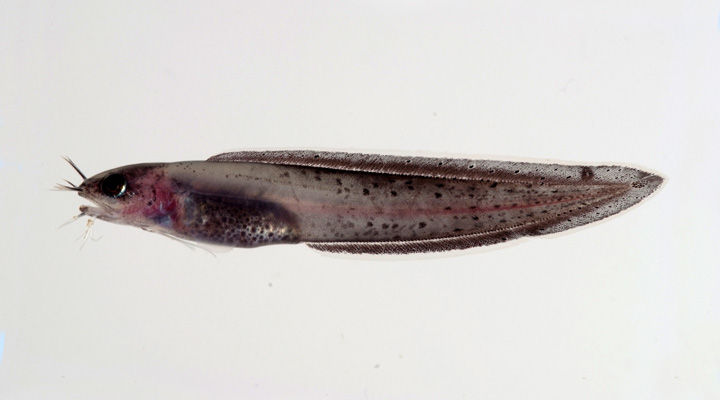
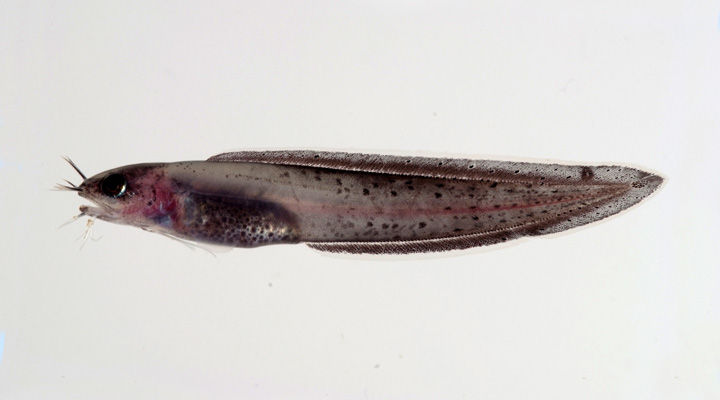
A juvenile Bearded Cusk, Brotula multibarbata, from Palau. Source: Jeff Williams / Smithsonian National Museum of Natural History. License: CC BY Attribution-Noncommercial-ShareAlike
Summary:
A dusky brown to greyish-brown. to dark brown cusk eel becoming paler on the abdomen, with a sub-marginal black band, a narrow white margin on the dorsal and anal fins, and 6 barbels on the snout and 6 on the chin. Small juveniles are paler overall and somewhat transparent, with dark spots.
Cite this page as:
Bray, D.J. 2025, Brotula multibarbata in Fishes of Australia, accessed 16 Oct 2026, https://fishesofaustralia.net.au/home/species/4577
Bearded Cusk, Brotula multibarbata Temminck & Schlegel 1847
More Info
|
Distribution |
Ningaloo Reef, Western Australia, around the tropical north to Sydney, New South Wales; also Cocos (Keeling) Islands and Christmas Island in the eastern Indian Ocean, Ashmore Reef in the Timor Sea, and the Lord Howe Province in the Tasman Sea. Elsewhere the species occurs in the Indo-west-central Pacific. A nocturnal species that inhabits crevices and caves of shallow lagoons and seaward reefs on the continental shelf and upper slope. Larvae and juveniles are epipelagic in oceanic waters far offshore. |
|
Features |
Dorsal fin 117-123; Anal fin 88-100; Pectoral fin 22-26; Pelvic fin 2; Developed gill rakers in first arch 4 or fewer; Branchiostegal rays 8; Barbels 12, 6 on snout, 6 on chin. Body elongate, tapering posteriorly, depth 4.4-7.0 in SL; head narrower than body; eye large, equal to or larger than width of fleshy interorbital; fine teeth present on jaws; adults with vomerine teeth in somewhat broad V-shaped band, juveniles with very narrow tooth bands on vomer and palatines. Body completely covered with small cycloid (smooth) scales. Dorsal and anal fins long, continuous with caudal fin; pelvic fins inserted at about level of preopercle, well behind eye, outer half of each ray free from membrane. |
|
Size |
~100 cm TL |
|
Feeding |
Feeds on fishes and crustaceans. |
|
Etymology |
The specific name is from the Latin multi- (= many) and barbata (= bearded), presumably in reference to the barbels on the chin and snout. |
|
Species Citation |
Brotula multibarbata Temminck & Schlegel 1846, Fauna Japonica Parts 10-14: 251, Pl. 111 (fig. 2). Type locality: Shimabara, Ariake Sea, Nagasaki Prefecture, Japan |
|
Author |
Bray, D.J. 2025 |
|
Resources |
Bearded Cusk, Brotula multibarbata Temminck & Schlegel 1847
References
Allen, G.R. 1993. Fishes of Ashmore Reef and Cartier Island. Records of the Western Australian Museum, Supplement 44: 67-91
Allen, G.R. 1997. Marine Fishes of Tropical Australia and South-east Asia. Perth : Western Australian Museum 292 pp. 106 pls.
Allen, G.R. & Erdmann, M.V. 2012. Reef fishes of the East Indies. Perth : Tropical Reef Research 3 vols, 1260 pp.
Allen, G.R., Hoese, D.F., Paxton, J.R., Randall, J.E., Russell, B.C., Starck, W.A., Talbot, F.H. & Whitley, G.P. 1976. Annotated checklist of the fishes of Lord Howe Island. Records of the Australian Museum 30(15): 365-454 figs 1-2
Allen, G.R. & Smith-Vaniz, W.F. 1994. Fishes of Cocos (Keeling) Islands. Atoll Research Bulletin 412: 1-21
Allen, G.R., Steene, R.C. & Orchard, M. 2007. Fishes of Christmas Island. Christmas Island : Christmas Island Natural History Association 2 edn, 284 pp.
Allen, G.R. & Swainston, R. 1988. The Marine Fishes of North-Western Australia. A field guide for anglers and divers. Perth, WA : Western Australian Museum vi 201 pp., 70 pls.
Boeseman, M. 1947. Revision of the fishes collected by Burger and van Siebold in Japan. Zoologische Mededelingen (Leiden) 28: 1-242 pls 1-5
Choat, J.H., van Herwerden, L., Robbins, W.D., Hobbs, J.P. & Ayling, A.M. 2006. A report on the ecological surveys undertaken at Middleton and Elizabeth Reefs, February 2006. Report by James Cook University to the Department of the Environment and Heritage. 65 pp.
Francis, M. 1993. Checklist of the coastal fishes of Lord Howe, Norfolk, and Kermadec Islands, southwest Pacific Ocean. Pacific Science 47(2): 136-170 figs 1-2
Günther, A. 1862. Catalogue of the Fishes in the British Museum. Catalogue of the Acanthopterygii Pharyngognathi and Anacanthini in the collection of the British Museum. London : British Museum Vol. 4 534 pp. (described as Brotula ensiformis, type locality Aneiteum Island, Vanuatu)
Hobbs, J-P.A., Newman, S.J., Mitsopoulos, G.E.A., Travers, M.J., Skepper, C.L., Gilligan, J.J., Allen, G.R., Choat, H.J. & Ayling, A.M. 2014. Checklist and new records of Christmas Island fishes: the influence of isolation, biogeography and habitat availability on species abundance and community composition. Raffles Bulletin of Zoology Supplement 30: 184–202
Hobbs, J-P.A., Newman, S .J., Mitsopoulos, G.E.A., Travers, M.J., Skepper, C.L., Gilligan, J.J., Allen, G.R., Choat, H.J. & Ayling, A.M. 2014. Fishes of the Cocos (Keeling) Islands: new records, community composition and biogeographic significance. Raffles Bulletin of Zoology Supplement 30: 203–219
Kuiter, R.H. 1996. Guide to Sea Fishes of Australia. A comprehensive reference for divers and fishermen. Sydney, NSW, Australia : New Holland Publishers xvii, 434 pp.
Larson, H.K., Williams, R.S. & Hammer, M.P. 2013. An annotated checklist of the fishes of the Northern Territory, Australia. Zootaxa 3696(1): 1-293
Nielsen, J.G., Cohen, D.M., Markle, D.F. & Robins, C.R. 1999. Ophidiiform Fishes of the World. An annotated and illustrated catalogue of pearlfishes, cusk-eels, brotulas and other ophidiiform species known to date. FAO Fisheries Synopsis No. 125 Vol. 18. 178 pp.
Nielsen, J.G. & Cohen, D.M. 1986. Family No. 96: Ophidiidae. pp. 345-350 in Smith, M.M. & Heemstra, P.C. (eds). Smith's Sea Fishes. Johannesburg : Macmillan South Africa xx + 1047 pp. 144 pls.
Nielsen. J.G. 1999. Families Carapidae, Ophidiidae, Bythitidae, Aphionidae. pp. 1978-1985 in Carpenter, K.E. & Niem, V.H. (eds). The Living Marine Resources of the Western Central Pacific. FAO Species Identification Guide for Fisheries Purposes. Rome : FAO Vol. 3 pp. 1397-2068.
Okiyama, M., Leis, J.M. & Rennis. D.S. 2000. Ophidiidae (Cusk Eels). pp. 108-112 in Leis, J.M. & Carson-Ewart, B.M. The larvae of Indo-Pacific coastal fishes. An identification guide to marine fish larvae. Fauna Malesiana Handbooks Leiden : Brill Vol. 2 870 pp.
Randall, J.E., Allen, G.R. & Steene, R. 1990. Fishes of the Great Barrier Reef and Coral Sea. Bathurst : Crawford House Press 507 pp. figs.
Temminck, C.J. & Schlegel, H. 1847. Pisces. 248-289 pls 111-128, 129 (in part) in Siebold, P. Fr de (ed.). Fauna Japonica. Leyden : Apud Arnz & Socios Vol. 4(14, 15).
Uiblein, F., Ho, H., Everett, B., Matiku, P. & Sithole, Y. 2020. Brotula multibarbata. The IUCN Red List of Threatened Species 2020: e.T46076701A46664274. https://dx.doi.org/10.2305/IUCN.UK.2020-1.RLTS.T46076701A46664274.en. Accessed on 21 October 2025.