Barhead Pipefish, Microphis leiaspis (Bleeker 1854)
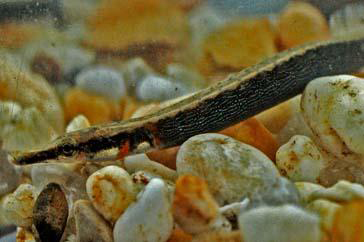
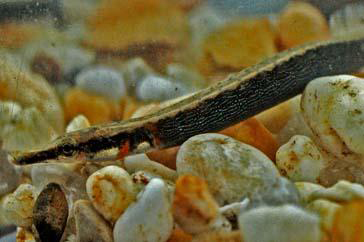
A Barhead Pipefish, Microphis leiaspis, in an aquarium. Source: Frank M. Greco / FishBase. License: CC by Attribution-NonCommercial
Summary:
Males are plain brownish to greyish, becoming paler below, without distinctive markings. Females have an orange to reddish chin and gill cover, and fine pale blue/aqua or green reticulations on the body.
Cite this page as:
Bray, D.J. 2025, Microphis leiaspis in Fishes of Australia, accessed 29 Sep 2026, https://fishesofaustralia.net.au/home/species/5790
Barhead Pipefish, Microphis leiaspis (Bleeker 1854)
More Info
|
Distribution |
Australian Wet Tropics, including the Cape Tribulation area and just south of Cairns, Queensland. Elsewhere the species occurs in the East-Indo-west Pacific, from Indonesia east to Fiji, north to southern Japan, south To New Caledonia. The Barhead Pipefish is amphidromous, with adults found in the lower-mid course of short, steep, coastal rainforest streams, in association with pebble fields. |
|
Features |
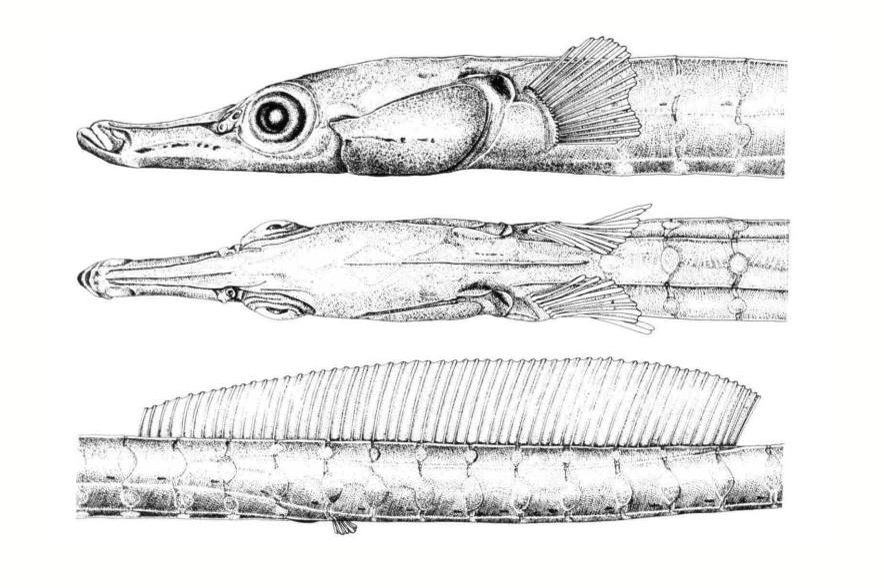
Dorsal fin 53- 60; Pectoral fin 17-20; Caudal fin 9; Trunk rings 17-18; Tail rings 31-33; Subdorsal rings 11.5-13, subdorsal trunk rings 3.5-4, subdorsal tail rings 8-9. Snout length 4-5 %SL. Opercle without ridges. Lateral and inferior trunk ridges indistinct. Superior trunk and tail ridges discontinuous; lateral trunk ridge confluent with inferior tail ridge under the dorsal fin, tail rings inferior to ring 33. Brood pouch beneath the tail of males. Caudal fin well-developed. Brood-pouch plates present, pouch folds absent. |
|
Size |
|
|
Feeding |
Feeds on microscopic benthic invertebrates. Although individuals may forage as a moving group, more often they forage individually, regularly checking in with other members of the group. |
|
Biology |
Inhabits and breeds in lowland reaches of streams. Ebner et al. (2023) report that the species is most commonly found in the larger streams of the Cape Tribulation region, and individuals appear to be social. Males mature at 105-125 mm SL, and females mature at 130 mm. Females deposit their eggs in the brood pouch on the abdomen of the male, where the embryos are incubated until being released as larvae. At Okinawa Island, Japan, drifting newly hatched larvae were collected with a plankton net mostly after dusk in the lower freshwater reaches of a stream each month from spring to fall (Maeda & Tashihara 2010). |
|
Remarks |
Individuals hook and press their tail around small pebbles or rocks, allowing them to maintain or change position in the fast-flowing stream. They are site-attached, usually occurring in loose groups on a pebble-cobble benthos of about 5-30 m in area. |
|
Species Citation |
Syngnathus leiaspis Bleeker 1854, Verhandelingen van het Bataviaasch Genootschap van Kunsten en Wetenschappen: 20. Type locality: Batavia (Jakarta, Java, Indonesia) |
|
Author |
Bray, D.J. 2025 |
|
Resources |
Barhead Pipefish, Microphis leiaspis (Bleeker 1854)
References
Allen, G.R. 1991. Field Guide to the Freshwater Fishes of New Guinea. Madang : Christensen Research Institute 268 pp.
Allen, G.R., Hortle, K.G. & Renyaan, S.J. 2000. Freshwater fishes of the Timika region, New Guinea. Timika (PT Freeport Indonesian Company, Timika Environmental Laboratory). i-ix + 1-175.
Bleeker, P. 1854. Bijdrage tot de kennis der Troskieuwige visschen van den Indischen Archipel. Verhandelingen van het Bataviaasch Genootschap van Kunsten en Wetenschappen 25(6): 1-30. https://www.biodiversitylibrary.org/part/12859
Dawson, C.E. 1984. Revision of the genus Microphis Kaup (Pisces, Syngnathidae). Bulletin of Marine Science 35(2): 117-181. See ref online
Dawson, C.E. 1985. Indo-Pacific Pipefishes (Red Sea to the Americas). Ocean Springs (Mississippi) : Gulf Coast Research Laboratory 230 pp. 293 figs.
Ebner, B.C., Maeda, K., Donaldson, J.A., Harasti, D., Lord, C., Haÿ, V., Heffernan, J., Starrs, D., Thuesen, P., Beatty, S., Boseto, D., Copeland, L.K. F., Rashni, B., Hevalao, R.S., & Keith, P. 2023. Pebbled places preferred by people and pipefish in a World Heritage protected area. Cybium 47(4): 401-416. https://doi.org/10.26028/CYBIUM/2023-039
Ebner B.C. & Thuesen P.A. 2010. Discovery of stream-cling-goby assemblages (Stiphodon species) in the Australian wet tropics. Australian Journal of Zoology 58: 331-340. https://doi.org/10.1071/ZO 10061 (as Dorichthys sp.)
Haÿ, V., Mennesson, M.I., Keith, P. & Lord, C. 2022. A new species of freshwater pipefish (Teleostei: Syngnathidae: Coelonotus) from Papua New Guinea. Cybium 45(4): 275-282. https://doi.org/10.26028/cybium/2021-454-003 (as Coelonotus leiaspis)
Haÿ, V., Mennesson, M.I., Lord, C. & Keith, P. 2023. Why several when one can unite them all? Integrative taxonomic revision of Indo-Pacific freshwater pipefish (Nerophinae). Zoological Journal of the Linnean Society 198(4): 923-956 https://doi.org/10.1093/zoolinnean/zlad007
Ishihara T. & Tachihara K. 2008. Reproduction and early development of a freshwater pipefish Microphis leiaspis in Okinawa-jima Island, Japan. Ichthyological Research 55(4): 349-355. https://doi.org/10.1007/s10228-008-0049-y
Jenkins, A., Kullander, F.F., Tan, H.H., Sparks, J.S. & Pollom, R. 2017. Microphis leiaspis. The IUCN Red List of Threatened Species 2017: e.T169358A58318427. https://dx.doi.org/10.2305/IUCN.UK.2017-2.RLTS.T169358A58318427.en. Accessed on 14 December 2025.
Keith, P., Boseto, D. & Lord, C. 2021. Freshwater Fish of the Solomon Islands. Paris, France : Société Francaiçe d'Ichtyologie, 173 pp. (as Coelonotus leiaspis)
Kottelat, M., Whitten, A.J., Kartikasari, S.N. & Wirjoatmodjo, S. 1993. Freshwater fishes of Western Indonesia and Sulawesi. Hong Kong : Periplus Editions. 221 pp.
Kuiter, R.H. 2009. Seahorses and their relatives. Seaford, Australia : Aquatic Photographics 331 pp.
Maeda K. & Tachihara K. 2010. Diel and seasonal occurrence patterns of drifting fish larvae in the Teima Stream, Okinawa Island. Pacific Science 64(2): 161-176. https://doi. org/10.2984/64.2.161
Myers, R.F., Burdick, D.R., Mundy, B.C., Lindfield, S.J., et al. 2025. New and recent records of fishes from the Mariana Islands, western Pacific Ocean. Journal of the Ocean Science Foundation 42: 15-90. https://doi.org/10.5281/zenodo.14750902 (as Coelonotus leiaspis)
Paulus, T. 1999. Family Syngnathidae. pp 2264-2276 in Carpenter K.E. & Niem, V.H. (eds) The Living Marine Resources of the Western Central Pacific. FAO Species Identification Guide For Fisheries Purposes. FAO Vol. 4. pp 2069-2790.
Thuesen P.A., Ebner B.C., Larson H., Keith P., et al. 2011. Amphidromy links a newly documented fish community of Continental Australian streams, to Oceanic Islands of the west Pacific. PLoS ONE, 6: e26685. https://doi.org/10.1371/journal.pone.0026685 (as Dorichthys sp.)