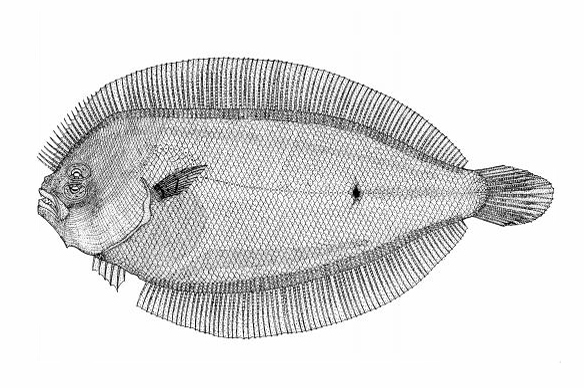
Armstrong's Flounder, Caulopsetta armstrongi Scott 1975
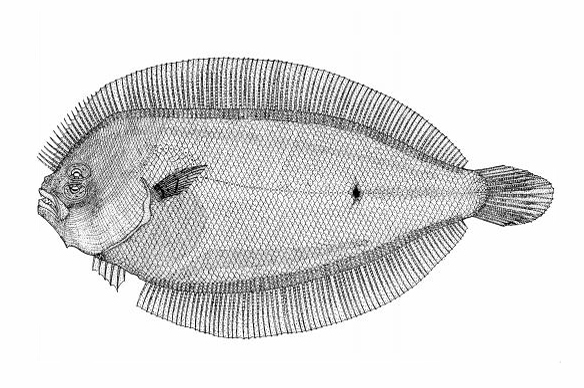
Illustration of the holotype of Armstrong's Flounder, Arnoglossus armstrongi, from Bridport, Tasmania, QVM 1974:5:0168. Source: Fig. 2, in Scott (1975) Papers and Proceedings of the Royal Society of Tasmania 109: 127-173 / University of Tasmania. License: CC BY Attribution
Summary:
Armstrong's Flounder is known only from the holotype, a poorly preserved specimen. Some authors have considered this species to be a junior synonym of Mueller's Flounder, Caulopsetta muelleri.
This species was previously known as Arnoglossus armstrongi.
This species was previously known as Arnoglossus armstrongi.
Cite this page as:
Bray, D.J. 2026, Caulopsetta armstrongi in Fishes of Australia, accessed 18 Oct 2026, https://fishesofaustralia.net.au/home/species/937
Armstrong's Flounder, Caulopsetta armstrongi Scott 1975
More Info
|
Distribution |
Known only from the type locality: off Bridport, Tasmania. |
|
Features |
Dorsal fin 98; Anal fin 74; Pectoral fin 12; Pelvic fin 6; Caudal fin 17 (3 upper, 2, ?3, lower, rays simple). Lateral line (tubed scales) 91 (22 in anterior curved segment, 58 in horizontal segment to hypural, 11, becoming progressively smaller, on caudal). Anterior dorsal profile rising; body depth 2.2, head 3.8 in length without caudal. Barely notched in front of eyes, but decidedly concave. Scales ctenoid on ocular side, cycloid on blind side. Lateral line on left side only; curved over pectoral, no supratemporal branch. Gill rakers low, broad, partly spinulate ('palmate'). Dorsal- and anal-fin rays with scales on ocular, not on blind side. |
|
Remarks |
Gomon (1994) considered this species to be a junior synonym of Mueller's Flounder, Arnoglossus muelleri. A. armstrongi is known only from the holotype. Although live coloration of this species is unknown, the dark marking on the rear of the body is similar to that of A. muelleri. |
|
Etymology |
The type specimen was caught “...by Mr Philip Armstrong, in whose honour the species is named.” |
|
Species Citation |
Arnoglossus armstrongi Scott 1975, Papers and Proceedings of the Royal Society of Tasmania 109: 159, fig. 2. Type locality: Bridport, northern Tasmania. |
|
Author |
Bray, D.J. 2026 |
|
Resources |
Armstrong's Flounder, Caulopsetta armstrongi Scott 1975
References
Amaoka, K., Arai, M. & Gomon, M.F. 1997. A new species of Arnoglossus (Pleuronectiformes: Bothidae) from the southwestern coast of Australia. Ichthyological Research 44(2): 131-136 figs 1-3 https://doi.org/10.1007/BF02678692 (as Arnoglossus armstrongi)
Amaoka, K., Matsuura, K. & Carpenter, K.E. 2020. Arnoglossus armstrongi. The IUCN Red List of Threatened Species 2020: e.T143819132A143844382. https://dx.doi.org/10.2305/IUCN.UK.2020-1.RLTS.T143819132A143844382.en. Accessed on 21 January 2025. (as Arnoglossus armstrongi)
Gomon, M.F. 1994. Family Bothidae. pp. 844-850, figs 747-752 in Gomon, M.F., Glover, C.J.M. & Kuiter, R.H. (eds). The Fishes of Australia's South Coast. Adelaide : State Printer 992 pp. 810 figs. (as a synonym of Arnoglossus muelleri)
Last, P.R., Scott, E.O.G. & Talbot, F.H. 1983. Fishes of Tasmania. Hobart : Tasmanian Fisheries Development Authority 563 pp. figs. (as Arnoglossus armstrongi)
Scott, E.O.G. 1975. Observations on some Tasmanian fishes. Part 21. Papers and Proceedings of the Royal Society of Tasmania 109: 127-173 figs 1-2 https://doi.org/10.26749/rstpp.109.127 (as Arnoglossus armstrongi)
Tongboonkua, P., Chanet, B. & Chen, W.-J. 2026. Integrated molecular and morphological analyses resolve long-standing classification challenges in the sinistral flatfish family Bothidae (Teleostei: Carangiformes). Zoologica Scripta 55: 15-36. https://doi.org/10.1111/zsc.70020