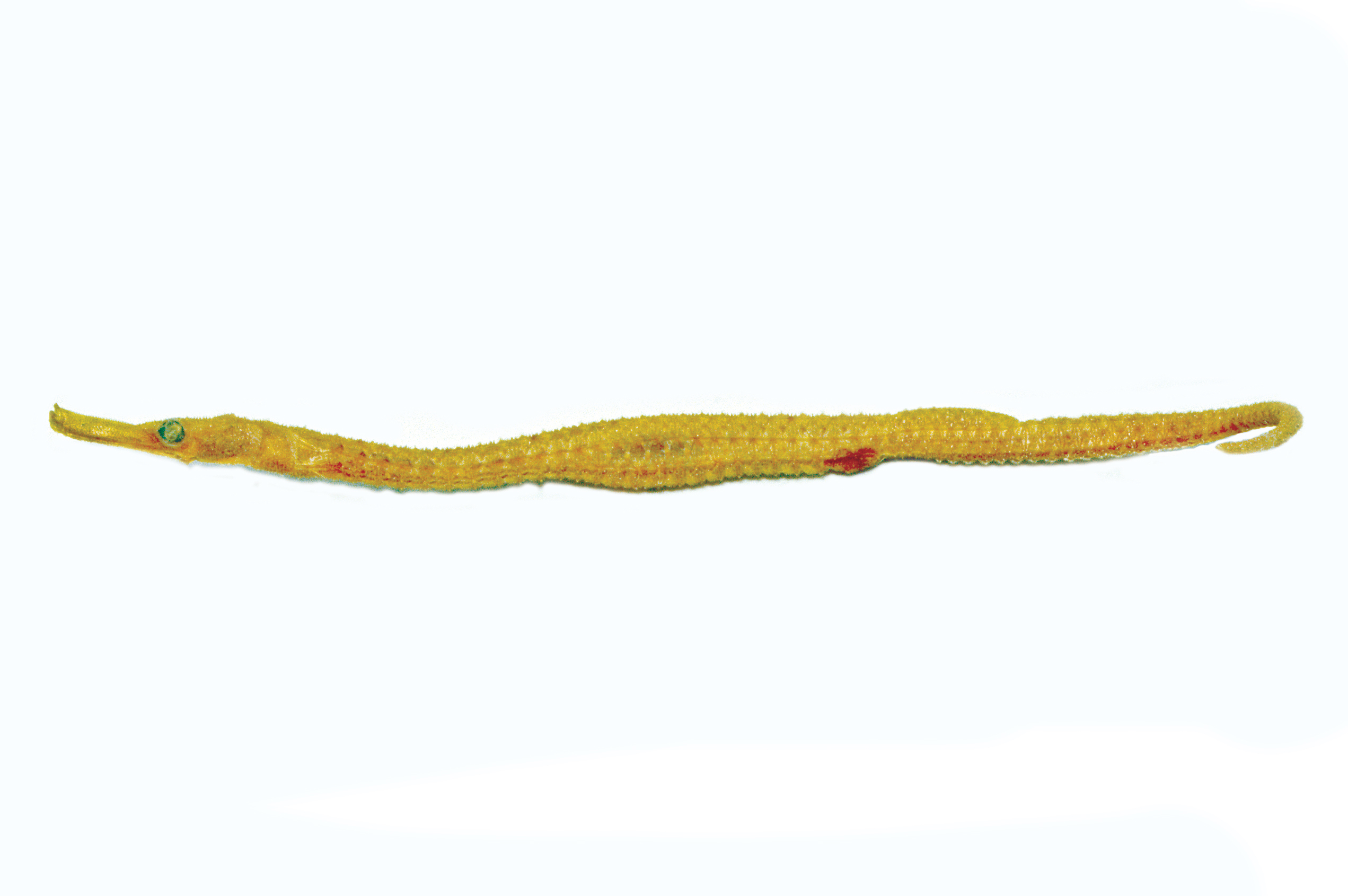
Robust Pipehorse, Solegnathus robustus McCulloch 1911

A Robust Pipehorse, Solegnathus robustus, from off South Australia, depth 200 m. Source: Australian National Fish Collection, CSIRO / Marine National Facility. License: All rights reserved
A rare pipehorse, endemic to South Australian waters. Little is known of the biology of this species.
Robust Pipehorse, Solegnathus robustus McCulloch 1911
More Info
|
Distribution |
Endemic to temperate waters of South Australia, with a limited distribution from Port Weyland, Spencer Gulf westwards to Flinders Island, in 30-68m. Specimens have occasionally been washed ashore after storms. A 2008 report of two specimens of the Spiny Pipehorse taken in giant crab pots in the Victorian Giant Crab fishery in 70-90m cannot have be verified. Although there is no habitat information for this species, pipehorses use their prehensile tails to cling to structures on the seafloor. |
|
Features |
Dorsal fin 30-34; Pectoral fin 23-25; trunk rings 25-27; tail rings 47-51; total rings 73-78; total subdorsal rings 8-9.5 Superior trunk and tail ridges discontinuous near rear end of dorsal-fin base; confluent lateral trunk and tail ridges continuous with superior tail ridge. Snout moderately deep, depth less than 5 in snout length; anterior post-dorsal part of tail strongly oval in cross-section; ssupplemental ridges between elevated median ridge on scutella and principal body ridges. Opercular membrane with spinous platelets on sides and ventral surface; body surfaces clearly spinulose; with a short, strong spine under upper 5~8 pectoral-fin rays. Head length about 6.3-7.6 in total length; dorsal surface of trunk and anterior half of tail strongly convex; body surfaces densely spinulose; strong short spine under pectoral fin. |
|
Size |
Maximum length to at least 35 cm. |
|
Colour |
In preservative – pale with no prominent markings. Some specimens with dusky to dark brown shading on lower half of last 2-3 trunk rings. Recently preserved specimens have diffuse dusky shading on side of snout , dorsal surface and upper parts of sides peppered with tiny light brown spots; dorsal surface with minute bilateral spots around the bases of the median marginal spiones on the superior ridges of some rings. |
|
Feeding |
Unknown – pipehorses use their prehensile tails to cling to structures on the seafloor, feeding on drifting crustaceans and other zooplankton. |
|
Biology |
The smallest examined brooding male measured 314 mm total length. |
|
Fisheries |
Although most specimens have been taken as incidental bycatch in trawls (one specimen was collected in a dredge sample, and others may be collected in cray pots or crab pots), the species is of no interest to fisheries or aquaculture. Several other members of the genus Solegnathus are sold dried in the Traditional Chinese Medicine Industry. |
|
Conservation |
IUCN: Least Concern |
|
Remarks |
|
|
Similar Species |
Solegnathus robustus is most similar to S. spinosissimus, differing in having a deeper snout (Snout depth 3.7~4.5 in snout length versus 5.6~10.1 in snout length), anterior part of tail strongly oval in cross-section (versus not strongly oval in cross-section), body rings with short ridges between the principal ridges and an elevated median ridge on each scutella (versus the body rings without short longitudinal ridges between the principal ridges and no elevated median ridge on each scutella). The combination of bony platelets on the sides and ventral surface of the opercular membrane, a strong spine under the pectoral fin, ridged scutella, spinulose body surfaces and low numbers of dorsal fin rays (30-34 vs 37-51) distinguishes S. robustus from all other members of the genus Solegnathus except for S. spinosissimus. |
|
Etymology |
The specific name is from the Latin robustus (= thick, stout), most likely in reference to the “broad snout and very thick tail” of this species. |
|
Species Citation |
Solegnathus robustus McCulloch 1911, Zool. (Biological) Results. Endeavour 1(1): 28, pl. 9(2). Type locality: Off Flinders Island, 134°30'E, South Australia, 37 fathoms. |
|
Author |
Bray, D.J. 2025 |
|
Resources |
Robust Pipehorse, Solegnathus robustus McCulloch 1911
References
Dawson, C.E. 1982. Synopsis of the Indo-Pacific genus Solegnathus (Pisces: Syngnathidae). Japanese Journal of Ichthyology 29(2): 139-160.
Dawson, C.E. 1985. Indo-Pacific Pipefishes (Red Sea to the Americas). Gulf Coast Research Laboratory, Ocean Springs, Mississippi, USA, 230pp.
Kuiter, R.H. 2008. Family Syngnathidae pp. 448–479 in Gomon, M.F., D.J. Bray & R.H. Kuiter. (Eds.) Fishes of Australia's Southern Coast. New Holland Press & Museum Victoria, Melbourne, Australia, 928 pp.
Kuiter, R.H. 2009. Seahorses and their relatives. Aquatic Photographics, Seaford, Australia. Pp. 1–333.
Martin-Smith, K.M. & Vincent, A.C.J. 2006. Exploitation and trade of Australian seahorses and their relatives (syngnathids). Oryx 40(2): 141-151.
Martin-Smith, K.M., Lam, T.F.-N. & Lee, S.K.-H. 2003. Trade in Pipehorses Solegnathus spp. for Traditional Medicine in Hong Kong. Traffic Bulletin 19: 139–148.
McCulloch, A.R. 1911. Report on the fishes obtained by the F.I.S. Endeavour on the coasts of New South Wales, Victoria, South Australia and Tasmania. Part 1. Zoological (Biological) Results. Endeavour : 1–87. See ref at BHL
Pollom, R. 2017. Solegnathus robustus. The IUCN Red List of Threatened Species 2017: e.T20317A67623270. https://dx.doi.org/10.2305/IUCN.UK.2017-3.RLTS.T20317A67623270.en. Accessed on 02 July 2025.
Vincent, A.C.J. 1996. The International Trade in Seahorses. TRAFFIC International, Cambridge, UK.