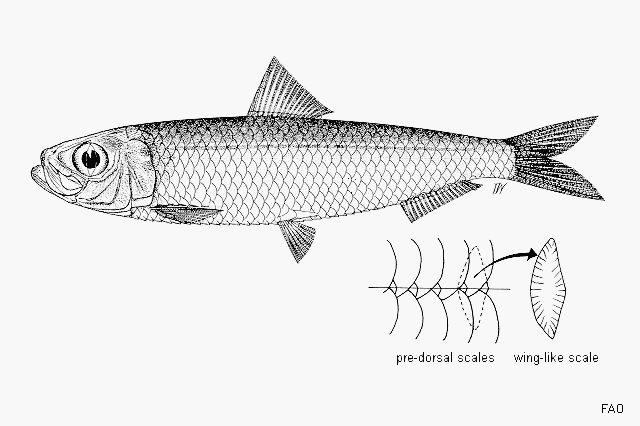
- Classification
- ACTINOPTERYGII
- CLUPEIFORMES
- CLUPEIDAE
- Herklotsichthys
- quadrimaculatus
Goldspot Herring, Herklotsichthys quadrimaculatus (Rüppell 1837)
Other Names: Bluestripe Herring, Fourspot Herring, Gold-spot Herring, Murray Island Sardine, Oily Herring, Small-spotted Herring
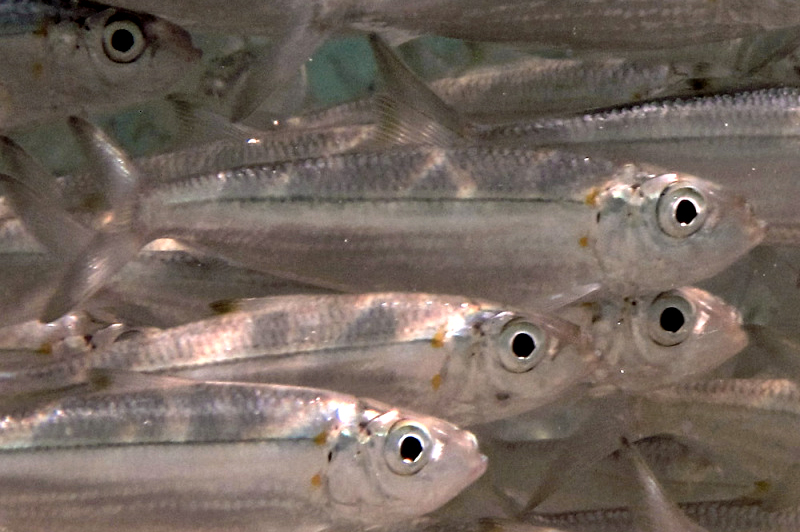
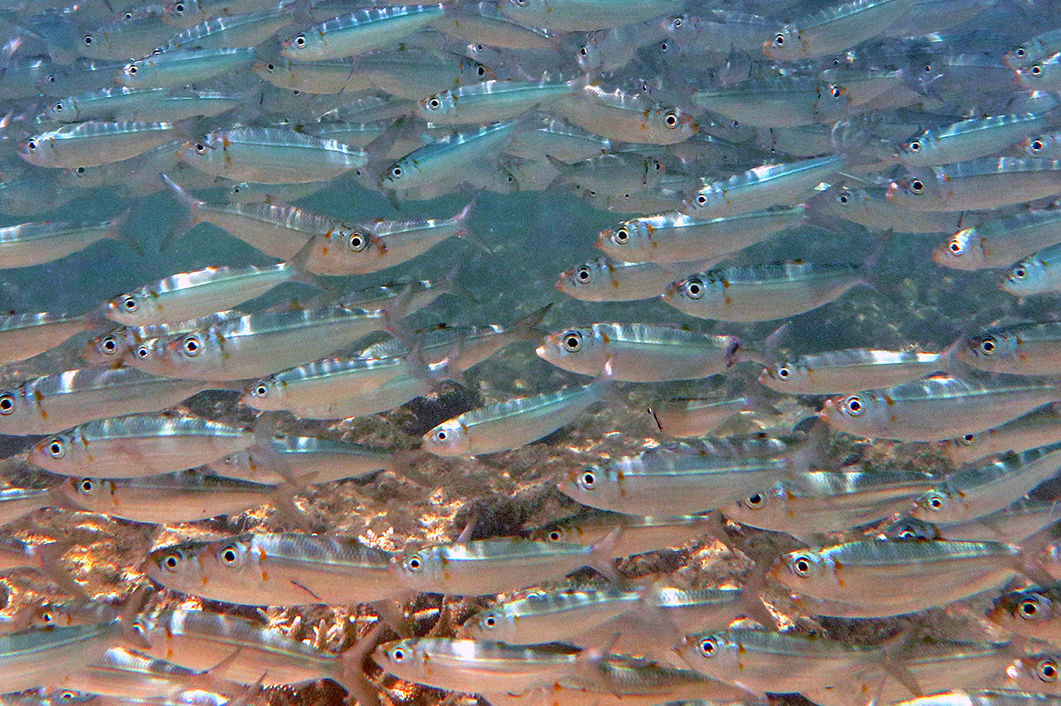
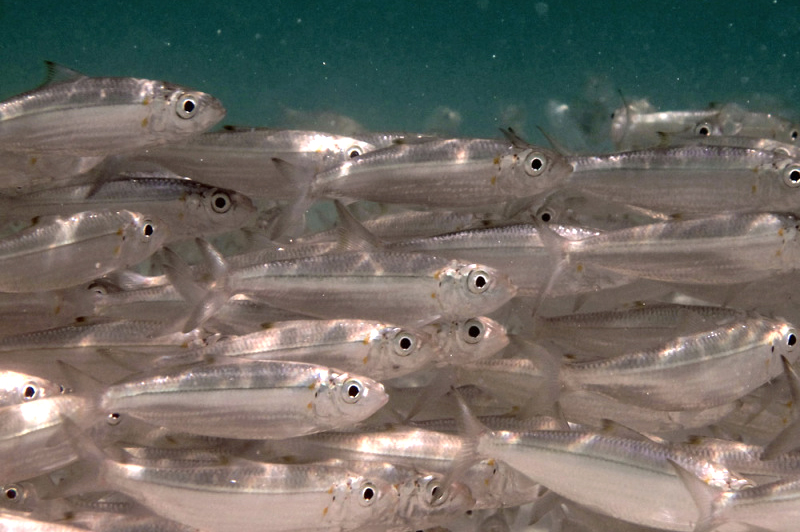
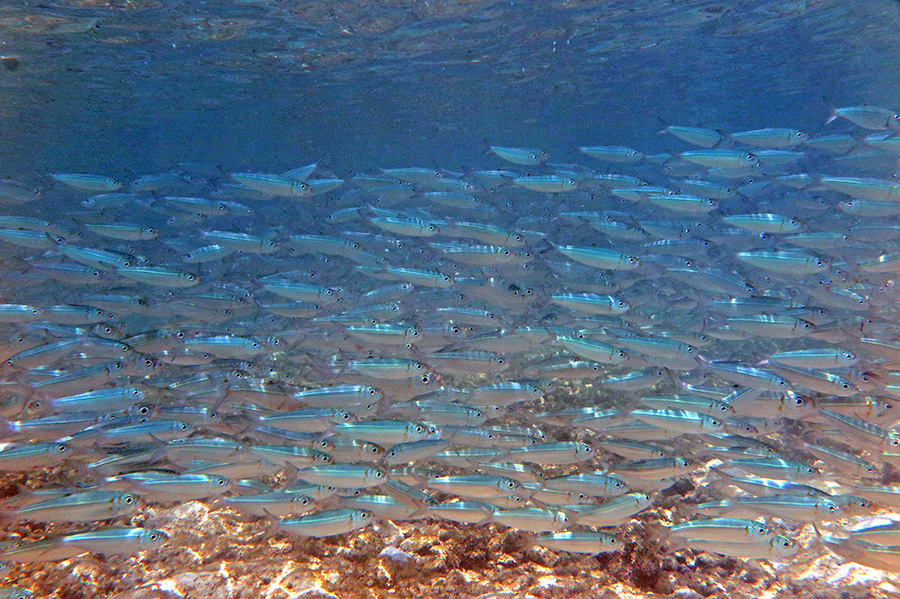
Goldspot Herring, Herklotsichthys quadrimaculatus, at Lizard Island, Great Barrier Reef, Queensland. Source: Mark Shepherd / Lizard Island Field Guide. License: CC by Attribution
Summary:
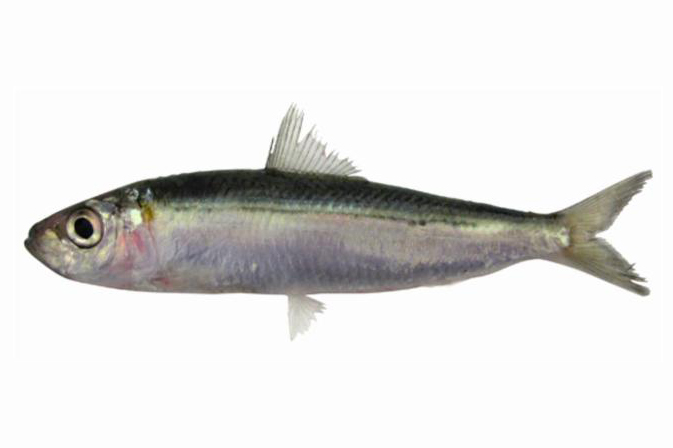
A bluish-green herring becoming silvery on the sides and below, with one to two orange-yellow spots just behind the gill cover (one above the other if two spots). The species has a prominent keel of scutes on the abdomen.
Cite this page as:
Bray, D.J. 2025, Herklotsichthys quadrimaculatus in Fishes of Australia, accessed 03 Sep 2026, https://fishesofaustralia.net.au/home/species/2056
Goldspot Herring, Herklotsichthys quadrimaculatus (Rüppell 1837)
More Info
|
Distribution |
Shark Bay, Western Australia, around the tropical north to the Magnetic Island, Queensland. Elsewhere, the species is widespread in the tropical, Indo-west Pacific, and was accidentally introduced to Hawaii. The species is pelagic in coastal waters. Adults form schools near mangroves, shallow protected coastal bays and lagoons during the day, before moving further offshore into deeper waters at night. |
|
Features |
Dorsal fin 17-20; Anal fin 17-19; Pectoral fin 15-16; Longitudinal scale series 38-45; ventral scutes 30-32; Gill rakers, lower limb 30-37. Body depth 3.1-3.9 in SL; transversely elongate wing-like scales present below the normal paired pre-dorsal scales; lower part of 2nd supramaxilla larger than upper part. |
|
Size |
Abdomen with a distinct keel of scutes; lower part of 2nd supramaxilla larger than upper; 30–36 lower gill rakers. Colour: Back blue-green; flanks silvery with 1 or 2 orange spots behind gill openi |
|
Feeding |
Feed mostly at night on zooplankton. Juveniles consume mostly copepods, while adults adults feed on larger prey such as chaetognaths, polychaete worms, shrimps and small fishes. Breeding occurs on the first year and individuals may only survive for a few months once mature. |
|
Fisheries |
Fished throughout much of its range. |
|
Etymology |
The specific name is from the Latin quadri– (= four) and maculatus (= spotted), presumably in reference to the orange spots immediately behind the gill opening - two on each side. |
|
Species Citation |
Clupea quadrimaculatus Rüppell 1837, Fische des Rothen Meeres 3: 78, pl. 21(3). Type locality: Bay of Massawa, Eritrea, Red Sea. |
|
Author |
Bray, D.J. 2025 |
|
Resources |
Goldspot Herring, Herklotsichthys quadrimaculatus (Rüppell 1837)
References
Allen, G.R. 1997. Marine Fishes of Tropical Australia and South-east Asia. Perth : Western Australian Museum 292 pp. 106 pls.
Allen, G.R. & Erdmann, M.V. 2012. Reef fishes of the East Indies. Perth : Tropical Reef Research 3 vols, 1260 pp.
Grant, E.M. 2002. Guide to Fishes. Redcliffe : EM Grant Pty Ltd 880 pp.
Munroe, T.A., Wongratana, T. & Nizinski, M.S. 1999. Family Clupeidae. pp. 1775-1821 in Carpenter, K.E. & Niem, V.H. (eds). The Living Marine Resources of the Western Central Pacific. FAO Species Identification Guide for Fisheries Purposes. Rome : FAO Vol. 3 pp. 1397-2068.
Ogilby, J.D. 1898. New species of Australian fishes. Proceedings of the Linnean Society of New South Wales 22(4): 759-761. (described as Harengula stereolepis, type locality Darnley Island, Torres Strait)
Randall, J.E., Allen, G.R. & Steene, R. 1997. Fishes of the Great Barrier Reef and Coral Sea. Bathurst : Crawford House Press 557 pp. figs.
Rüppell, W.P.E. 1837. Neue Wirbelthiere zu der Fauna von Abyssinien gehörig. Fische des Rothen Meeres. Frankfurt Vol. 3, pp. 53–80, pls 15–21. https://doi.org/10.5962/bhl.title.53778
Sainsbury, K.J., Kailola, P.J. & Leyland, G.G. 1985. Continental Shelf Fishes of Northern and North-Western Australia. Canberra : Fisheries Information Service 375 pp. figs & pls.
Santos, M., Deligero, R., Alcantara, M., Doyola, M.C., Gatlabayan, L.V., Villarao, M.C., Tambihasan, A.M., Lopez, G., Villanueva, J.A., Buccat, F.G.A., Parido, L., Lanzuela, N., Belga, P.B. & Gapuz, A.V. 2017. Herklotsichthys quadrimaculatus. The IUCN Red List of Threatened Species 2017: e.T57506640A58341331. https://dx.doi.org/10.2305/IUCN.UK.2017-3.RLTS.T57506640A58341331.en. Accessed on 30 September 2025.
Saville-Kent, W. 1889. Preliminary Report on the Food-fishes of Queensland. Brisbane : Government Printer 12 pp. 16 pls. (described as Clupea profundus, Clupea raneleyi, Clupea torresiensis - all nomena nuda)
Whitehead, P.J.P. 1985. FAO species catalog. Clupeoid fishes of the world (suborder Clupeoidei). Part 1 — Chirocentridae, Clupeidae and Pristigasteridae. FAO Fisheries Synopsis No. 125 Vol. 7 Pt 1. pp. 1-303