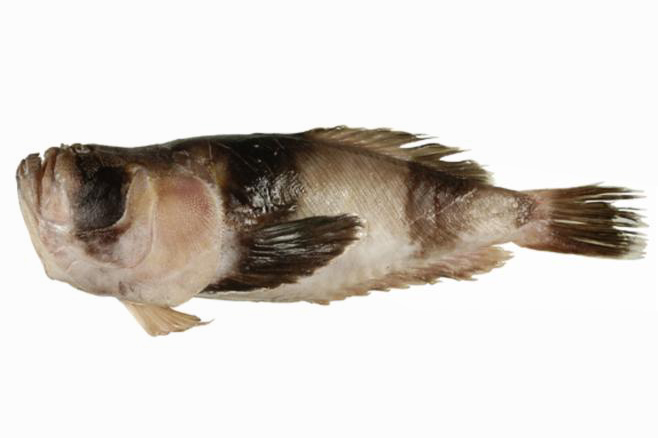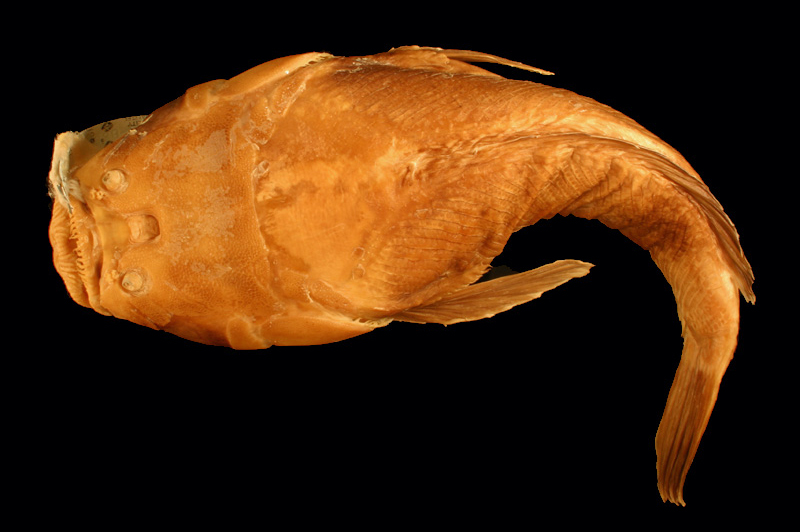
Fringe Stargazer, Ichthyscopus barbatus Mees 1960
Other Names: Fringed Stargazer
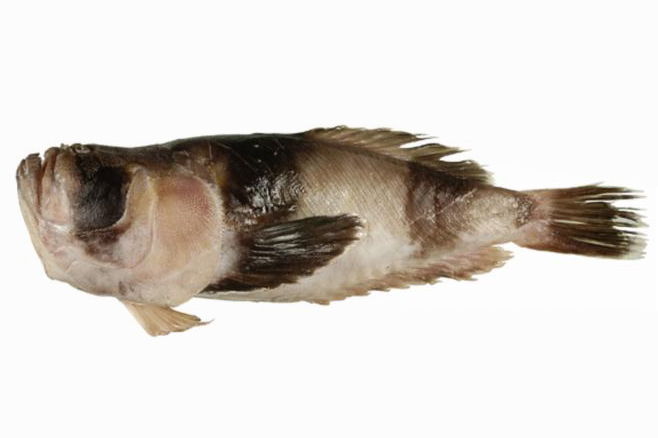
Fringe Stargazer, Ichthyscopus barbatus. Source: Australian National Fish Collection, CSIRO. License: CC By Attribution-NonCommercial
Summary:
A pale brown stargazer with a pinkish-white underside, the bony portion of head reddish brown, a dark brown cheek, two broad brown bands across the upper part of the body below the dorsal fin, first near origin and second near termination of fin, and a dark brown caudal fin. The lips have a prominent fleshy fringe, the chin is rounded with a pair of fleshy barbels, and lacks bony flaps.
Cite this page as:
Bray, D.J. 2025, Ichthyscopus barbatus in Fishes of Australia, accessed 15 Sep 2026, https://fishesofaustralia.net.au/home/species/2599
Fringe Stargazer, Ichthyscopus barbatus Mees 1960
More Info
|
Distribution |
Off Port Stephens, to south of Green Cape, New South Wales, and the Gulf St Vincent, South Australia, to off Perth, Western Australia. |
|
Features |
Dorsal fin 19; Anal fin 15-16; Pectoral fin 14; Pelvic fin I, 5; Caudal fin 12. Body deep (30-34% SL), of moderate length; head nearly round in cross section, body compressed posteriorly. Head large (30-36% SL), almost completely encased in bone; non-bony space between orbits narrow (9-16% HL); except for moderately large humeral spine, spines and bony ridges not developed; eyes small (12-16% HL), directed upward; mouth large, vertical; lips with prominent fleshy fringe; teeth in lower jaw of moderate size, slender, widely spaced, in one row, those in upper tiny, in narrow band; chin smoothly curved or wrinkled without bony flaps but with pair of fleshy barbels; humeral spine covered by skin with fleshy fringing below; opercle with fleshy fringe on free edge. Scales on body in about 42 well defined diagonal rows. Single, long based, continuous dorsal fin without spines, located posteriorly on body; anal fin with elongate base, rays increasing in length posteriorly; caudal fin rounded. Pectoral fins large. Pelvic fins fleshy, jugular, arising below eyes. |
|
Fisheries |
Occasionally taken by hook and line in sandy areas adjacent reefs. |
|
Similar Species |
The similar Blackfin Stargazer, Ichthyscopus nigripinnis, lacks chin barbels. |
|
Etymology |
The specific name is from the Latin barbatus (= bearded), in reference to the two small barbels on the chin |
|
Species Citation |
Ichthyscopus barbatus Mees 1960, Journal of the Royal Society of Western Australia 43(2): 49, figs 3-4, 5a. Type locality: Between Rottnest Island and the Stragglers, Western Australia, depth 25-30 feet. |
|
Author |
Bray, D.J. 2025 |
|
Resources |
Fringe Stargazer, Ichthyscopus barbatus Mees 1960
References
Gomon, M.F. 2008. Family Uranoscopidae. pp. 678-683 in Gomon, M.F., Bray, D.J. & Kuiter, R.H. (eds). Fishes of Australia's Southern Coast. Sydney : Reed New Holland 928 pp.
Gomon, M.F., Glover, C.J.M. & Kuiter, R.H. (eds) 1994. The Fishes of Australia's South Coast. Adelaide : State Printer 992 pp. 810 figs.
Gomon, M.F. & Johnson, J.W. 1999. A new fringed stargazer (Uranoscopidae: Ichthyscopus) with descriptions of the other Australian species in the genus. Memoirs of the Queensland Museum 43(2): 597-619 figs 1-9 https://www.biodiversitylibrary.org/part/50873
Hoschke, A., Whisson, G. & Moore, G.I. 2019. Complete list of fishes from Rottnest Island, pp. 150-161 in Whisson, G. & Hoschke, A. (eds). The Rottnest Island fish book. 2nd ed. Perth, Western Australia : Aqua Research and Monitoring Services..
Hutchins, J.B. & Swainston, R. 1986. Sea Fishes of Southern Australia. Complete field guide for anglers and divers. Perth : Swainston Publishing 180 pp.
May, J.L. & Maxwell, J.G.H. 1986. Trawl fish from temperate waters of Australia. Hobart, Tasmania : CSIRO Division of Fisheries Research, 492 pp.
Mees, G.F. 1960. The Uranoscopidae of Western Australia. Journal of the Royal Society of Western Australia 43(2): 46-58 figs 1-9 https://www.biodiversitylibrary.org/part/144475
Pietsch, T.W. 1989. Phylogenetic relationships of trachinoid fishes of the family Uranoscopidae. Copeia 1989(2): 253-303