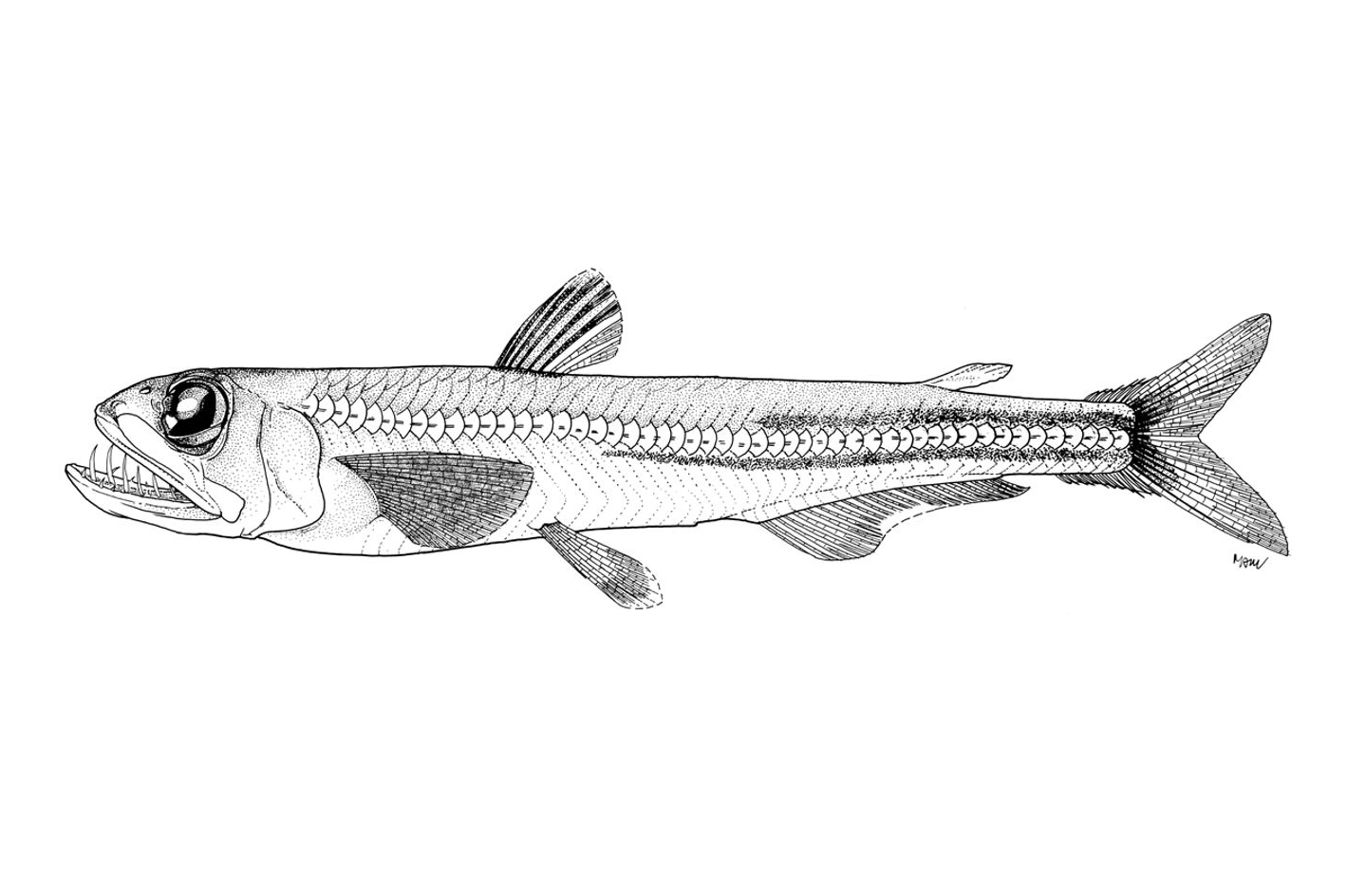
Shortfin Pearleye, Scopelarchus analis (Brauer 1902)
Other Names: Blackbelly Pearleye, Short Fin Pearleye
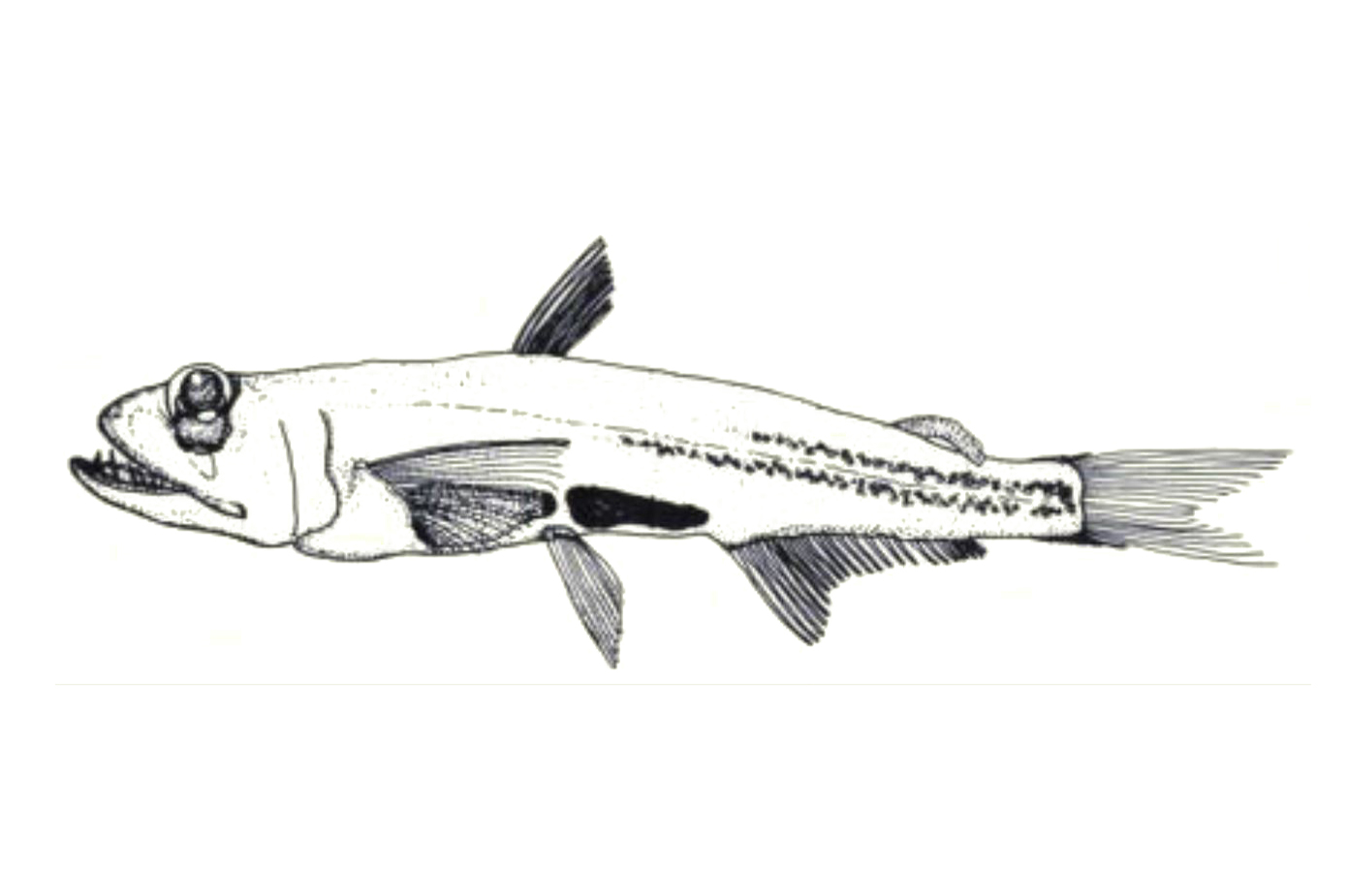
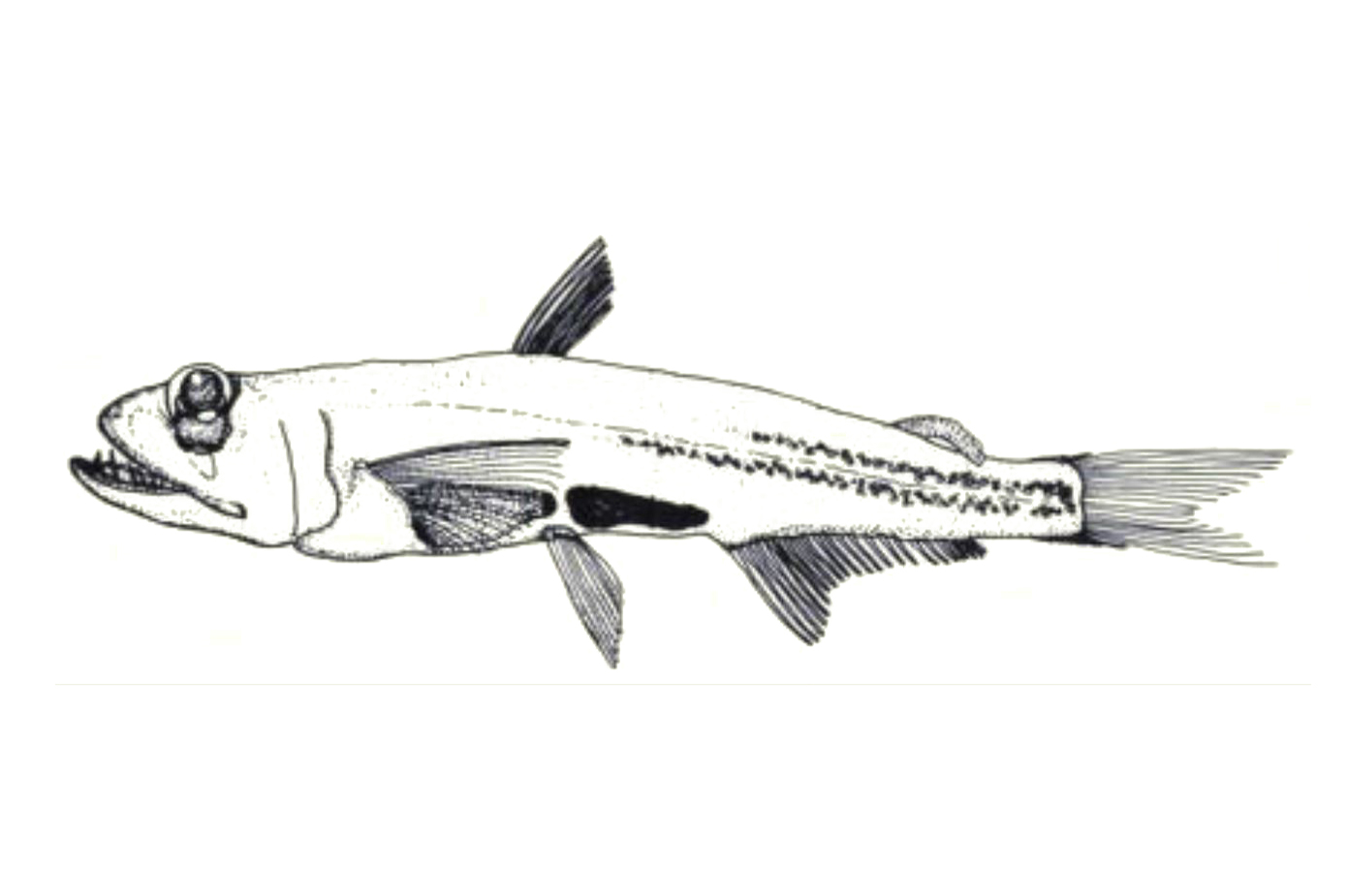
Illustration of a Shortfin Pearleye, Scopelarchus analis. Source: After Fig. 49A, in Johnson (1974) Fieldiana Zoology 66: 154 / Biodiversity Heritage Library. License: CC by Attribution-NonCommercial-ShareAlike
Summary:
A pearleye with dark pigment stripes above and below the lateral line extending forward from the caudal peduncle, a dark pectoral fin that is longer than the pelvic fin, and 22-25 anal-fin rays.
Cite this page as:
Bray, D.J. 2025, Scopelarchus analis in Fishes of Australia, accessed 15 Oct 2026, https://fishesofaustralia.net.au/home/species/2778
Shortfin Pearleye, Scopelarchus analis (Brauer 1902)
More Info
|
Distribution |
Off central New South Wales, and off Albany, Western Australia. Larvae have also been collected in the upper 200 m along the 110 meridian. Elsewhere the species is circumglobal in tropical and temperate waters. Larvae and juveniles have been collected in the upper 200 m, while adults usually occur in deeper waters. |
|
Features |
Dorsal fin 7-9; Anal fin 21-26; Pectoral fin 18-22; Branchiostegal rays 8; Lateral line scales 45-50; Vertebrae 44-49. Body moderately short, moderately deep, with moderately deep caudal peduncle. Head length >20% S.L; snout length greatly exceeding eye diameter; eye lacking rounded lobe of pigment over lens. Pectoral fin reaching to or slightly beyond pelvic-fin origin, but not reaching anal-fin origin. |
|
Feeding |
Pearleyes use their dorsally-directed tubular eyes to search for prey above them in the water column. |
|
Biology |
Synchronous hermaphrodites with ovotestes containing functional male and female reproductive tissue. |
|
Remarks |
Scopelarchus analis has highly modified eyes that are cylindrical and dorsally-directed, providing binocular vision of objects above. The eye contains multiple retinae - a main retina at the base of the cylinder, an accessory retina along the nasal wall, and a retinal diverticulum separating the two. The main retina enables the formation of a focused image, while the accessory retina provides gross light perception. |
|
Similar Species |
The Shortfin Pearleye differs from Scopelarchus guentheri in having pigment present on the pectoral fins vs. absent, and 21-26 anal-fin rays (usually 22-25) vs. 24-29 anal rays (usually 25-28). |
|
Etymology |
The specific name is from Latin analis (= anal, of the anus), in reference to the long anal fin, 1/3 length of body, nearly reaching tail. |
|
Species Citation |
Dissomma anale Brauer 1902, Zoologischer Anzeiger 25(668): 278. Type locality: Guinea Basin, eastern Atlantic, 0°28'N, 6°32'W, Valdivia station 50. |
|
Author |
Bray, D.J. 2025 |
|
Resources |
Shortfin Pearleye, Scopelarchus analis (Brauer 1902)
References
Bannermann, P., Nunoo, F., Poss, S. & Russell, B. 2015. Scopelarchus analis. The IUCN Red List of Threatened Species 2015: e.T190316A15603060. https://dx.doi.org/10.2305/IUCN.UK.2015-4.RLTS.T190316A15603060.en. Downloaded on 27 June 2020.
Brauer, A. 1902. Diagnosen von neuen Tiefseefischen, welche von der Valdivia-Expedition gesammelt sind. Zoologischer Anzeiger 25(668): 277-298. https://www.biodiversitylibrary.org/part/30361
Davis, M.P. 2015. Evolutionary Relationships of the deep-sea pearleyes (Aulopiformes: Scopelarchidae) and a new genus of pearleye from Antarctic waters. Copeia 2015(1): 64-71. https://doi.org/10.1643/CI-14-139
Johnson, R.K. 1974. A revision of the alepisauroid family Scopelarchidae (Pisces : Myctophiformes). Fieldiana Zoology 66: 1-249 figs 1-60 See ref at BHL
Johnson, R.K. 1982. Fishes of the families Evermannellidae and Scopelarchidae: systematics, morphology, interrelationships and zoogeography. Fieldiana Zoology ns 12: 1-252 figs 1-74
Locket, N.A. 1971. Retinal anatomy in some scopelarchid deep-sea fishes. Proceedings of the Royal Society (B) Biological Sciences 178: 161–184 https://doi.org/10.1098/rspb.1971.0059
Olivar, M.P. & Beckley, L.E. 2022. Latitudinal variation in diversity and abundance of mesopelagic fishes associated with change in oceanographic variables along 110°E, south-east Indian Ocean. Deep Sea Research Part II: Topical Studies in Oceanography 198 https://doi.org/10.1016/j.dsr2.2022.105053
Olivar, M.P. & Beckley, L.E. 2022. Vertical distribution patterns of early stages of mesopelagic fishes along 110 °E, south-east Indian Ocean. Deep Sea Research Part II: Topical Studies in Oceanography 201: 105111. https://doi.org/10.1016/j.dsr2.2022.105111
Partridge, J.C., Archer, S.N. & van Oostrum, J. 1992. Single and multiple visual pigments in deep-sea fishes. J. Marine Biological Association of the United Kingdom 72: 113 -130. https://doi.org/10.1017/S0025315400048827
Pointer, M.A., Carvalho, L.S., Cowing, J.A., Bowmaker, J.K. & Hunt, D.M. 2007. The visual pigments of a deep-sea teleost, the pearl eye Scopelarchus analis. Journal of Experimental Biology 210: 2829-2835. https://doi.org/10.1242/jeb.006064
Stewart, A.L. 2015. Family Scopelarchidae. pp. 566-574 in Roberts, C.D., Stewart, A.L. & Struthers, C.D. The Fishes of New Zealand. Wellington : Te Papa Press Vol. 2 pp. 1-576.
Watson, W. & Sandknop, E.M. 1996. Scopelarchidae: pearleyes. pp. 332-343 in Moser, H.G. 1996. The early stages of fishes in the California Current region. Fisheries Investigations Atlas No. 33. Lawrence, Kansas : California Cooperative Oceanic Allen Press, Inc. 1505 pp.