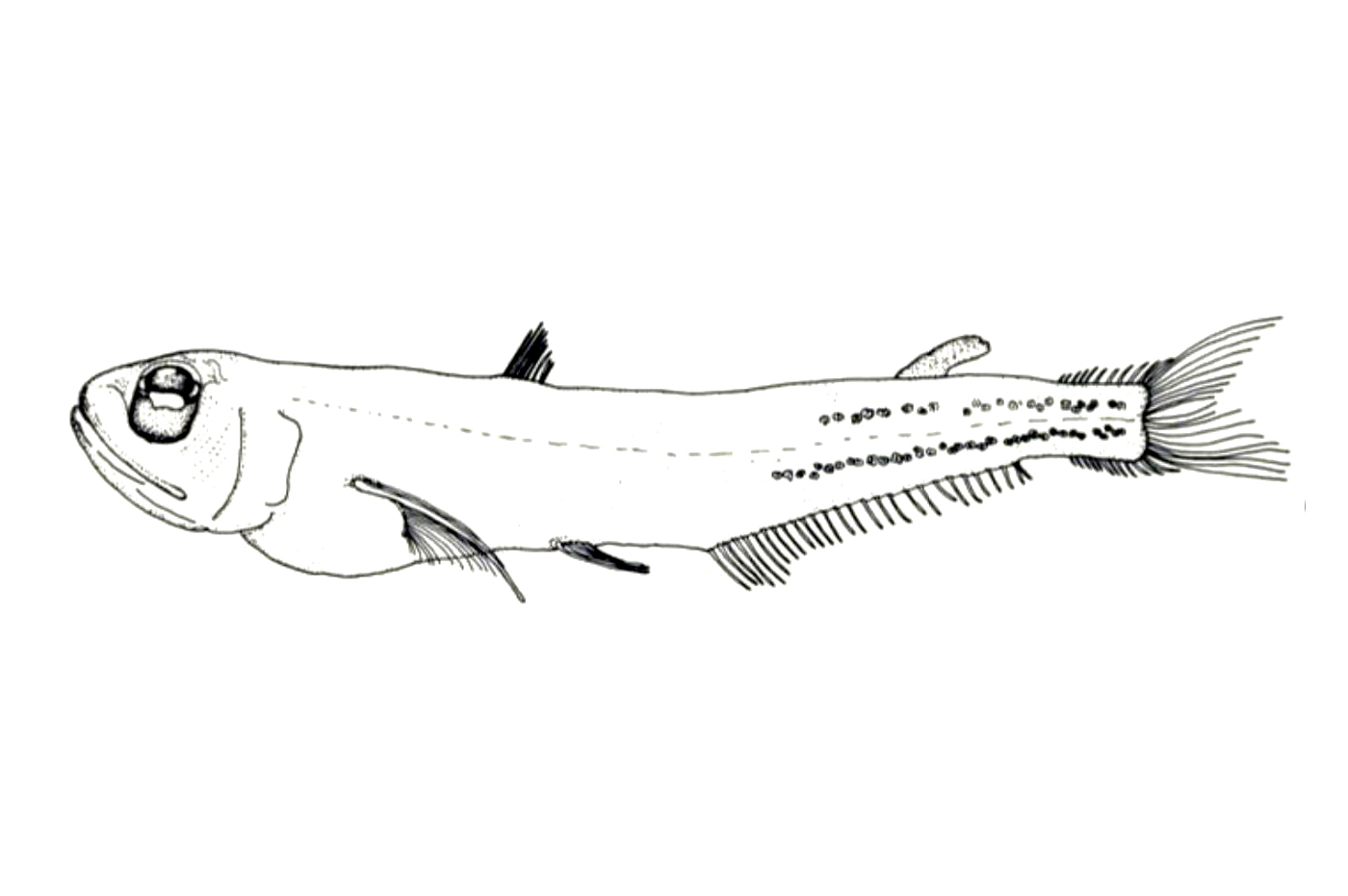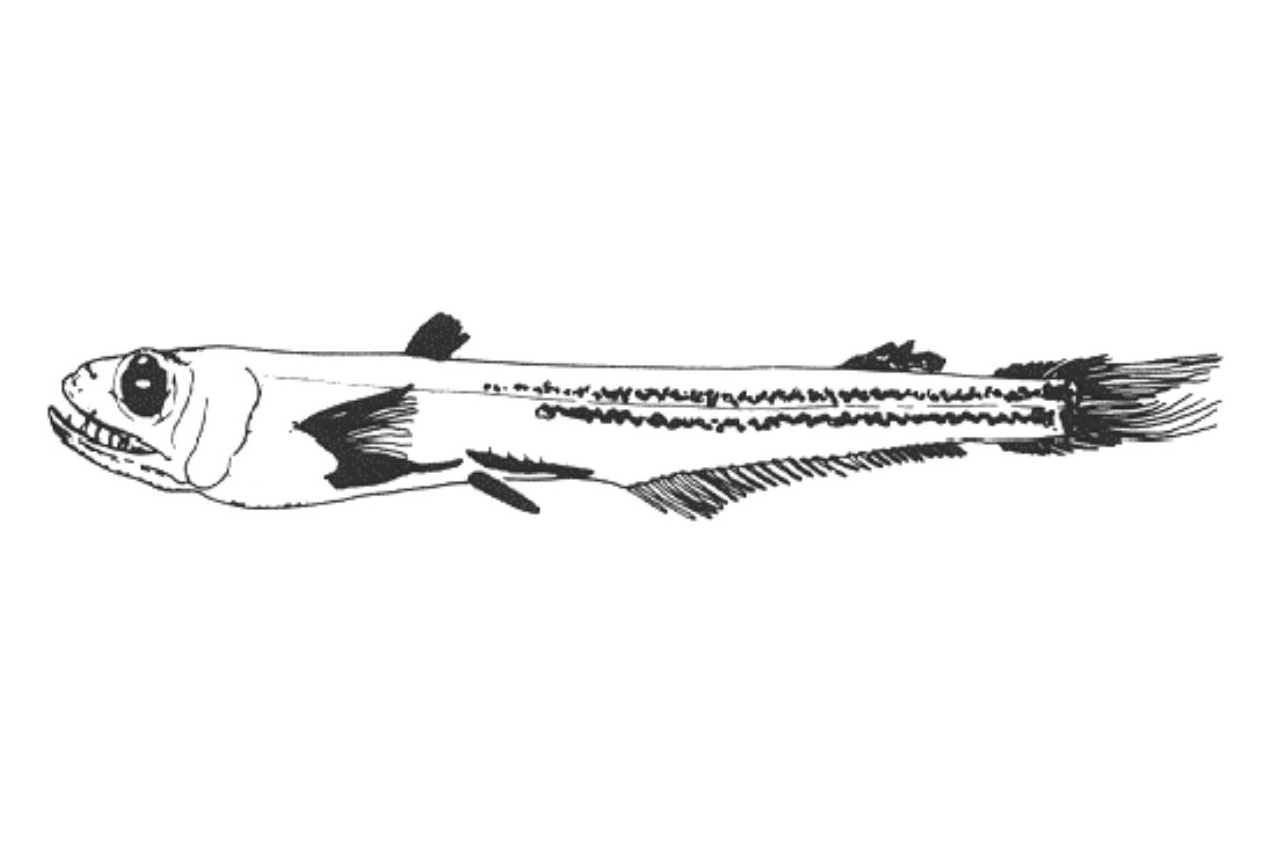
Staring Pearleye, Scopelarchus guentheri Alcock 1896
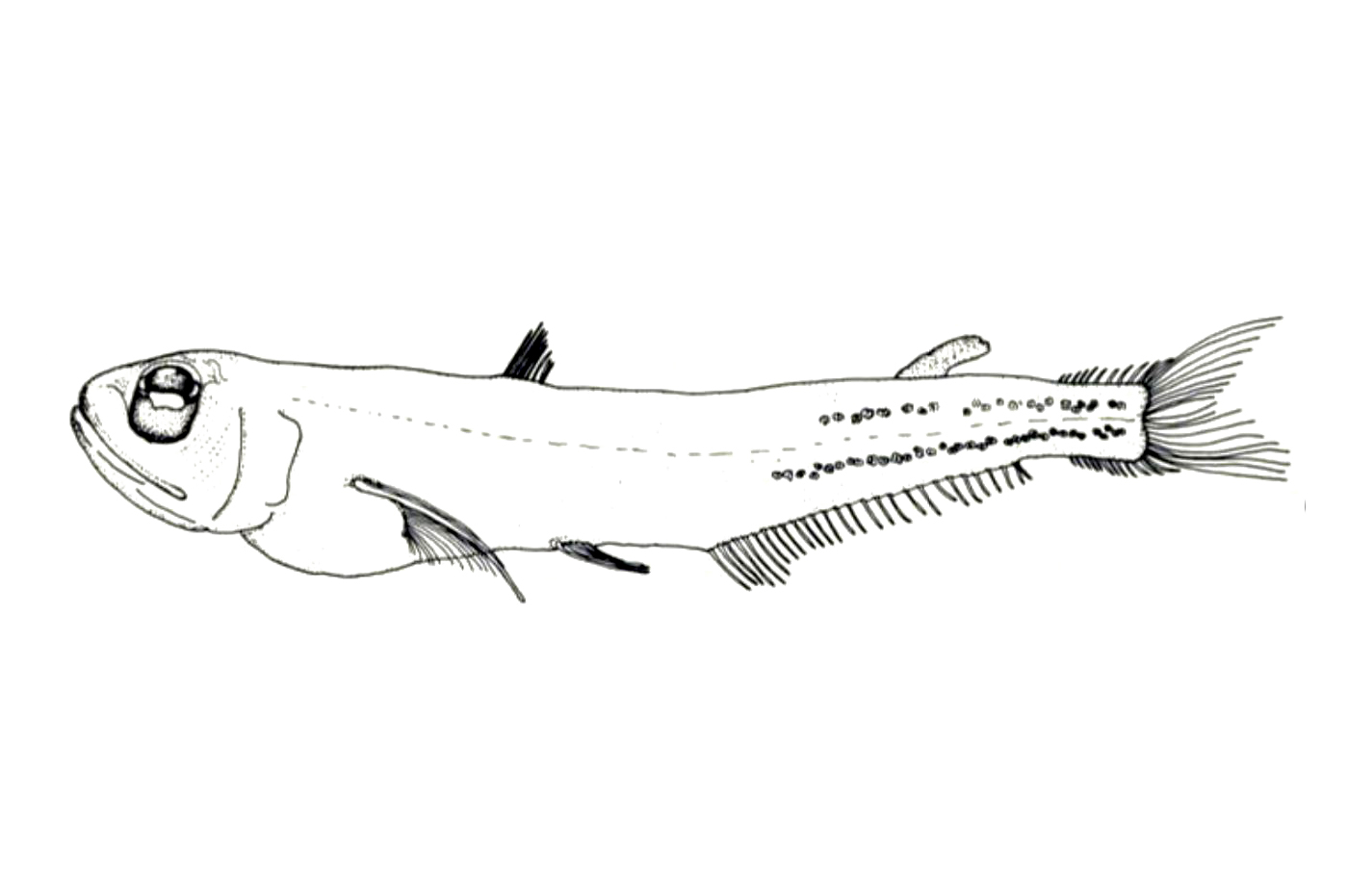
Illustration of a Staring Pearleye, Scopelarchus guentheri (DANA 3904.1, 96 mm SL). Source: Fig. 53A, in Johnson (1974) Fieldiana Zoology 66: 174 / Biodiversity Heritage Library. License: CC by Attribution-NonCommercial-ShareAlike
Summary:
A pearleye with dark pigment stripes above and below the lateral line extending forward from the caudal peduncle, and unpigmented pectoral fins that are longer than the pelvic fins.
Cite this page as:
Bray, D.J. 2025, Scopelarchus guentheri in Fishes of Australia, accessed 15 Oct 2026, https://fishesofaustralia.net.au/home/species/3322
Staring Pearleye, Scopelarchus guentheri Alcock 1896
More Info
|
Distribution |
West of Coral Bay, Western Australia, and off Nowra, New South Wales. Elsewhere the species is circumglobal in tropical and subtropical waters. Undertakes vertical migrations at night. |
|
Features |
Dorsal fin 7-8; Anal fin 24-29; Pectoral fin 18-22; Lateral line scales 47-51; Vertebrae 46-52; Branchiostegal rays 8. |
|
Biology |
Scopelarchids are simultaneous (synchronous) hermaphrodites with an ovotestis containing functional male and female reproductive tissue. |
|
Similar Species |
The similar Scopelarchus analis differs from S. guentheri in having pigmented pectoral fins, 21-26 anal-fin rays (usually 22-25) vs. 24-29 anal rays (usually 25-28). |
|
Etymology |
The species is presumably named in honour of Albert Günther, of the British Museum (Natural History). |
|
Species Citation |
Scopelarchus guentheri Alcock 1896, J. Asiatic Soc. Bengal 65(2,3): 307. Type locality: off India [22°14´N, 67°09´E] |
|
Author |
Bray, D.J. 2025 |
|
Resources |
Staring Pearleye, Scopelarchus guentheri Alcock 1896
References
Alcock, A.W. 1896. Natural history notes from H.M. Indian marine survey steamer Investigator, Series 2(2). A supplemental list of the marine fishes of India with descriptions of two new genera and eight new species. Journal of the Asiatic Society of Bengal 65(2,3): 301-338 Ref at BHL
Alcock, A.W. 1897. Illustrations of the zoology of the Royal Indian marine surveying steamer Investigator,...Fishes. Calcutta. Part 4: no. p., Pl. 17. Ref at BHL
Bannermann, P., Nunoo, F., Poss, S. & Russell, B. 2015. Scopelarchus guentheri. The IUCN Red List of Threatened Species 2015: e.T13485856A15603280. http://dx.doi.org/10.2305/IUCN.UK.2015-4.RLTS.T13485856A15603280.en. Downloaded on 23 May 2018.
Davis, M.P. 2015. Evolutionary relationships of the deep-sea pearleyes (Aulopiformes: Scopelarchidae) and a new genus of pearleye from Antarctic waters. Copeia 103(1): 64-71. https://doi.org/10.1643/CI-14-139
Post, A. 1990. Scopelarchidae, Pearl eyes, pp. 134-135, in Gon, O. & Heemstra, P.C. (eds) Fishes of the Southern Ocean. Grahamstown : J.L.B. Smith Institute of Ichthyology 462 pp. Ref at BHL
Johnson, R.K. 1974. A revision of the alepisauroid family Scopelarchidae (Pisces: Myctophiformes). Fieldiana Zoology 66: i-ix + 1-249. Ref at BHL
Johnson, R.K. 1982. Fishes of the families Evermannellidae and Scopelarchidae: systematics, morphology, interrelationships and zoogeography. Fieldiana Zoology ns 12: 1-252 figs 1-74 Ref at BHL
Johnson, R.K. 1986. Family No. 77: Scopelarchidae. pp. 265-267 in Smith, M.M. & Heemstra, P.C. (eds). Smith's Sea Fishes. Johannesburg : Macmillan South Africa xx + 1047 pp. 144 pls.
Watson, W. & Sandknop, E.M. 1996. Scopelarchidae: pearleyes. pp. 332-343 in Moser, H.G. 1996. The early stages of fishes in the California Current region. Fisheries Investigations Atlas No. 33. Lawrence, Kansas : California Cooperative Oceanic Allen Press, Inc. 1505 pp.