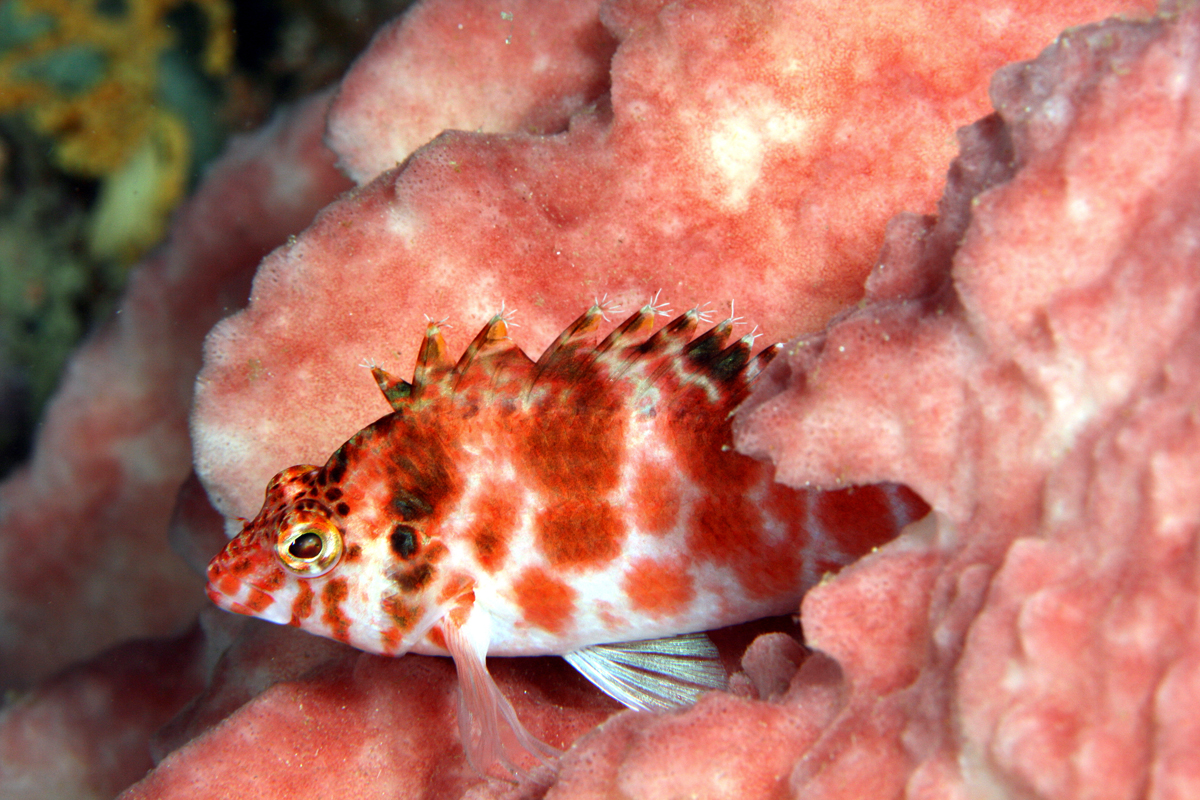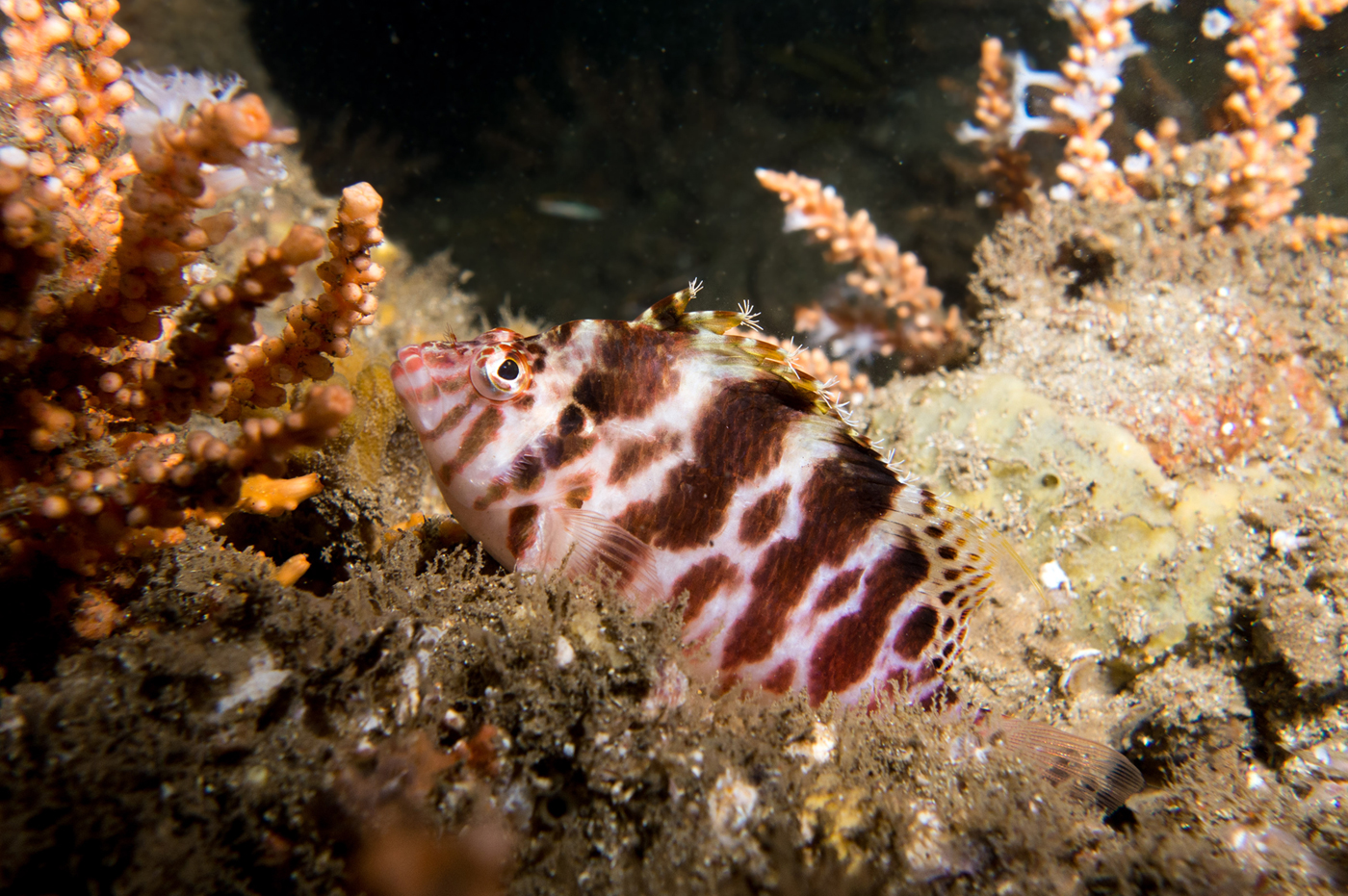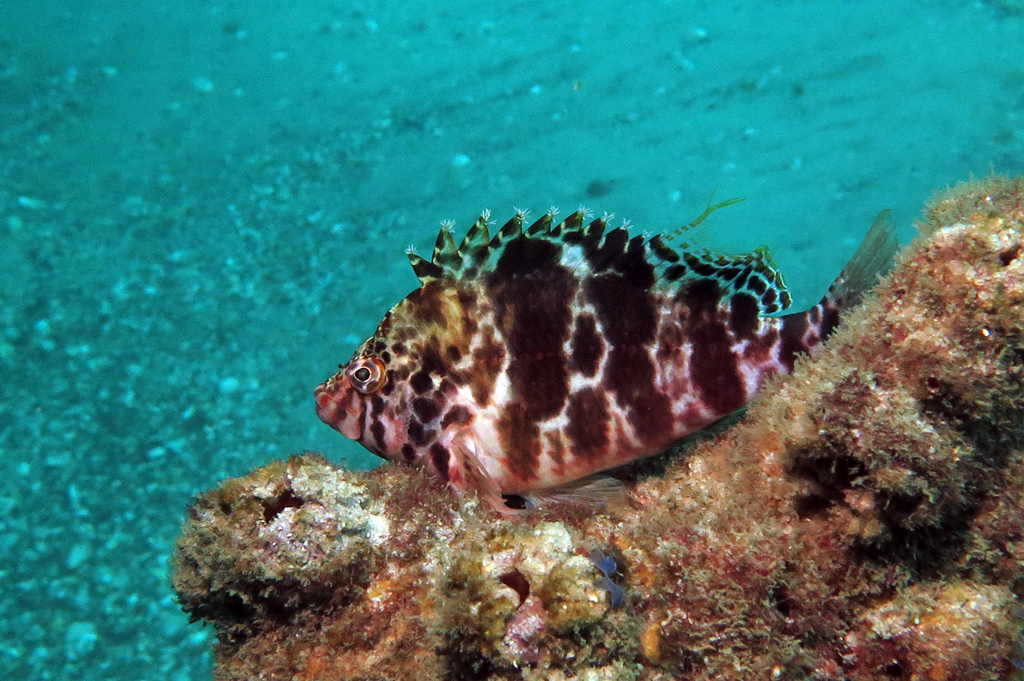
Blotched Hawkfish, Cirrhitichthys aprinus (Cuvier 1829)
Other Names: Boar Hawkfish, Red Barred Hawkfish, Threadfin Hawkfish
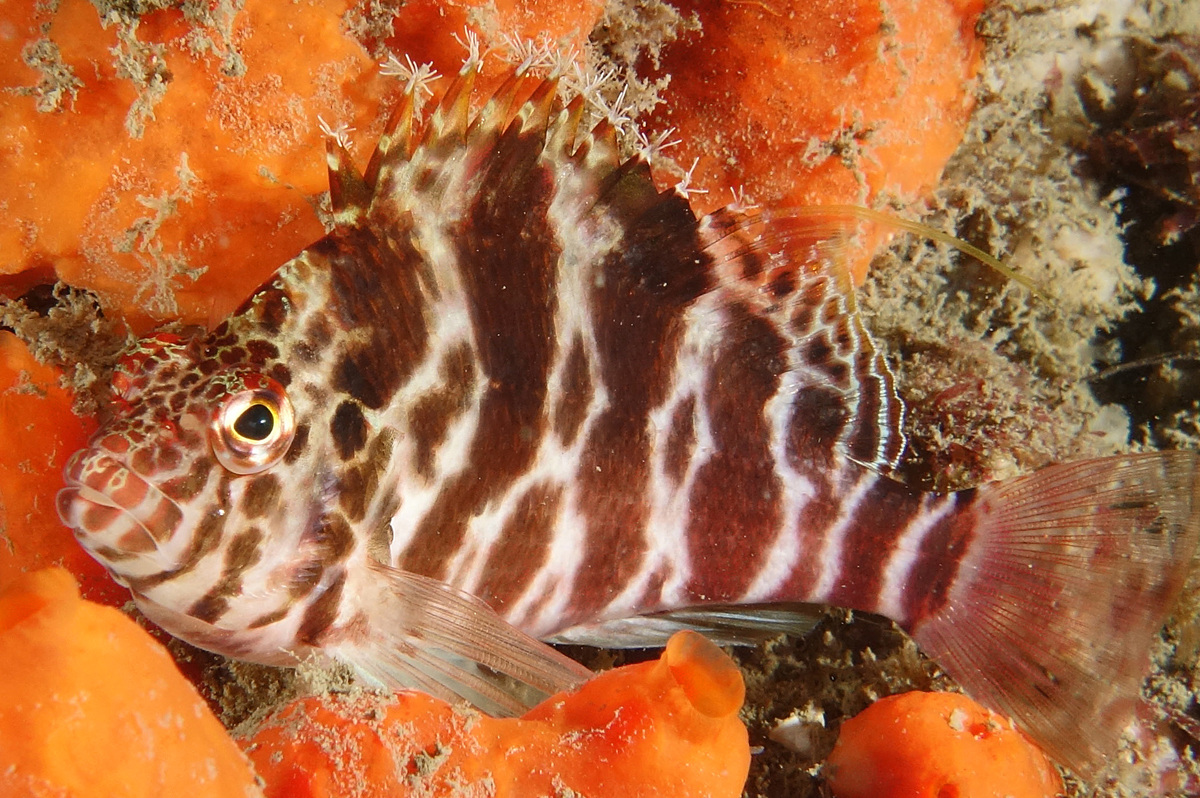
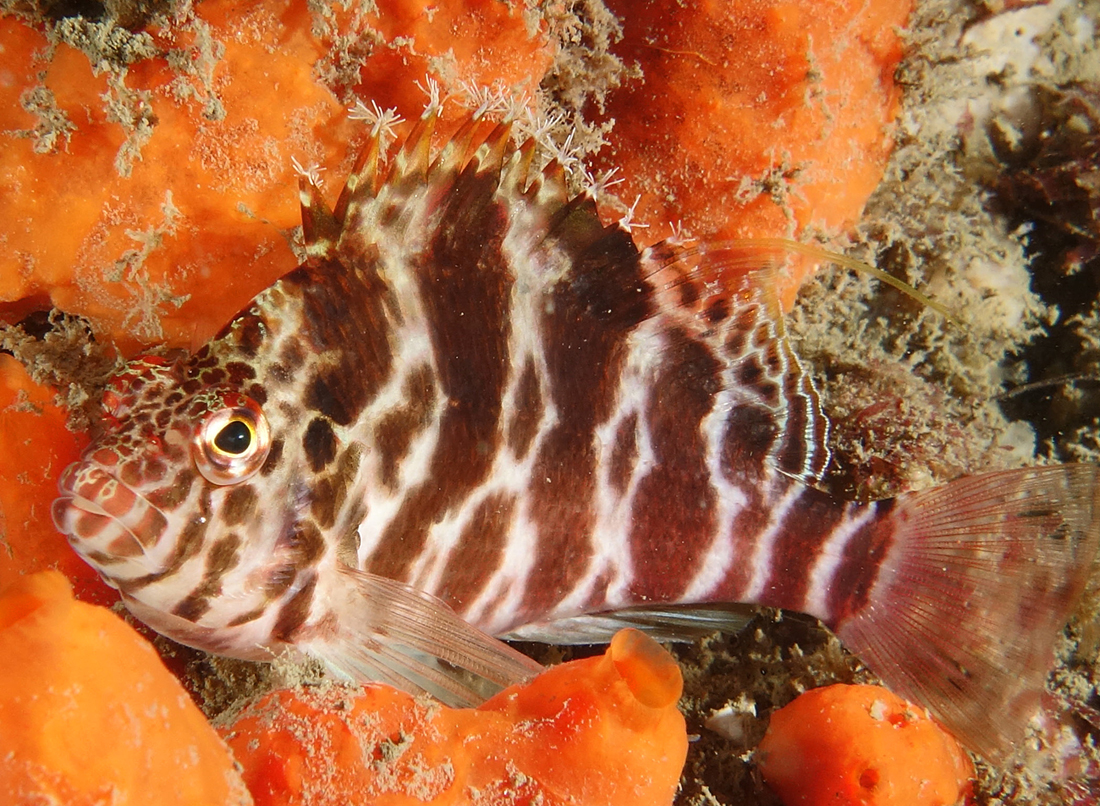
A Blotched Hawkfish, Cirrhitichthys aprinus, at Clifton Gardens, Sydney Harbour, New South Wales. Source: John Turnbull / Flickr. License: CC BY Attribution-Noncommercial-ShareAlike
Summary:
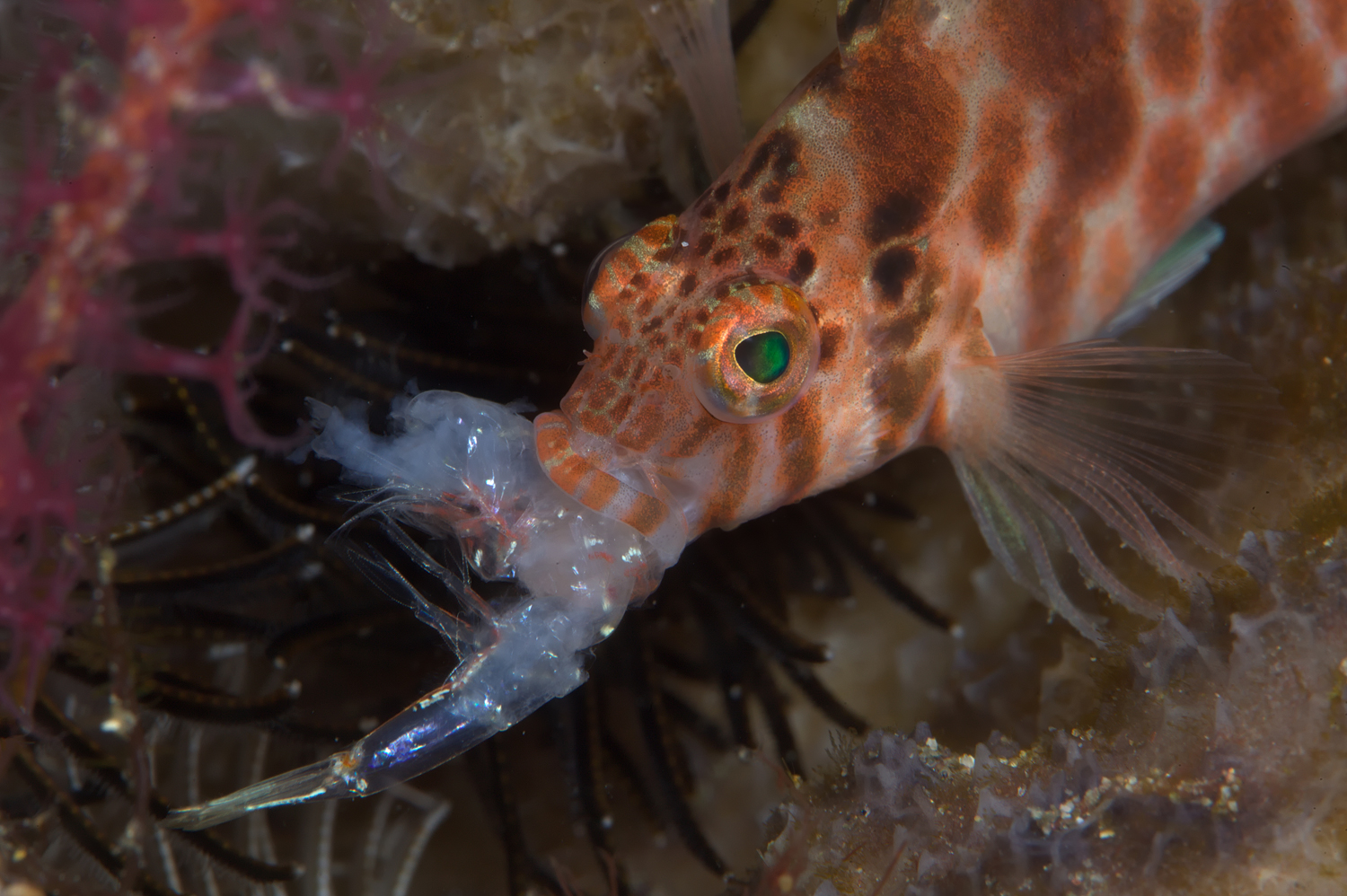
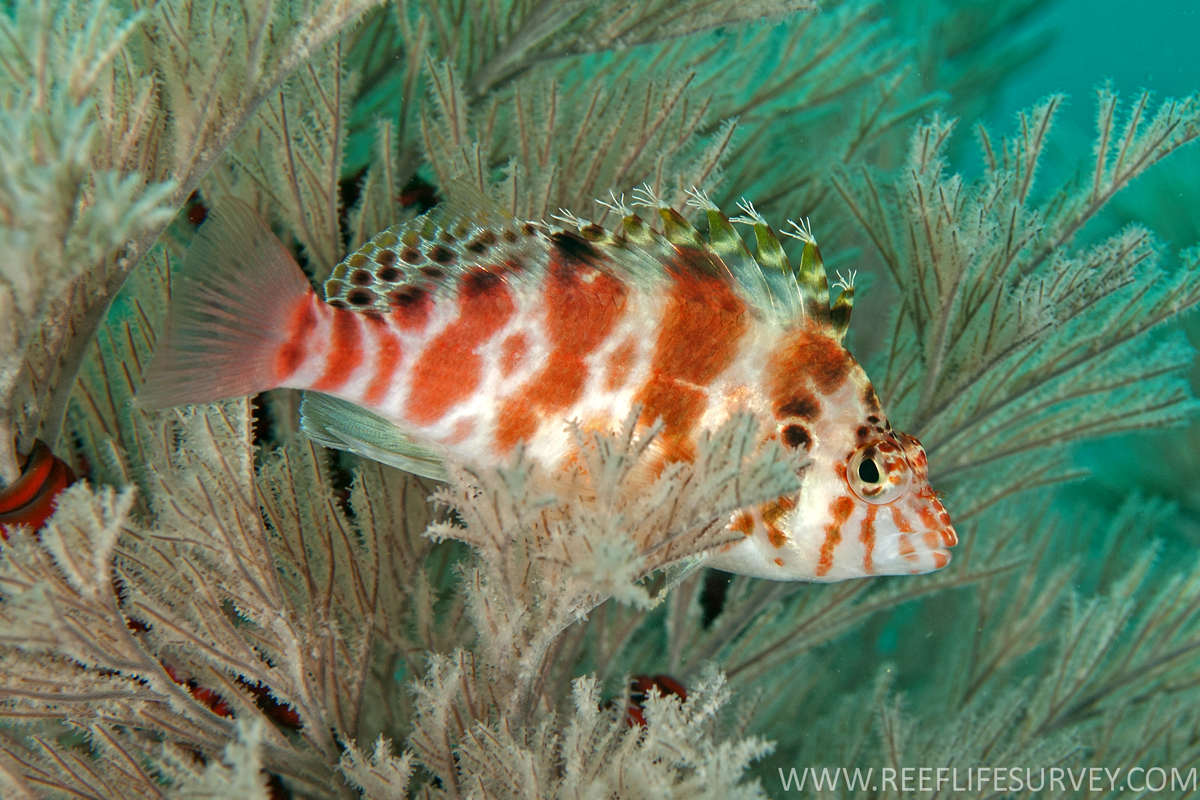
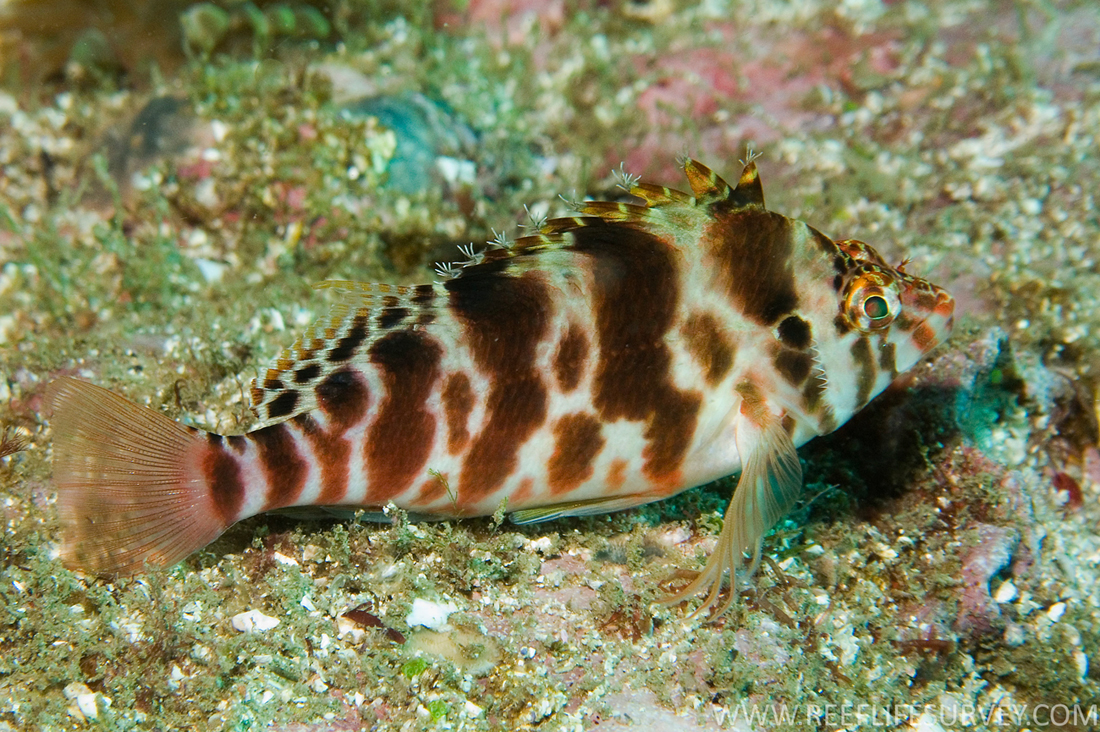
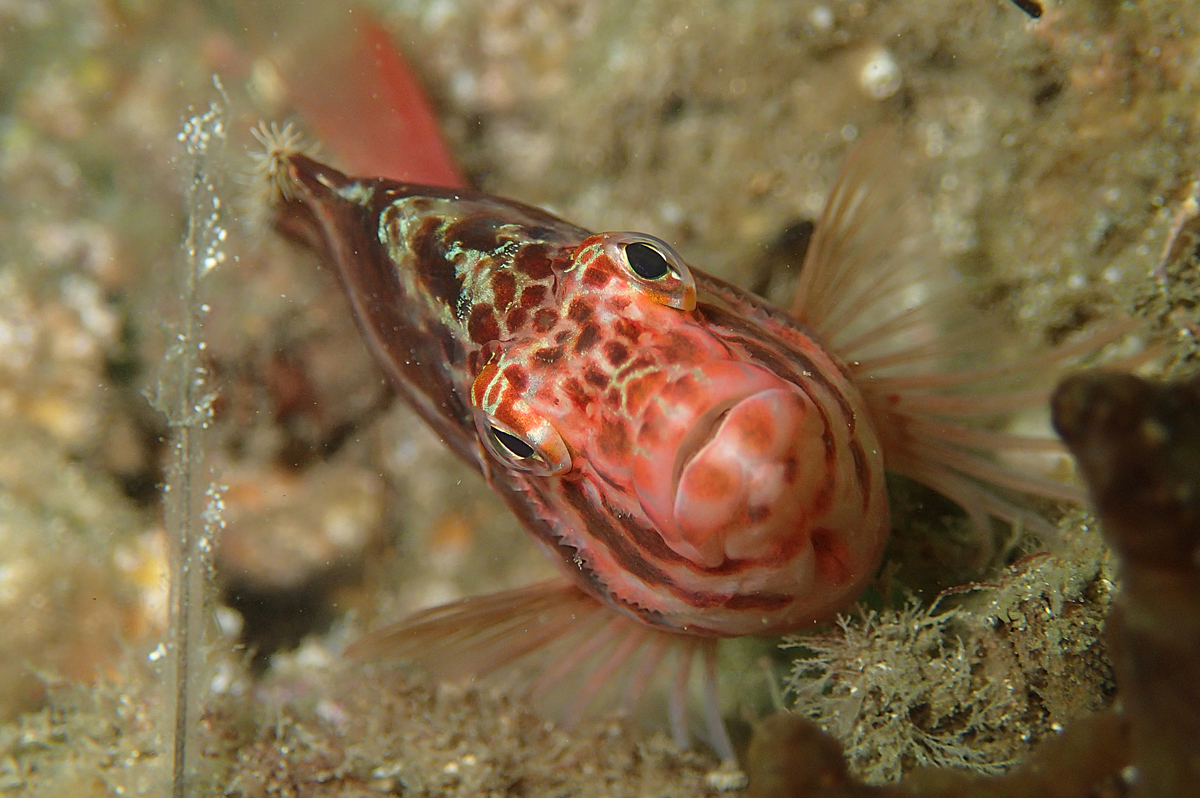
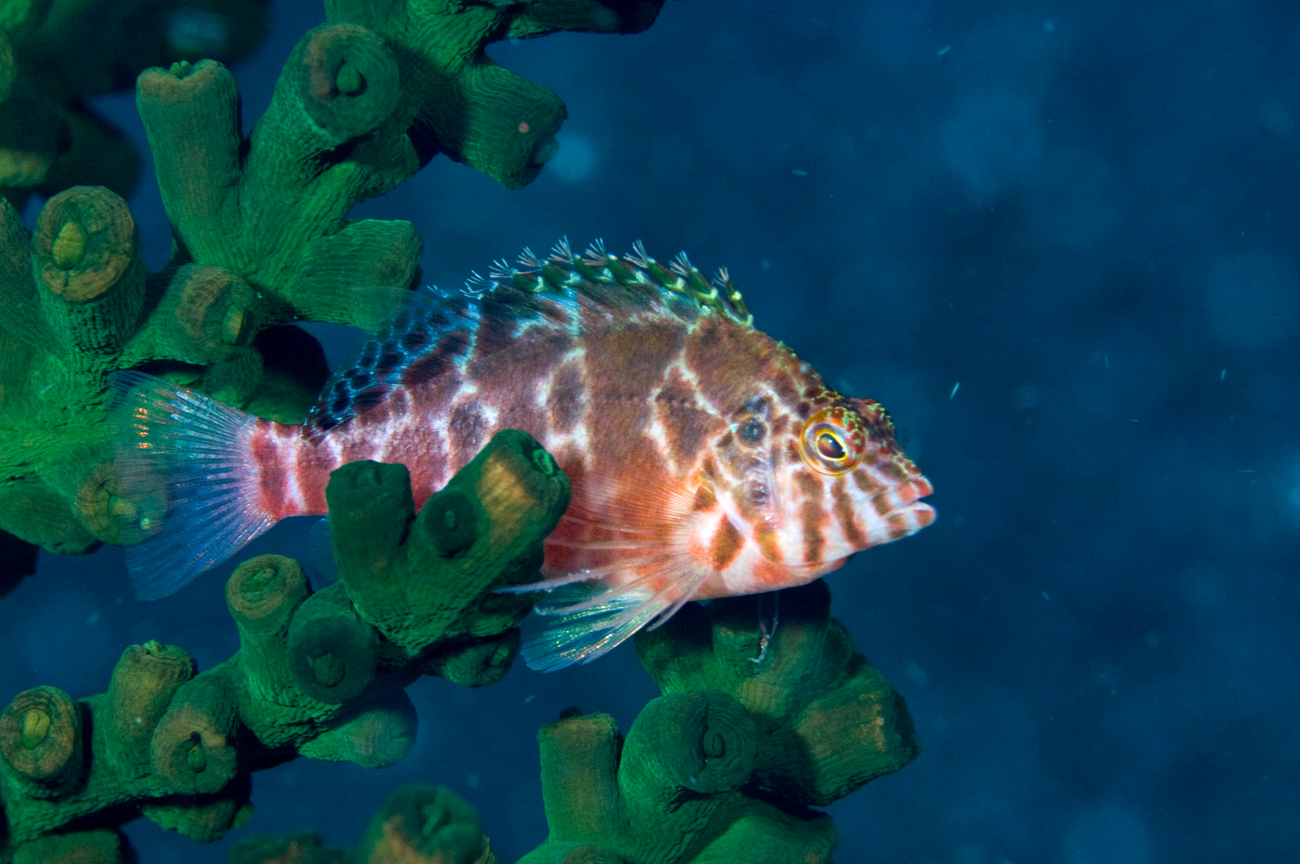
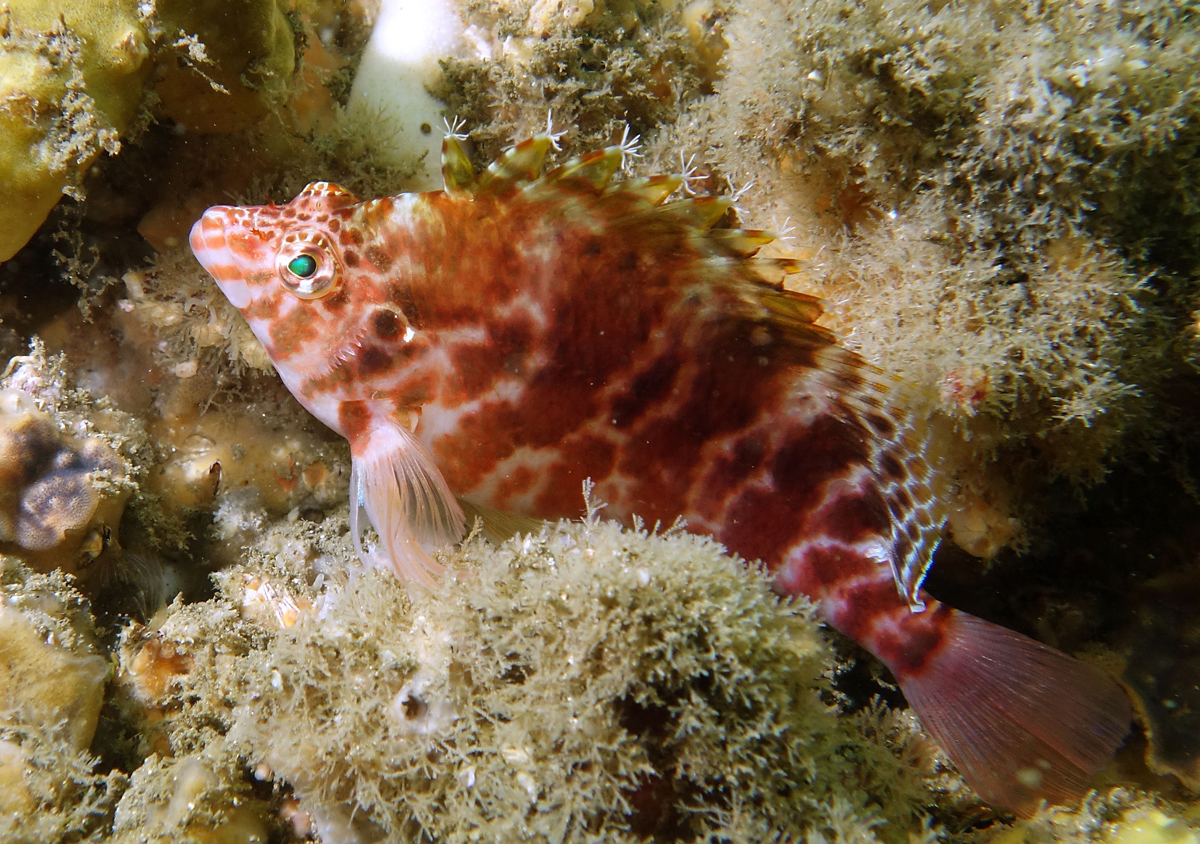
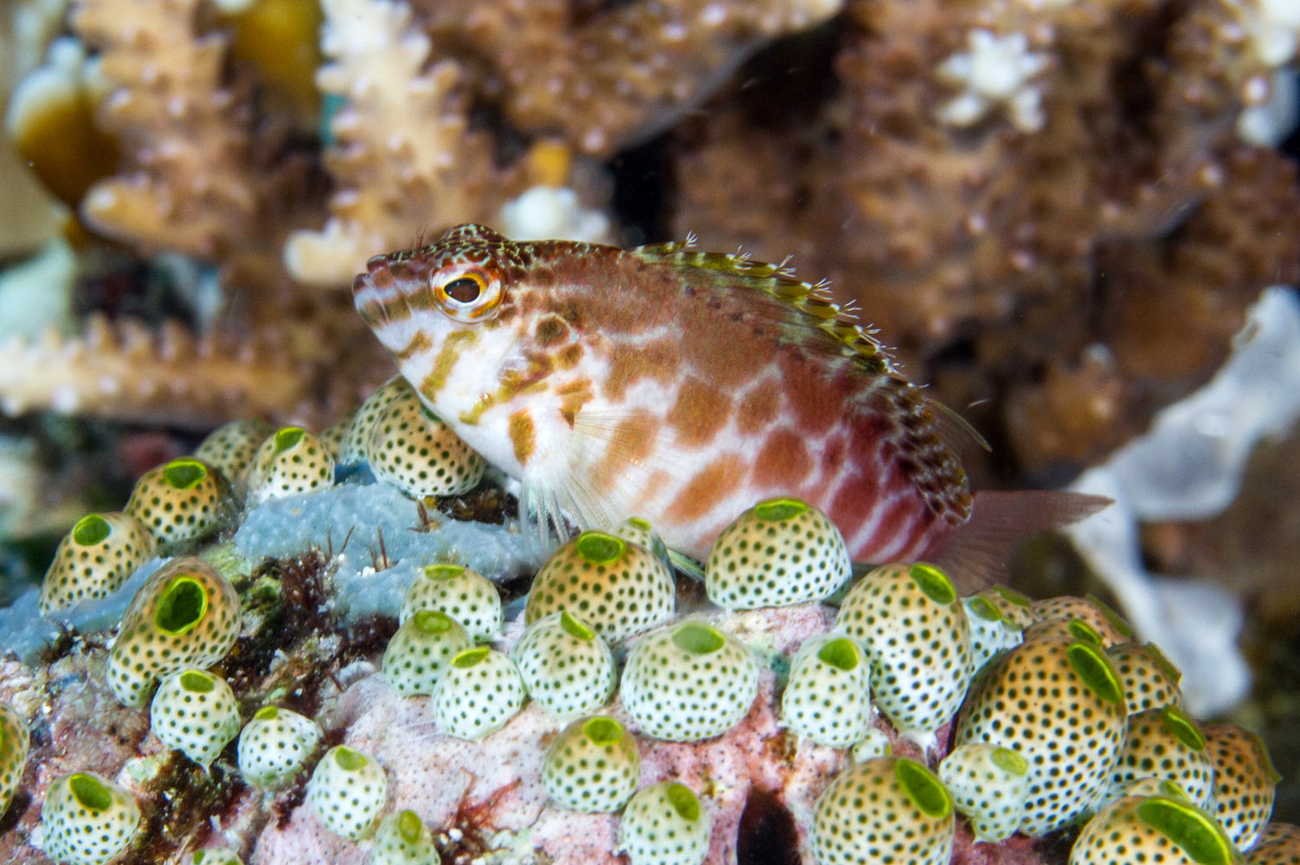
A whitish hawkfish with large reddish to brown blotches and bars along the side extending onto the dorsal fin, a pale-edged dark spot on upper edge of gill cover, 3-4 dark bars radiating from the eye, and tufts of filaments on the tips of the dorsal-fin spines.
Cite this page as:
Bray, D.J. 2025, Cirrhitichthys aprinus in Fishes of Australia, accessed 20 Sep 2026, https://fishesofaustralia.net.au/home/species/436
Blotched Hawkfish, Cirrhitichthys aprinus (Cuvier 1829)
More Info
|
Distribution |
Widespread in Australia, from the Houtman Abrolhos islands, Western Australia, to the Timor Sea, E of Margaret Harries Bank, Northern Territory, and the northern Great Barrier Reef, Queensland, to Merimbula, New South Wales; also Cocos (Keeling) Islands in the eastern Indian Ocean, Ashmore Reef in the Timor Sea, and the Lord Howe Province in the Tasman Sea. The species occurs elsewhere in the tropical, east-Indo-west Pacific. Often seen singly or in small groups perching on corals, sponges, sea tulips and other invertebrates. |
|
Features |
Dorsal fin X, 12; Anal fin III, 6; Pectoral fin 14, lower 6 rays unbranched; Gill rakers 4-5 + 9-11; Lateral-line scales 41-43, scale rows above lateral line 3, scale rows on cheek 4. Body depth 2.4-2.7 in SL; palatine teeth present; bony interorbital space 1.7 in eye diameter (adults); rear margin of preopercle coarsely serrate. Spinous dorsal-fin tips with tuft of cirri. |
|
Biology |
A protogynous hermaphrodite, with a haremic social system. Spawns in the water column. |
|
Fisheries |
Collected for the aquarium trade. |
|
Similar Species |
Differs from the Spotted Hawkfish, Cirrhitichthys oxycephalus, in having a conspicuous ocellated spot on the gill cover, and in lacking spots on the tail. |
|
Etymology |
The specific name is from the Latin aprinus (= wild boar), in reference to the strong canine tooth on the side of the lower jaw. |
|
Species Citation |
Cirrhites aprinus Cuvier, 1829, Histoire naturelle des poissons 3: 76. Type locality: Timor Island, southern Malay Archipelago. |
|
Author |
Bray, D.J. 2025 |
|
Resources |
Blotched Hawkfish, Cirrhitichthys aprinus (Cuvier 1829)
References
Allen, G.R. 1997. Marine Fishes of Tropical Australia and South-east Asia. Perth : Western Australian Museum 292 pp. 106 pls.
Allen, G.R. & Erdmann, M.V. 2012. Reef fishes of the East Indies. Perth : Tropical Reef Research 3 vols, 1260 pp.
Allen, G.R. & Smith-Vaniz, W.F. 1994. Fishes of Cocos (Keeling) Islands. Atoll Research Bulletin 412: 1-21.
Allen, G.R. & Swainston, R. 1988. The Marine Fishes of North-Western Australia. A field guide for anglers and divers. Perth, WA : Western Australian Museum vi 201 pp., 70 pls.
Bleeker, P. 1853. Derde bijdrage tot de kennis der ichthyologische fauna van Amboina. Natuurwetenschappelijk Tijdschrift voor Nederlandsch Indië 4: 91-130. (described as Cirrhites graphidopterus, type locality Ambon Island, Molucca Islands, Indonesia)
Cuvier, G.L. & Valenciennes, A. 1829. Histoire Naturelle des Poissons. Paris : Levrault Vol. 3 500 pp., pls 41-71. See ref at BHL
Donaldson, T.J. & Colin, P.L. 1989. Pelagic spawning of the hawkfish Oxycirrhites typus (Cirrhitidae). Environmental Biology of Fishes 24(4): 295-300. Abstract
Gloerfelt-Tarp, T. & Kailola, P.J. 1984. Trawled Fishes of Southern Indonesia and Northwest Australia. Jakarta : Dir. Gen. Fish. (Indonesia), German Tech. Coop., Aust. Dev. Ass. Bur. 406 pp.
Greenfield, D. & Williams, I. 2016. Cirrhitichthys aprinus (errata version published in 2017). The IUCN Red List of Threatened Species 2016: e.T67997172A115450822. https://dx.doi.org/10.2305/IUCN.UK.2016-1.RLTS.T67997172A68001651.en. Accessed on 21 July 2025.
Hutchins, J.B. & Swainston, R. 1986. Sea Fishes of Southern Australia. Complete field guide for anglers and divers. Perth : Swainston Publishing 180 pp.
Johnson, J.W. 2010. Fishes of the Moreton Bay Marine Park and adjacent continental shelf waters, Queensland, Australia. pp. 299-353 in Davie, P.J.F. & Phillips, J.A. Proceedings of the Thirteenth International Marine Biological Workshop, The Marine Fauna and Flora of Moreton Bay. Memoirs of the Queensland Museum 54(3)
Kuiter, R.H. 1993. Coastal Fishes of South-eastern Australia. Bathurst : Crawford House Press 437 pp.
Kuiter, R.H. 1996. Guide to Sea Fishes of Australia. A comprehensive reference for divers and fishermen. Sydney, NSW, Australia : New Holland Publishers xvii, 434 pp.
Kuiter, R.H. & Tonozuka, T. 2001. Pictorial guide to Indonesian reef fishes. Part 2. Fusiliers - Dragonets, Caesionidae - Callionymidae. Australia : Zoonetics pp. 304-622.
Randall, J.E. 1963. Review of the hawkfishes (family Cirrhitidae). Proceedings of the United States National Museum 114(3472): 389-451. See ref at BHL
Randall, J.E. 2001. Cirrhitidae, Cheilodactylidae. pp. 3321-3330 in Carpenter, K.E. & Niem, V.H. (eds). The Living Marine Resources of the Western Central Pacific. FAO Species Identification Guide for Fisheries Purposes. Rome : FAO Vol. 5 2791-3379 pp.
Randall, J.E., Allen, G.R. & Steene, R. 1990. Fishes of the Great Barrier Reef and Coral Sea. Bathurst : Crawford House Press 507 pp. figs.
Randall, J.E., Allen, G.R. & Steene, R. 1997. Fishes of the Great Barrier Reef and Coral Sea. Bathurst : Crawford House Press 557 pp. figs.
Russell, B.C. 1983. Annotated checklist of the coral reef fishes in the Capricorn-Bunker group, Great Barrier Reef, Australia. Great Barrier Reef Marine Park Authority. Special Publication Series 1: 1-184 figs 1-2
Sadovy, Y. & Donaldson, T.J. 1995. Sexual pattern of Neocirrhites armatus (Cirrhitidae) with notes on other hawkfish species. Environmental Biology of Fishes 42(2): 143-150. https://doi.org/10.1007/BF00001992